





Advancements in Computer-Aided Design (CAD), Computer-Aided Engineering (CAE), and simulation, have allowed safety engineers to do much of their work in a virtual space before performing real-world crash tests.
GM Runs 92,000 Virtual Crash Tests to Develop 2027 Chevrolet Silverado 1500
GM used 92,000 simulated crashes to evaluate the 2027 Chevrolet Silverado 1500's safety performance before confirming results through physical testing.
November 16, 2026
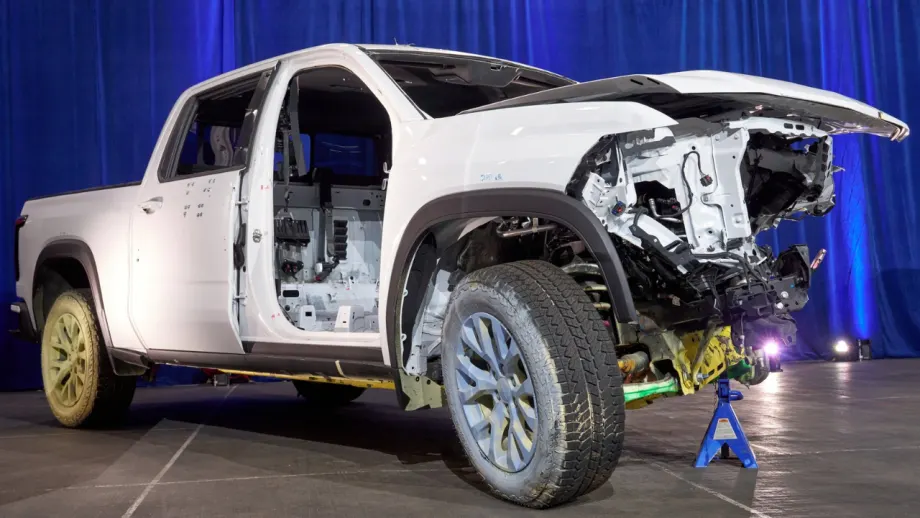
A 2027 Chevrolet Silverado 1500 following physical crash testing. GM used hundreds of virtual variations to evaluate how vehicle structures and passenger restraint systems would perform during a 40-mph, 40% frontal overlap collision.
Credit:
General Motors
4 min to read
Before a new pickup reaches a job site, delivery route, or fleet garage, engineers have already spent years evaluating how it will perform in different conditions. For the 2027 Chevrolet Silverado 1500, that process included approximately 92,000 virtual crash tests.
General Motors (GM) recently shared details about how computer simulations, physical crash testing, and artificial intelligence (AI) are being used to develop the next-generation Silverado 1500.
According to GM, approximately 80% of the truck's passive safety engineering work was completed virtually, allowing engineers to evaluate thousands of crash scenarios and design variations before confirming results through physical testing.
For commercial fleets that rely on light-duty pickups, the work offers a look at how automakers are developing occupant protection systems and evaluating vehicle safety before trucks reach the road.
Testing Thousands of Crash Scenarios Before Building a Truck
Traditionally, physical crash testing has played a central role in vehicle safety development. While those tests remain essential, advances in computer-aided design (CAD), computer-aided engineering (CAE), and simulation technology allow manufacturers to evaluate more potential outcomes earlier in the development process.
Instead of building and destroying a physical vehicle for every test, engineers can use virtual models to examine how different components and safety systems might perform during a collision.
“GM is using math-based virtual engineering to run thousands of simulated crashes before physical properties exist,” said Regina Carto, GM vice president, Global Product Safety, Systems and Certification. “Engineers can evaluate a much broader range of conditions — including different crash modes, occupant sizes, and seating positions. They can examine design details, identify issues earlier and iterate in weeks rather than months.”
GM's Global Safety Product Integration (GSPI) team conducted approximately 92,000 virtual crash tests during development of the 2027 Silverado 1500, generating nearly 2 petabytes of data.
Those simulations allowed engineers to examine details such as material thickness, component connections, vehicle structure, and passenger restraint systems.
Even small changes can affect how a vehicle performs during a collision. By evaluating those variables virtually, engineers can identify potential concerns and make adjustments before moving further into physical testing.
How Virtual Testing Supports Real-World Crash Performance
One example of GM's testing involved a 40-mph frontal crash in which 40% of the Silverado's width on the driver's side struck a barrier. The physical test used a crash-test dummy representing a 50th-percentile male in the driver's seat and a dummy representing a 5th-percentile female seated directly behind the driver.
Before conducting the physical test, GM engineers had already evaluated hundreds of variations involving the vehicle's structure and occupant restraint systems.
These simulations helped engineers understand how differences in materials, manufacturing processes, and vehicle components could influence crash performance. This type of testing is particularly relevant because trucks carry different drivers and passengers, and no two real-world collisions are exactly alike.
However, virtual testing does not eliminate the need for physical crash tests.
“Virtual engineering makes our physical testing more targeted, more efficient, and more informative,” Carto said. “Virtual models help us explore more possibilities and refine the design; physical tests then confirm those results and help us improve the models. Together, these tools enable us to learn earlier in the process, and with greater fidelity to the real-world conditions our customers may face.”
The process also creates a feedback loop. Results from physical crash tests can be used to improve computer models, which can then support additional engineering decisions.
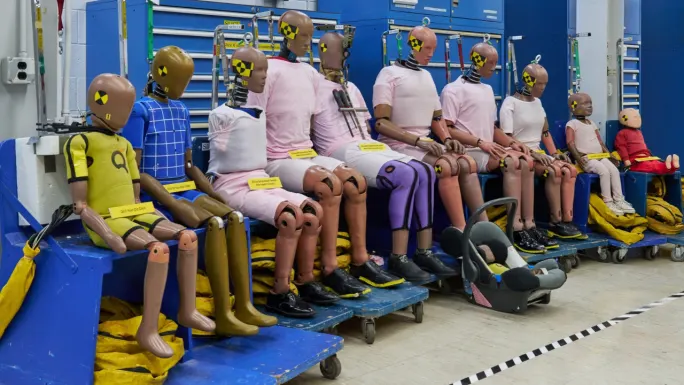
Crash-test dummies at GM's Anthropomorphic Test Device Laboratory in Milford, Michigan, on Nov. 10, 2026. The dummies represent different occupant sizes and help engineers evaluate vehicle safety and occupant protection during physical crash testing.
Credit:
Steve Fecht for General Motors
AI Helps Engineers Process Crash-Test Data
The volume of information generated through virtual testing presents another challenge. GM reported that the Silverado 1500's virtual safety engineering work produced nearly 2 petabytes of data, equivalent to approximately 2.1 million gigabytes.
AI is increasingly being used to help engineers process that information, troubleshoot simulation models, and reduce time spent on repetitive tasks. According to GM, these capabilities could eventually help engineers evaluate additional design variations and make decisions earlier in vehicle development.
The company has also outlined a broader goal of reducing vehicle development timelines from the current industry standard of four to five years by approximately half.
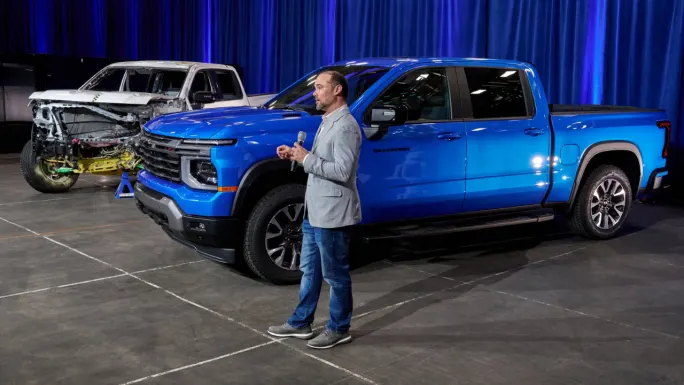
Scott Garver, vehicle chief engineer for the 2027 Chevrolet Silverado 1500, discusses the next-generation pickup at GM's Crash Test Facility at the Milford Proving Ground in Michigan on Nov. 10, 2026. GM conducted approximately 92,000 virtual crash tests during the truck's development to evaluate vehicle structure and occupant protection.
Credit:
Steve Fecht for General Motors
What This Means for the Next-Generation Silverado 1500
The 2027 Chevrolet Silverado 1500 is part of GM's next generation of full-size pickups, and its development illustrates how manufacturers are combining digital engineering with traditional vehicle testing.
While the 92,000 simulations provide insight into GM's development process, they are not a substitute for published crash-test ratings or independent safety evaluations.
For fleets considering future pickup purchases, those results, along with available driver-assistance technologies, vehicle configurations, and operational requirements, will remain important parts of the evaluation process.
“The GSPI team designs and analyzes crash performance with extraordinary precision—down to fractions of millimeters and milliseconds so we can help protect people in a collision,” Carto said. “We hope customers never have to experience this work firsthand; no one gets into a vehicle expecting a crash. However, if one happens, we want them to be confident we’ve done the work to help protect them. We strive for the best possible outcomes in the worst possible moments.”
GM has not provided independent crash-test ratings for the 2027 Silverado 1500 as part of this announcement.
More Safety & Compliance

Thanksgiving Cargo Theft Risks Put Fleet Security in Focus
J. J. Keller shares cargo theft prevention tips for work truck fleets ahead of Thanksgiving, when parked vehicles and reduced staffing can increase security risks.
Read More →
5 Winter Fleet Videos to Help Keep Trucks Running and Drivers Safe
From preventing cold-weather breakdowns to navigating icy roads, these five videos offer practical winter preparation tips for work truck fleets.
Read More →
Navigating the Effects of Daylight Saving Time on Work Truck Fleets
Discover how daylight saving time impacts work truck fleets and get essential tips for fleet managers and drivers to navigate the "fall back" transition.
Read More →From Our Partners




How Halloween Changes the Job for Work Truck Drivers
Truck traffic doesn’t take the same Halloween break as other drivers. What fleet managers should know about timing, neighborhood stops, and braking data.
Read More →
Tips for Driving Safely on Halloween Night
This video features a reminder from the Connecticut Department of Transportation (DOT) and the Connecticut Police Chiefs Association, urging drivers to prioritize safety this Halloween.
Read More →
Re-rating Gross Vehicle Weight Ratings (GVWR): Why and How it's Done
Sometimes, it is not in a fleet’s best interests to have a vehicle at a given GVWR. Changing the GVWR to a special value can be done, but the process is complicated.
Read More →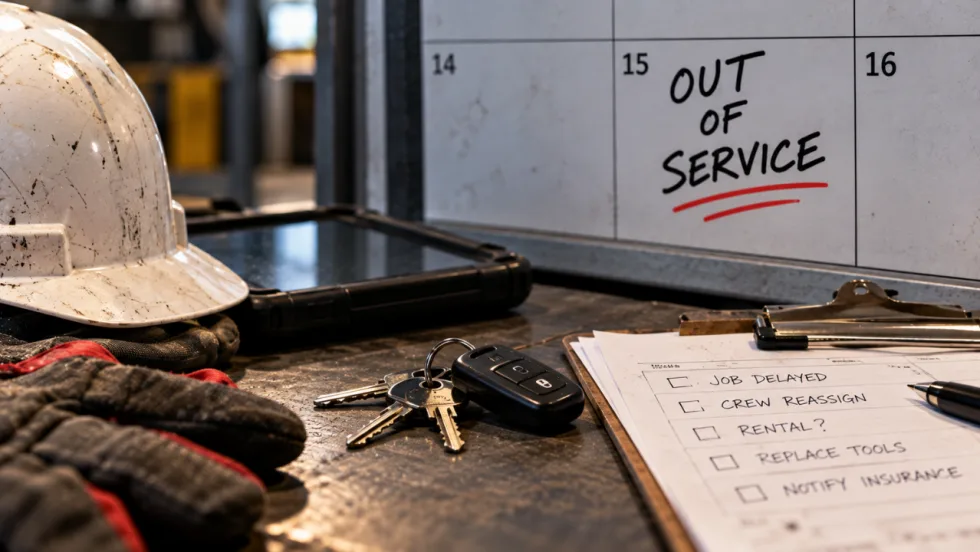
When a Work Truck Gets Stolen, the Real Loss Is Time
A stolen work truck can take more than a vehicle off the road. From tools and access cards to crew downtime, here’s how fleets can prepare for theft before it disrupts the entire workday.
Read More →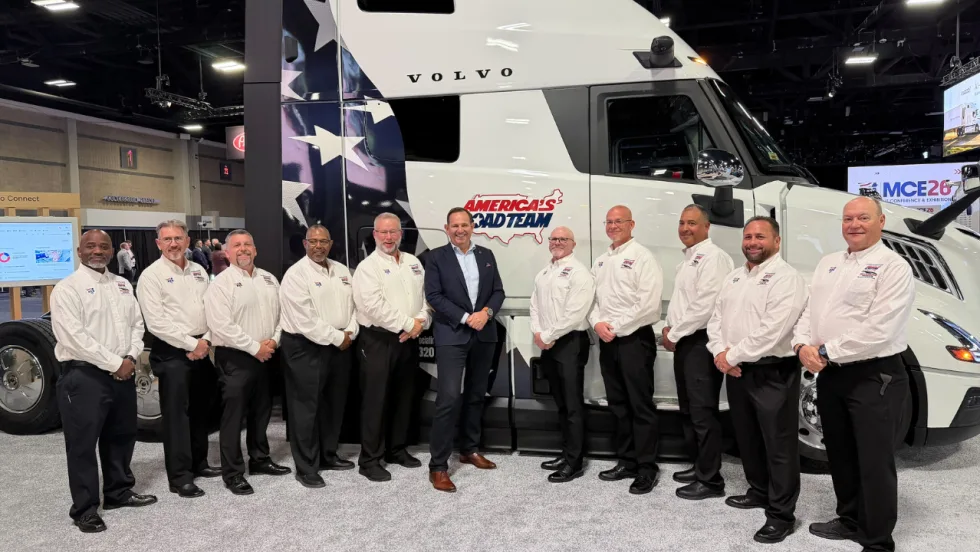
Volvo Trucks Marks 25 Years as Exclusive Sponsor of America's Road Team
Volvo Trucks North America will serve as the exclusive sponsor of the American Trucking Associations' America's Road Team, marking 25 years of Volvo sponsorship. The group of professional drivers promotes safety and the industry as they travel the country.
Read More →
Streamlight’s High-Output Scene Light Recognized with Occupational Safety Award
Streamlight’s Portable Scene Light III (PSL III) won the 2026 Occupational Health & Safety (OH&S) New Product of the Year Award in the Lighting category.
Read More →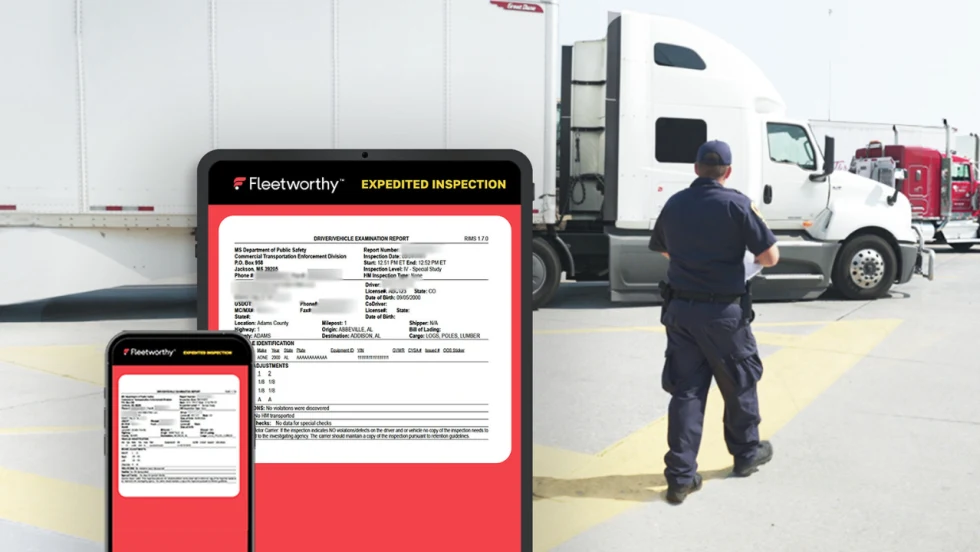
Fleetworthy Expands Expedited Inspection to 5 States
Following its industry-first launch in Nevada, Fleetworthy’s automated inspection technology is now live in California, Michigan, Vermont, and Maine.
Read More →