





Related: For the Love of Robots
Global Self-Driving Market Expected to Grow 40% by 2027
The global autonomous vehicle market revenue is expected to grow at a compound average growth rate of 39.6% over the next 10 years - resulting in a $126.8 billion market by 2027, according to Infoholic Research.
July 12, 2017
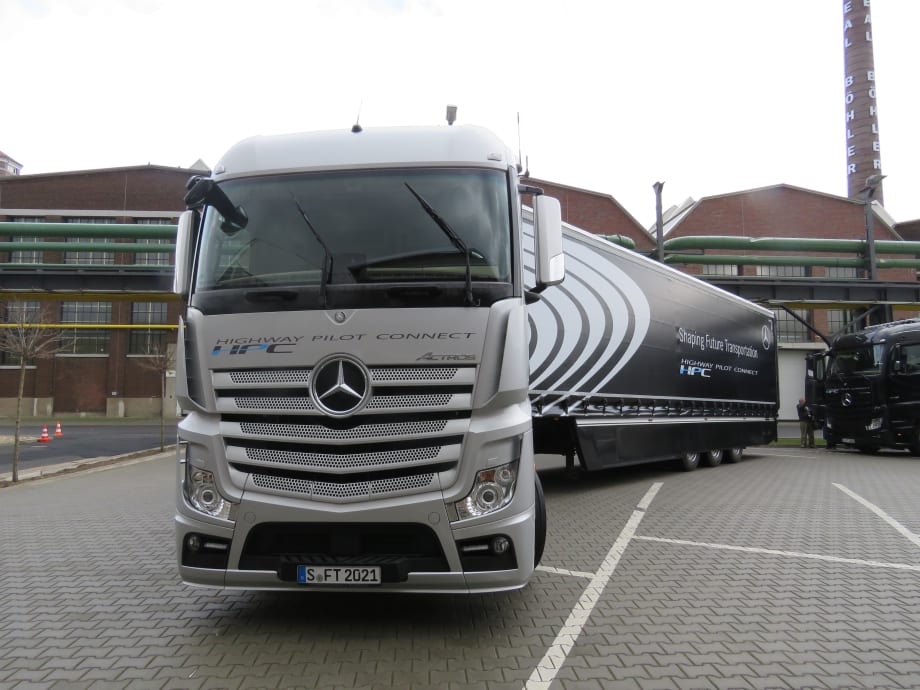
Mercedes-Benz Actros tractor used to demonstrate Daimler’s Highway Pilot Connect autonomous technology on German roads. Photo: David Cullen
2 min to read
The global autonomous vehicle market revenue is expected to grow at a compound average growth rate (CAGR) of 39.6% over the next 10 years — resulting in a $126.8 billion market by 2027, according to Infoholic Research.
“The increasing investments from the automakers, the rising consumer demands, and technology advancements in the automotive industry have led to the increased demand for driverless vehicles,” stated the research firm in a press release on its newly released market report.
“In the current market scenario, self-driving is not just limited to cars but is also gaining popularity among public transport and trucks," said Infoholic Research. Thus, most of the enterprise sectors including retail, manufacturing, transportation, and logistics will prefer autonomous vehicles for delivery purposes in the future.”
Mercedes-Benz Actros tractor used to demonstrate Daimler’s Highway Pilot Connect autonomous technology on German roads. Photo: David Cullen
The report segments the market and analyzes it by product type, autonomous vehicles type, and operating regions.
In terms of product type, software is expected to hold the major market share, followed by the hardware and services segments.
“The software segment is mainly driven by the fully autonomous vehicles when compared to semi-autonomous vehicles,” Infoholic stated. And while hardware providers have “new business opportunities due to different types of components that will be used in autonomous vehicles,” hardware market share is expected to drop in the coming years as "the adoption rate of autonomous vehicles increases."
Segmentation by region shows that North America is the leading arena in the autonomous vehicle market. Infoholic called it “an attractive destination for key stakeholders due to the availability of high-end infrastructure, rising investments from automakers, and government initiatives."
Also key will be the Asia Pacific region. China, India, and Japan are expected to lead that market for the next 6 to 8 years. The researchers pointed out that in India, “government bodies, too, are supporting electric vehicles. This is one of the major drivers for the growth of the autonomous vehicles market." However, Infoholic said the lack of adequate infrastructure may slow down the market in developing countries.
“The trending technology-- Artificial Intelligence (AI)-- will play a significant role in the autonomous vehicles era and the count of startups offering such services is expected to increase in [the] coming years,” noted Bhavya H., senior research analyst at Infoholic. “Partnerships and M&A strategies among the value chain players; security, services, suppliers, [and] software and hardware providers will ensure success for them.”
Originally posted on Automotive Fleet
More Safety
When Work Trucks Under 26,001 Pounds Need IRP Registration
Think trucks under 26,001 pounds are automatically in the clear when it comes to IRP? Not always. Learn where lighter vehicles can still run into trip permit, apportioned registration, and IFTA compliance requirements when crossing state or provincial lines.
Read More →
Volvo Trucks Releases New Safety Recommendations for Traveling with Pets
One of the most important recommendations for professional drivers traveling with pets is to ensure pets are properly restrained while the truck is moving. Other tips are available in the new guide from Volvo Trucks North America and Center for Pet Safety.
Read More →
API Issues Refueling Safety Guidelines
The American Petroleum Institute offers a list of safe vehicle refueling guidelines, including ways to avoid potential problems with static electricity discharges in fall, winter, and early spring.
Read More →
Winter Fleet Prep: Expert Tips to Keep Vehicles Running Smoothly
Cold weather can expose weak batteries, tires, fuel systems, and maintenance gaps fast. Use this winter fleet checklist to prepare trucks and drivers before temperatures drop.
Read More →
When a Work Truck Breaks Down, the Job Can Stop, Too
A work truck breakdown can stop more than the vehicle. Discover how payloads, jobsites, and specialty equipment change the roadside response.
Read More →
What Stronger Long-Term Fleet Service Partnerships Actually Require
Fleet service partnerships rarely fall apart all at once. Learn the three warning signs that trust is eroding and what fleets and providers can do before downtime, frustration, and lost revenue follow.
Read More →
Applause & TRUCE Software Partner to Improve Driver Safety Through AI-Powered Telematics & Employee Performance Management
Applause has integrated TRUCE driving metrics directly into its employee-first performance and safety platform that transforms mobile devices into AI-powered telematics.
Read More →
How Detroit Assurance with Active Brake Assist Works
Do you want to see what it is like to experience Detroit Assurance’s Active Brake Assist? In this video, Work Truck will put you in the cab to see how it all works and then hear more details from DTNA’s Mike Young.
Read More →
Get Left of Loss: A 5-Step Workplace Violence Prevention Framework for Fleet Operators
Violence risks do not stop at the driver’s door. Learn five practical steps fleets can take to spot threats early and protect workers before loss occurs.
Read More →
Sponsored•July 17, 2026
How Better Visibility Cut Speeding Violations by 48%
Fleet leaders don't need more data, they need clearer visibility into what the data is saying. This case study explores how one utility replaced speeding-event counts with a single metric — miles driven in violation — to strengthen safety and significantly reduce speeding violations.
Read More →