





Related news: New Ford Business Unit Offers EV Services, Products
Ford Pursues Venture to Make EV Batteries as Demand Rises
The company has invested in and is working with a number of battery suppliers to secure capacity and scale delivery for next-generation Ford and Lincoln battery electric vehicles.
May 26, 2021
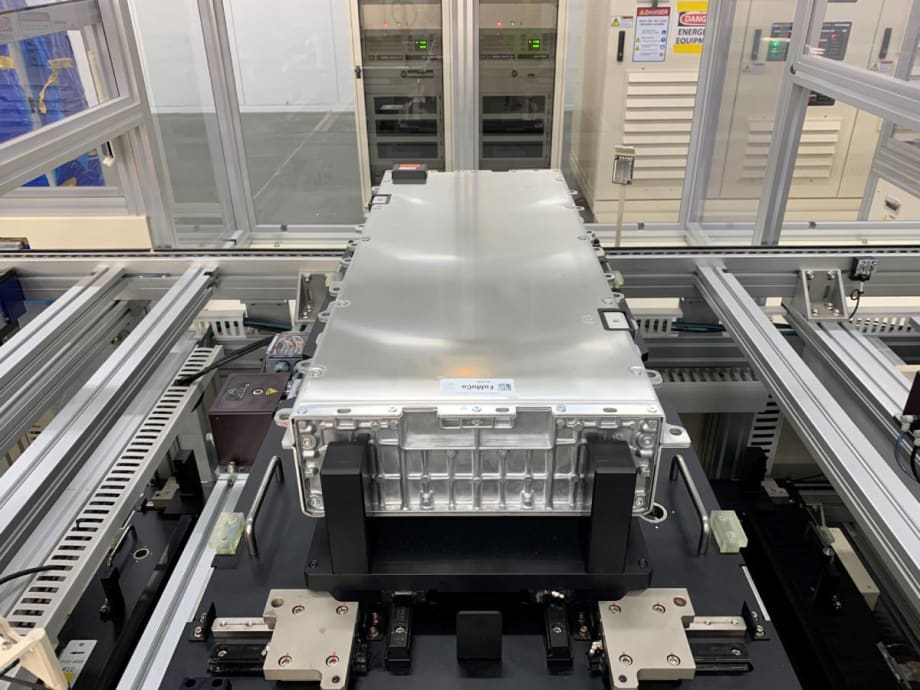
The BlueOvalSK MoU builds on Ford’s recently announced investments to accelerate R&D of battery technology and manufacturing – including a new global battery center of excellence and an additional investment in a solid-state battery startup.
Photo: Ford
5 min to read
Ford and SK Innovation announced May 26 they have signed a memorandum of understanding (MOU) to create a joint venture – to be called BlueOvalSK – to produce about 60 GWh annually in traction battery cells and array modules, starting mid-decade, with potential to expand, according to a press release.
"This MOU is just the start; it’s a key part of our plan to vertically integrate key capabilities that will differentiate Ford far into the future,” said Jim Farley, Ford president and CEO, in the release. “We will not cede our future to anyone else.”
“Ford is one of the most active players in vehicle electrification today,” said Kim Jun, SK Innovation CEO & President. “Our JV with Ford will play a pivotal role in fleshing out the electric vehicle value chain in the United States, a key objective of the current U.S. administration.”
The creation of the JV is subject to definitive agreements, regulatory approvals and other conditions. Next-gen cells and arrays will be used to power several future Ford battery electric vehicles.
“Through the JV, Ford and SKI will jointly develop and industrialize battery cells at scale that are tailored to deliver optimum performance and value for our Ford and Lincoln customers,” said Lisa Drake, Ford’s North America chief operating officer. “SKI is an important partner in helping deliver batteries with better range and value for our fully electric vehicles by mid-decade.”
Ford’s global BEV plan calls for at least 240 gigawatt hours (GWh) of battery cell capacity by 2030 – about 10 plants’ worth of capacity. About 140 GWh will be required in North America, with the balance dedicated to other key regions, including Europe and China.
“Global automakers have praised SK Innovations’ EV batteries for their safety, high capacity and long life,” said Jee Dong-seob, Head of SK Innovation’s Battery Business. “SK Innovation will be supplying batteries for the fully electric version of Ford’s legendary and best-selling F-150 pickup truck. We are thrilled to be supporting the electrification of a vehicle that represents the very best of American automaking.”
SK Innovation is a global energy conglomerate headquartered in Seoul, South Korea. The company has pioneered the development of mid- to large-size EV batteries since 1991 and has expanded its battery operations globally since 2010. SK already operates a battery plant in Commerce, Georgia – serving two global OEMs – and is expanding its production capacity in the European Union and China.
SK Innovation plans to become one of the world’s top three EV battery suppliers by 2025 with over 125 GWh in global production capacity.
SK Innovation has specialized in the development and commercialization of high-nickel NCM battery technology. The company developed the world’s first NCM-811 battery in 2016 and continued to innovate and to develop the world’s first Nickel 9 battery that will be mass produced in the U.S., powering Ford’s F-150 Lightning.
Ford Gaining EV Momentum
Ford plans to lead the electric vehicle revolution – including by delivering fifth-generation lithium ion batteries as well as preparing for the transition to solid-state batteries, which promise longer range, lower cost and safer EVs for customers.
Ford this year announced its commitment to invest at least $22 billion through 2025 to deliver connected, all-electric vehicles, building on its areas of strength, starting with EV versions of its most popular nameplates – including Mustang Mach-E, E-Transit and F-150 Lightning.
To support its longer-term battery plans, Ford is investing in battery R&D. Last month, Ford announced a new global battery center of excellence – named Ford Ion Park – to accelerate its battery and battery cell technology R&D – including future battery manufacturing.
Ford is building on nearly two decades of battery expertise by centralizing a cross-functional team of 150 experts in battery technology development, research, manufacturing, planning, purchasing, quality and finance to help Ford more quickly develop and manufacture battery cells and batteries, ultimately aiming to deliver more lower costs EVs.
The Ford Ion Park team already is underway. In addition, a $185 million collaborative learning lab in Southeast Michigan that is dedicated to developing, testing and building vehicle battery cells and cell arrays opens late next year.
Earlier this month, Ford also announced it is growing its investment in Solid Power, an industry-leading producer of all-solid-state batteries for EVs. Initially investing in Solid Power in 2019, Ford is making an additional equity investment to help accelerate further development of solid-state vehicle battery technology, contributing to a $130 million Series B investment round in which the BMW Group becomes an equal equity owner with Ford.
Solid-state batteries are showing great promise. They don’t use the liquid electrolyte found in conventional lithium-ion batteries, can be lighter, with greater energy density, and provide more range and lower cost. They also can be made on today’s lithium-ion battery lines, allowing Ford to reuse about 70% of its capital investment in lithium-ion manufacturing lines.
Electrification Expertise
SK Innovation so for has a clean health and safety record and has not registered a single EV battery-related fire.
Ford has been involved in battery research and electric vehicles, starting with Henry Ford and Thomas Edison. To date, the company has secured more than 2,500 U.S. patents in electrification technologies, with another 4,300 patents pending.
Since 2004, Ford has sold more than one million hybrids, plug-in hybrids and all-electric vehicles and integrated four generations of batteries into its vehicles. By year-end, the company will be manufacturing electrified vehicles and supporting technologies at more than 15 powertrain and vehicle assembly plants globally.
Ford has assembled hybrid battery packs and electric motors in Michigan since 2012. That same year, Ford invested $135 million to design, engineer and produce these components for hybrids. It included a combined 170 jobs at the Rawsonville plant to assemble batteries and VanDyke Transmission plant to assemble e-motors, plus hiring more than 50 electric vehicle engineers.
Originally posted on Charged Fleet
More Green Fleet

Fleet Forward Conference Introduces One-Day Passes for 2026
New one-day registration gives fleet professionals the flexibility to attend Tuesday, Wednesday, or Thursday, with passes available for $199 through Sept. 18.
Read More →
CALSTART Rebrands as Catalyst Mobility, Will Combine with Forth in 2027
CALSTART has rebranded as Catalyst Mobility and will combine with Forth at the start of 2027. The new organization said it is poised to become one of the world's largest, strongest, and most impactful clean transportation nonprofits.
Read More →
Electric Truck and Charging Programs to Boost Sustainability at NY & NJ Ports
Together, the Port Authority of New York and New Jersey and CALSTART will electrify drayage and terminal operations serving the East Coast’s busiest container port. A pair of incentive programs totaling $45 million has launched to accelerate adoption of zero-emission drayage trucks and terminal tractors.
Read More →
Xos Hub Surpasses One Gigawatt-Hour of Energy Delivered in the Field
A single Xos Hub has surpassed one gigawatt-hour of energy across more than 33,600 charging sessions in the field, demonstrating performance that supports Xos' expansion across new products and markets.
Read More →
Carrier Transicold Launches All-Electric Vector 8200 TRU for Diesel-Free On-Site Cold Storage
Carrier Transicold’s first engineless multi-temperature TRU helps fresh- and frozen-food fleets add supplemental cold storage capacity during seasonal peaks.
Read More →
Narro Trucks Introduces Electric Utility Vehicle
Narro Trucks officially launched its operations on Aug. 20 and hosted a ride and drive to showcase its electric truck, which will be produced in Virginia.
Read More →
Samsung SDI Takes Full Control of GM Battery JV as Indiana Plant Pivots to Energy Storage
Samsung SDI is taking full control of its Indiana battery plant with GM, marking a major shift from the EV-focused joint venture Charged Fleet first covered in 2023.
Read More →
NWSA Taps CALSTART to Administer Zero-Emission Drayage Assistance Program
CALSTART will provide free technical assistance services to drayage fleets serving the Ports of Seattle and Tacoma and looking to transition to cleaner technologies and help decarbonize freight hubs.
Read More →
EV Fleet Reality Check: What Operators Wish They Knew Before Electrifying Their Work Vans
Electric work truck upfits bring new compatibility questions. Learn how parts availability, OEM guidance, power demands, and route planning can affect fleet performance.
Read More →
Peterbilt Expands Sourcewell Partnership with Electric Vehicle Lineup
Peterbilt Motors Company’s cooperative purchasing agreement with Sourcewell and its Canadian partner, Canoe Procurement Group, now includes including Peterbilt's battery-electric vehicle lineup.
Read More →