




Feds Provide $232.5M for Emergency Road Repairs
The funds from the Federal Highway Administration reimburse states for the repair of roads and bridges damaged by storms and other unexpected disasters.
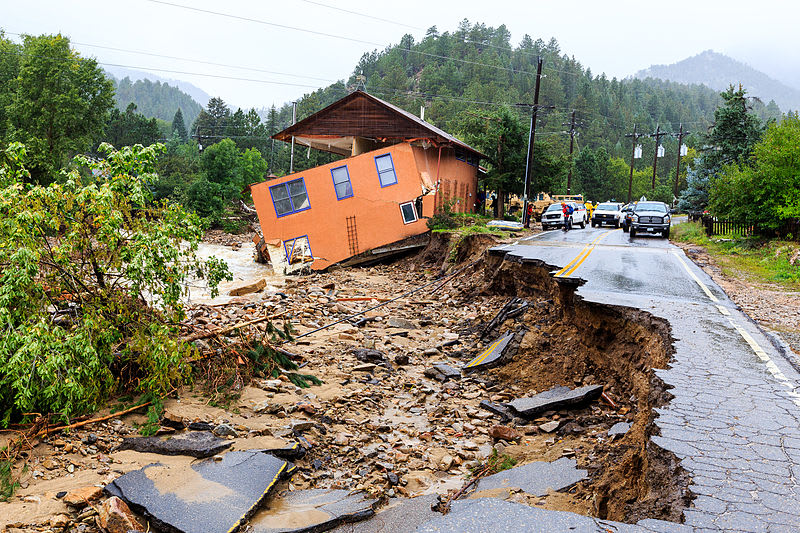
Road damage in Jamestown, Colo., caused by Boulder County flooding in September 2013. Photo by Steve Zumwalt/FEMA via Wikimedia Commons.
Road damage in Jamestown, Colo., caused by Boulder County flooding in September 2013. Photo by Steve Zumwalt/FEMA via Wikimedia Commons.
The U.S. Department of Transportation announced the allocation of $232.5 million in emergency relief funds to 26 states and Puerto Rico for the repair of roads and bridges damaged by storms, floods and other disasters.
The Federal Highway Administration (FHWA) released the funds. Transportation Secretary Anthony Fox announced the allocation totals on Feb. 18.
“We are committed to getting transportation facilities restored as quickly as possible following natural disasters and other emergencies,” Foxx said.
FHWA’s emergency relief program reimburses states for eligible expenses associated with damage from natural disasters or other emergency situations, based on state requests. The funds help to pay for the reconstruction or replacement of damaged highways and bridges, along with equipment set up for detours and the replacement of such items as guardrails.
The FHWA estimates that approximately $77 billion in annual investment is needed to meet the needs of the U.S. federal-aid highway system, according to a DOT report issued earlier this month.
Of special concern are 60,000 miles of coastal roads exposed to flooding from heavy rain and storm surges. Low-lying road infrastructure is particularly vulnerable to storm surges. Bridges, which often cross or stand near bodies of water, are also vulnerable.
At $55 million, Colorado topped the list among states reimbursed through the emergency relief program. The funding need was tied to flooding that caused widespread damage throughout the state. The hardest hit area in the state was Boulder.
Arizona received $36 million for a slope failure on US 89 in Coconino County, while Ohio drew $34 million for rock-fall damage on SR 7 in Jefferson County.
Both Alabama (Baldwin and Mobile counties) and Tennessee (south of Nashville) were repaid for repairs on two bridges on I-65 damaged by truck fires.
Delaware received funding to fix damaged piers on the I-495 bridge spanning the Christina River, near the Port of Wilmington.
Twenty other states received funding for extensive flooding, rainfall and other eligible events as well.
Emergency Relief Program Allocation
State
Event Title
Allocation
Alabama
Feb. 9, 2012 -- I-20 Sinkhole
$320,000
Alabama
Feb. 1-26, 2013 -- Severe Flooding
$1,200,000
Alabama
April 28, 2014 -- Storms and Flooding
$1,500,000
Alabama
May 22, 2014 -- Truck Crash and Fire on I-65 Bridge
$4,607,000
Alabama
July 31, 2014 -- Truck Crash/Fire on I-10 EB Bridge at Exit 30
$850,000
Arizona
Jan. 2010 -- Winter Storm
$1,000,000
Arizona
Feb. 20, 2013 -- US 89 Slope Failure
$36,000,000
Arizona
Sept. 2014 -- Rainfall and Flooding
$12,500,000
California
Feb. 2014 -- Storms
$2,765,597
California
Aug. 24, 2014 -- Napa Valley Earthquake
$4,800,000
Colorado
Sept. 11, 2013 -- Flooding
$55,000,000
Colorado
Aug. 9, 2013 -- US 24 Flood Damage
$576,159
Colorado
Jan. 2014 -- US 550 Rockfall
$850,000
Delaware
June 2014 -- I-495 Bridge Pier Damage
$4,000,000
Florida
Aug. 25, 2012 -- Tropical Storm Isaac
$900,000
Florida
April 29-30, 2014 -- Spring Flooding
$13,400,000
Idaho
July 31-Aug. 7, 2014 -- Heavy Rainfall and Flooding
$320,000
Indiana
April 2011 -- Severe Storms and Flooding
$369,603
Kentucky
June 2011 -- Storms and Flooding
$212,611
Kentucky
March 2012 -- Tornadoes and Storms
$53,342
Kentucky
April 2013 -- Storms and Flooding
$100,437
Michigan
Sept. 26, 2014 -- Pedestrian Bridge Collapse
$200,000
Montana
March 2014 -- Severe Flooding
$1,639,860
Nebraska
May 2011 -- Platte and Missouri River Flooding
$2,015,609
Nevada
Sept. 2014 -- Rainfall and Flooding
$9,144,000
New Mexico
Sept. 9, 2013 -- Flooding
$3,000,000
New Mexico
September 18, 2014 -- Severe Storms and Flooding
$530,500
New York
May 2014 -- Flooding
$1,000,000
North Dakota
May 19, 2014 -- Southern Mouse River Basin Flooding
$3,954,540
North Dakota
May 19, 2014 -- West James River Basin Flooding
$1,736,539
North Dakota
May 19, 2014 -- Divide County Basin 1 Flooding
$4,923,337
North Dakota
May 19, 2014 -- Divide County Basin 2 Flooding
$1,283,498
Ohio
Mid‐March 2011 -- Heavy Rain fall
$1,500,000
Ohio
Jan. 2012 -- ER Event in Jefferson County
$34,375,000
Oklahoma
May 24 - June 10, 2007 -- Flooding Event
$1,044,000
Oregon
Feb. 6, 2014 -- I-84 Rockslide
$750,000
Puerto Rico
May 10, 2014 -- Rio Grande Rainfall
$1,000,000
South Carolina
Aug. 6, 2013 -- Jones Mill Rd Bridge Failure
$483,412
South Dakota
June 2014 -- Heavy Rainfall and Flooding
$4,608,812
Tennessee
April 28-30, 2014 -- Storms, Landslide, and Rockslide
$825,600
Tennessee
Aug. 15, 2014 -- Tanker Truck Crash and Fire on I-65
$2,060,497
Utah
Sept. 2014 -- Rainfall and Flooding - Utah detours
$200,000
Vermont
April 23 - May 30, 2011 -- Severe Storms and Flooding
$166,000
Vermont
Aug. 27, 2011 -- Tropical Storm Irene
$4,440,000
Washington
Sept. 2013 -- Rain US 12 Slide
$230,027
Washington
March 2014 -- Abnormal Rainfall
$5,093,898
Washington
Aug. 21, 2014 -- Heavy Rainfall and Flooding
$3,527,285
Wisconsin
June 2012 -- NW Wisconsin Flooding Event
$1,200,000
Wisconsin
Sept. 25, 2013 -- I-43 Leo Frigo Bridge Pier Failure
$200,000
Total
$232,457,163
Source: U.S. Department of Transportation.
Originally posted on Automotive Fleet
More Safety
When Work Trucks Under 26,001 Pounds Need IRP Registration
Think trucks under 26,001 pounds are automatically in the clear when it comes to IRP? Not always. Learn where lighter vehicles can still run into trip permit, apportioned registration, and IFTA compliance requirements when crossing state or provincial lines.
Read More →
Volvo Trucks Releases New Safety Recommendations for Traveling with Pets
One of the most important recommendations for professional drivers traveling with pets is to ensure pets are properly restrained while the truck is moving. Other tips are available in the new guide from Volvo Trucks North America and Center for Pet Safety.
Read More →
API Issues Refueling Safety Guidelines
The American Petroleum Institute offers a list of safe vehicle refueling guidelines, including ways to avoid potential problems with static electricity discharges in fall, winter, and early spring.
Read More →
Winter Fleet Prep: Expert Tips to Keep Vehicles Running Smoothly
Cold weather can expose weak batteries, tires, fuel systems, and maintenance gaps fast. Use this winter fleet checklist to prepare trucks and drivers before temperatures drop.
Read More →
When a Work Truck Breaks Down, the Job Can Stop, Too
A work truck breakdown can stop more than the vehicle. Discover how payloads, jobsites, and specialty equipment change the roadside response.
Read More →
What Stronger Long-Term Fleet Service Partnerships Actually Require
Fleet service partnerships rarely fall apart all at once. Learn the three warning signs that trust is eroding and what fleets and providers can do before downtime, frustration, and lost revenue follow.
Read More →
Applause & TRUCE Software Partner to Improve Driver Safety Through AI-Powered Telematics & Employee Performance Management
Applause has integrated TRUCE driving metrics directly into its employee-first performance and safety platform that transforms mobile devices into AI-powered telematics.
Read More →
How Detroit Assurance with Active Brake Assist Works
Do you want to see what it is like to experience Detroit Assurance’s Active Brake Assist? In this video, Work Truck will put you in the cab to see how it all works and then hear more details from DTNA’s Mike Young.
Read More →
Get Left of Loss: A 5-Step Workplace Violence Prevention Framework for Fleet Operators
Violence risks do not stop at the driver’s door. Learn five practical steps fleets can take to spot threats early and protect workers before loss occurs.
Read More →
How Better Visibility Cut Speeding Violations by 48%
Fleet leaders don't need more data, they need clearer visibility into what the data is saying. This case study explores how one utility replaced speeding-event counts with a single metric — miles driven in violation — to strengthen safety and significantly reduce speeding violations.
Read More →