




FedEx and Nissan Expand Cooperative Testing of the 100% Electric Nissan e-NV200 to New Global Markets
HANOVER, GERMANY – Nissan unveiled the all-new 100-percent electric Panel Van version e-NV200 Concept, decorated with Nissan and FedEx graphics and logos.
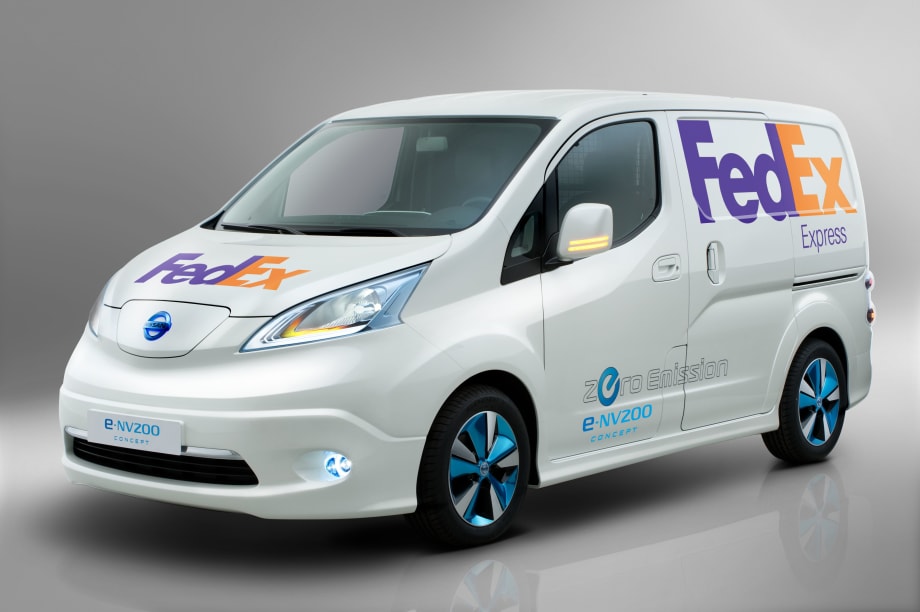
The e-NV200 combines the advanced powertrain of the 100-percent electric Nissan LEAF with all the spaciousness, versatility, and practicality of the base vehicle-the NV200 multi-purpose compact van.
HANOVER, GERMANY – Nissan unveiled the all-new 100-percent electric Panel Van version e-NV200 Concept, decorated with Nissan and FedEx graphics and logos, at the 64th IAA Commercial Vehicle International Motor Show in Hanover.
Nissan is in the final development phase of its second mass production zero emission vehicle, the e-NV200 compact van. Electric vehicles are ideal for urban delivery applications, and this vehicle is envisaged for use as a delivery van that offers a breakthrough type of mobility for entrepreneurs, featuring efficiency and green consciousness. The company has been working with FedEx Express since December 2011 to test the e-NV200 in real world operations to help shape development of the 100% electric compact delivery vehicle. FedEx Express currently operates 130 all-electric vehicles worldwide, making the company an ideal collaborator for this research and development initiative.
FedEx Express is strongly committed to improving the environmental impact of its global vehicle fleet. The FedEx Express fleet is managed through a holistic approach to increase fuel efficiency and reduce emissions; the company has already achieved more than 80 percent of its goal to increase the fuel efficiency of its global vehicle fleet 20 percent by 2020. This collaborative initiative with Nissan will assist FedEx with developing best practices for managing its electric vehicle fleet in urban environments, while supporting the development of innovative technologies for overall industry improvement in efficiency and reduced environmental impact.
Nissan and FedEx Express engineers started working together in December 2011 by co-testing the e-NV200 prototype on the streets of London, UK. The test recently expanded to Yokohama, Japan, in order to obtain additional real-world driving feedback. The feedback will help Nissan to meet customer requirements in advance of the start of production, expected to commence in fiscal year (FY) 2013. Going forward, the proving tests will be newly expanded to countries such as Singapore, the USA and Brazil.
For additional information on the Nissan e-NV200 Concept, please visit http://www.env200.com/.
(Continued on next page.)[PAGEBREAK]
In addition to the cooperative testing, both companies have decided to continue their participation in the research and development of the urban parcel delivery vehicle and related software.
Nissan plans to roll out zero emission technologies into its LCV line-up. The e-NV200 will be the second of four electric vehicles (EV) announced by Nissan to reach mass production, underlining Nissan's leadership in the EV segment. The e-NV200 combines the advanced powertrain of the 100-percent electric Nissan LEAF with all the spaciousness, versatility, and practicality of the base vehicle-the NV200 multi-purpose compact van.
The e-NV200 will provide exceptionally smooth acceleration and quietness (driving characteristics are unique to electric vehicles) while keeping CO2 emissions zero at the point of use. Additionally, the model will be unique in offering new features, such as quick charging, and an innovative power outlet that enables the driver to plug in any electric device and work anywhere. Its advanced telematics system, combined with class-leading cargo volume in a compact body, will help the e-NV200 strive to reach its goal to become the industry benchmark. Additionally, the model's enviable running costs - a priority for many companies - offer additional energy cost savings compared to fuel cost and lower maintenance costs.
"As a global fleet operator, FedEx Express is always looking for measures to improve the efficiency of its vehicles," said Russell Musgrove, managing director Global Vehicles, FedEx Express. "Through the development and deployment of innovative technologies, FedEx Express has continually improved the energy efficiency and reduced the environmental impact of its fleet. We are delighted to collaborate with a global player like Nissan in the development of an urban all-electric delivery van."
With zero emissions, no tailpipe, and energy-recycling regenerative braking, e-NV200 will be particularly well-suited for urban environments. Regenerative braking affords the advantage of reclaiming energy in the start and stop of city traffic, reducing the wasteful loss of energy and increasing the efficiency of the vehicle's driveline. Battery charging options include a complete recharge overnight or up to 80 percent capacity in just 30 minutes using a Quick Charger.
"The e-NV200 will offer all the spaciousness, versatility and practicality of a traditional diesel or gas-powered compact van, but with zero CO2 or other pollutant emissions at the point of use. What's more, it will provide an outstanding driving experience that is unique to EVs. e-NV200 represents a bold and innovative addition to our commercial vehicle range, which is already one of the broadest of any manufacturer," said Hideto Murakami, corporate vice president, Nissan Motor Co., Ltd.
Nissan aims to be the leader in zero emissions vehicles. In addition to carrying out the development of electric vehicles, the company is engaged in comprehensive efforts to expand the use of electric vehicles and promote sustainable mobility. The Renault-Nissan Alliance has already concluded more than 100 partnerships related to zero emission mobility with national and local governments, and corporations, throughout the world. Nissan is also engaged in related efforts such as producing lithium ion batteries; developing the EV charging infrastructure and proprietary speed charging equipment; and the recycling and reuse of batteries.
For additional information on the Nissan e-NV200 Concept, please visit http://www.env200.com/.
More Green Fleet

Fleet Forward Conference Introduces One-Day Passes for 2026
New one-day registration gives fleet professionals the flexibility to attend Tuesday, Wednesday, or Thursday, with passes available for $199 through Sept. 18.
Read More →
CALSTART Rebrands as Catalyst Mobility, Will Combine with Forth in 2027
CALSTART has rebranded as Catalyst Mobility and will combine with Forth at the start of 2027. The new organization said it is poised to become one of the world's largest, strongest, and most impactful clean transportation nonprofits.
Read More →
Electric Truck and Charging Programs to Boost Sustainability at NY & NJ Ports
Together, the Port Authority of New York and New Jersey and CALSTART will electrify drayage and terminal operations serving the East Coast’s busiest container port. A pair of incentive programs totaling $45 million has launched to accelerate adoption of zero-emission drayage trucks and terminal tractors.
Read More →

Xos Hub Surpasses One Gigawatt-Hour of Energy Delivered in the Field
A single Xos Hub has surpassed one gigawatt-hour of energy across more than 33,600 charging sessions in the field, demonstrating performance that supports Xos' expansion across new products and markets.
Read More →
Carrier Transicold Launches All-Electric Vector 8200 TRU for Diesel-Free On-Site Cold Storage
Carrier Transicold’s first engineless multi-temperature TRU helps fresh- and frozen-food fleets add supplemental cold storage capacity during seasonal peaks.
Read More →
Narro Trucks Introduces Electric Utility Vehicle
Narro Trucks officially launched its operations on Aug. 20 and hosted a ride and drive to showcase its electric truck, which will be produced in Virginia.
Read More →
Samsung SDI Takes Full Control of GM Battery JV as Indiana Plant Pivots to Energy Storage
Samsung SDI is taking full control of its Indiana battery plant with GM, marking a major shift from the EV-focused joint venture Charged Fleet first covered in 2023.
Read More →
NWSA Taps CALSTART to Administer Zero-Emission Drayage Assistance Program
CALSTART will provide free technical assistance services to drayage fleets serving the Ports of Seattle and Tacoma and looking to transition to cleaner technologies and help decarbonize freight hubs.
Read More →
EV Fleet Reality Check: What Operators Wish They Knew Before Electrifying Their Work Vans
Electric work truck upfits bring new compatibility questions. Learn how parts availability, OEM guidance, power demands, and route planning can affect fleet performance.
Read More →
Peterbilt Expands Sourcewell Partnership with Electric Vehicle Lineup
Peterbilt Motors Company’s cooperative purchasing agreement with Sourcewell and its Canadian partner, Canoe Procurement Group, now includes including Peterbilt's battery-electric vehicle lineup.
Read More →