




Brake Safety Week is Here: Are You Ready?
The annual weeklong event run by the Commercial Vehicle Safety Alliance (CVSA) examines vehicles across the United States, Canada, and Mexico.

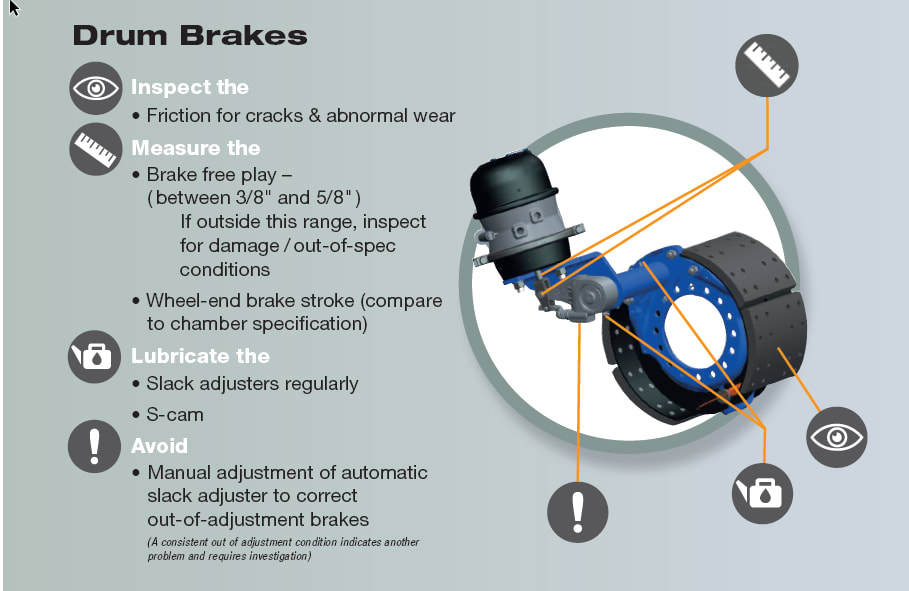
Improperly adjusted brakes can also drag – impacting fuel efficiency and speeding up pad wear – or experience decreased stopping power.
Photo: Bendix
In trucking as in life, there’s no substitute for being prepared – whether it’s the next load, storm, or inspection. And inspections are top of mind right now in the North American commercial vehicle industry, as one of the biggest touchpoints on the calendar is here: Brake Safety Week is happening this week (August 21-27).
The annual weeklong event run by the Commercial Vehicle Safety Alliance (CVSA) examines vehicles across the United States, Canada, and Mexico.
The team at Bendix Commercial Vehicle Systems LLC (Bendix) offers suggestions on getting ready.
“During last year’s CVSA Brake Safety Week, 12% of the 35,764 vehicles inspected were placed out of service for brake-related issues,” said Fred Andersky, Bendix director – demos, sales, and service training. “So many aspects of safe vehicle operation are directly impacted by what goes on at the wheel-ends and in the braking system that you really can’t overstate the importance of keeping up with maintenance and inspection of those areas. From stopping power to the performance of higher-level technologies like collision mitigation, everything is linked to how well the brakes and wheel-ends perform when they’re needed. That’s why these inspections matter so much, and why Bendix puts the word out with practical tips for being prepared and staying safe.”
Brake Safety Week is part of CVSA’s Operation Airbrake initiative, an outreach and enforcement campaign that aims to reduce the number of highway crashes caused by faulty brake systems on commercial motor vehicles. The event involves local, state, provincial, territorial, and federal motor carrier safety officials in the United States, Canada, and Mexico inspecting large trucks and buses, focusing on brake system violations.
What to Expect in Brake Safety Week
Brake Safety Week roadside inspectors conduct North American Standard Inspections, which cover a range of driver qualifications, documentation, and vehicle equipment conditions. They’ll be checking for:
Missing, nonfunctioning, loose, contaminated, or cracked parts
Holes caused by rust and through rubbing or friction
Broken springs in the spring brake housing section of the parking brake
Air leaks around brake components and lines
Air pressure in the target range of 90-100 psi
Slack adjusters not at the same length
Mismatched air chamber sizes across axles
Warning device functionality (such as antilock braking system indicator lights)
Inspectors will also look for brake hose and tubing chafing violations – the focus of this year’s Brake Safety Week.
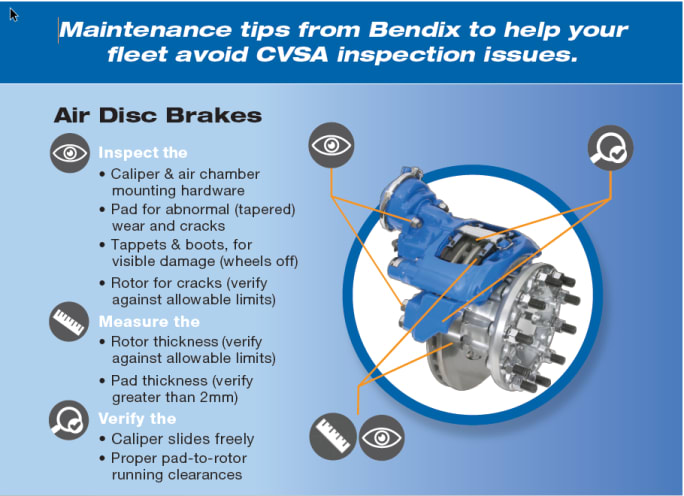
Where Brake Safety Week is concerned, air disc brakes and drum brakes have a few differing maintenance needs.
Photo: Bendix
How to Get Ready - During Brake Safety Week and Every Week
“Pre-, post-trip, and regular inspections can go a long way toward catching some obvious violations, including loose hoses or damaged components like air chambers or pushrods,” said Mark Holley, Bendix director of marketing and customer solutions, Wheel-End. He recommends the following:
Every day:
Check for damaged or loose-hanging air chambers, pushrods, or slack adjusters.
Make sure slack adjusters on each axle are extended out to the same angle. Different angles can indicate an out-of-adjustment brake or a broken spring brake power spring.
Examine tubing and hose condition, positioning, and connections.
Every week:
Perform a 90- to 100-psi brake application with the wheels chocked and the parking brakes released, and listen for leaks.
Check air disc brake rotors for cracks.
Inspect drum brake linings for wear and cracks.
Every month:
Check for moisture in the air system to prevent contamination that leads to component deterioration and system leaks.
“It’s also worth greasing the S-cam brake tubes and automatic slack adjusters any time you’ve got a vehicle in the shop,” Holley said. “This quick process helps prevent rust and corrosion, and helps keep the slack functioning properly.”
Regarding brake hose and tubing chafing, the focus of Brake Safety Week this year, Bendix recommends watching for two typical causes. First is improper routing and clipping, which can cause hoses to rub together while the vehicle is operating. Preventive measures include periodic inspections to ensure tie straps, clips, and any brackets are not damaged or broken. The second typical cause is improper hose length – an overly long replacement hose is susceptible to chafing. Damaged hoses should be replaced.
“In addition, from the larger perspective, never underestimate the significance of communication between drivers and technicians,” Andersky said. “A driver out on the road may be the first one to notice an issue with the truck. Being able to tell the technician what happened, where, and other details such as weather conditions is important – as is the technician asking questions to get a clearer understanding of the situation.”
Andersky continued, “This is all part of the holistic approach to upkeep, which is critical when considering the complex interconnectivity of the entire brake system and more advanced safety technologies. Any sign of something out of compliance can indicate wider maintenance issues. Meaning that, taken individually, things like an active full-stability light on the dash or a kink in an air hose – and everything else inspectors are looking for – are of consequence.”
How Drums and Discs Differ
Where Brake Safety Week is concerned, air disc brakes and drum brakes have a few differing maintenance needs.
“Key among the differences is the measurement of brake stroke,” Holley said. “Because air disc brakes include an internal adjustment mechanism, their brake stroke is not measured externally, as is the case with drum brakes. The internal adjustment mechanism significantly lowers the risk of out-of-adjustment violations.”
Measuring a drum brake’s chamber stroke is a matter of checking the distance from the air chamber to the clevis pin with the brakes released, and then again after a fully charged brake application. The difference between these is the brake stroke, and its maximum length depends upon the brake chamber type and size.
Improperly adjusted brakes can also drag – impacting fuel efficiency and speeding up pad wear – or experience decreased stopping power. Bendix has developed an infographic (included below and attached) to note the differing maintenance needs of air disc and drum brakes.
Select the Right Brake Parts
If you notice it’s time for new brake friction, make sure to keep things up to spec: Not all friction that is marketed as “acceptable” under current reduced stopping distance (RSD) regulations will actually perform to that standard. Whether you’re replacing air disc brake pads or drum brake shoes, select components that will ensure the original equipment manufacturer (OEM) requirements are met, so that the vehicle remains compliant.
“The aftermarket is more crowded than ever, particularly when it comes to brake friction,” Holley said. “The wrong choice can harm your system and undermine vehicle safety. Complications arising from improper friction selection can include cracks, degradation of braking performance, or damage to other wheel-end components. Remember, these are things that a roadside inspector will note and penalize you for.”
When it comes to remanufactured drum brake shoes, ask your supplier whether they have been coined back to their OEM-engineered shape, and not simply relined with new friction, Holley noted. Shoes become misshapen under the stress of regular use, and relining one of these without returning it to its original geometry can impact stopping power and friction life.
You’ll also want to protect the air supply against corrosive oil aerosols that lead to leaks and potential violations. Bendix recommends using an oil-coalescing air dryer cartridge like the Bendix PuraGuard. Oil-coalescing cartridges can be used to replace standard cartridges, but the reverse is not the case: You shouldn’t downgrade from an oil-coalescing cartridge to a standard.
Are you ready?
More Safety
When Work Trucks Under 26,001 Pounds Need IRP Registration
Think trucks under 26,001 pounds are automatically in the clear when it comes to IRP? Not always. Learn where lighter vehicles can still run into trip permit, apportioned registration, and IFTA compliance requirements when crossing state or provincial lines.
Read More →
Volvo Trucks Releases New Safety Recommendations for Traveling with Pets
One of the most important recommendations for professional drivers traveling with pets is to ensure pets are properly restrained while the truck is moving. Other tips are available in the new guide from Volvo Trucks North America and Center for Pet Safety.
Read More →
API Issues Refueling Safety Guidelines
The American Petroleum Institute offers a list of safe vehicle refueling guidelines, including ways to avoid potential problems with static electricity discharges in fall, winter, and early spring.
Read More →
Winter Fleet Prep: Expert Tips to Keep Vehicles Running Smoothly
Cold weather can expose weak batteries, tires, fuel systems, and maintenance gaps fast. Use this winter fleet checklist to prepare trucks and drivers before temperatures drop.
Read More →
When a Work Truck Breaks Down, the Job Can Stop, Too
A work truck breakdown can stop more than the vehicle. Discover how payloads, jobsites, and specialty equipment change the roadside response.
Read More →
What Stronger Long-Term Fleet Service Partnerships Actually Require
Fleet service partnerships rarely fall apart all at once. Learn the three warning signs that trust is eroding and what fleets and providers can do before downtime, frustration, and lost revenue follow.
Read More →
Applause & TRUCE Software Partner to Improve Driver Safety Through AI-Powered Telematics & Employee Performance Management
Applause has integrated TRUCE driving metrics directly into its employee-first performance and safety platform that transforms mobile devices into AI-powered telematics.
Read More →
How Detroit Assurance with Active Brake Assist Works
Do you want to see what it is like to experience Detroit Assurance’s Active Brake Assist? In this video, Work Truck will put you in the cab to see how it all works and then hear more details from DTNA’s Mike Young.
Read More →
Get Left of Loss: A 5-Step Workplace Violence Prevention Framework for Fleet Operators
Violence risks do not stop at the driver’s door. Learn five practical steps fleets can take to spot threats early and protect workers before loss occurs.
Read More →
How Better Visibility Cut Speeding Violations by 48%
Fleet leaders don't need more data, they need clearer visibility into what the data is saying. This case study explores how one utility replaced speeding-event counts with a single metric — miles driven in violation — to strengthen safety and significantly reduce speeding violations.
Read More →