




What’s an ePTO?
As work trucks become increasingly electrified, it’s important to specify the right components, starting with the ePTO.
Parker’s modular ePTO system includes the GVM Series Electric Motor and GVI Series Mobile Inverter paired with cooling circuitry to create a highly efficient system.
Photo: Parker Chelsea
In some ways, it feels like the fleet industry has been talking about electrification forever.
The desire to improve air quality, reduce emissions, and create a path to reduce carbon has driven various regulations, such as the Advanced Clean Truck rule, Phase 3 GHG, and California Air Resources Board investment plan, which have been evolving for several decades.
Yet, when it comes to applying the principles and design specs for electrifying any type of work truck, it feels like we are still taking baby steps into a somewhat unfamiliar world.
Of course, the trucks themselves are largely still doing the same type of work. The difference is in how they are powered and the components specified to power them.
With the changes in power source comes many new concepts and terms. One frequently heard, but still often misunderstood, is the electric power takeoff (ePTO).
Even today, you will likely find inconsistencies if you try to document a definition. After all this time, it turns out that an ePTO is still loosely defined. So let’s try to correct that problem with a more consistent definition.
In general terms, an ePTO is deployed on a zero-emission vehicle (ZEV) with a (traction) battery-powered hydraulic power source that operates with a motor, pump and inverter, using vehicle battery power (as a “take off”) from the vehicle’s primary batteries to power work functions on the vehicle.
Variations of ePTOs may be offered through the OEM, dealer, or bodybuilder, often as part of an a la carte selection of related electronic components.
Similar to a standard PTO, it can be connected to a mechanical transmission system (cardan shaft or gearbox) or a hydraulic pump. In general, ePTOs create an opportunity for further improvements in efficiency and noise.
Types of ePTOs to Power EVs
There are several options to power ePTOs. The first uses the ZEV chassis or a separate rechargeable battery system which can complete a day's work and be recharged on-demand or overnight. Benefits of this alternative include lower energy prices (vs diesel) and the environmental advantages that come from using “green” or carbon-neutral energy.
Alternatively, on diesel hybrids the battery can be charged using a generator driven by the internal combustion engine (ICE). This solution is most suited to stop-start applications like refuse trucks, drayage trucks, and buses.
Because the battery can be recharged by capturing brake energy, system size and weight are reduced, but total cost of ownership (TCO) must be analyzed to comprehend the return on investment for the enabling technology.
There are many different hybrid ePTO concepts that combine a mechanical PTO and an electric motor system. Engine off ePTO systems have their own battery system added to the ICE or ZEV chassis.
This increases chassis energy storage and can separate the work energy from the chassis drive system energy. Hybrid ePTOs represent a viable interim opportunity because of their additional energy, effectively addressing range anxiety by extending the time over which work can be done.
3 Types of ePTOs
Currently, there are three different types of power transformations called "ePTO” on the market:
DC Plug Only — DC power at some fused current, typically for a high voltage (HV) vehicle. This would be an OEM chassis-supported HVDC plug-in.
An HV DC connection supplies power to auxiliary DC devices
AC Plug Only (AC power 240 or 120V) — A power electronic device implemented to convert HV DC to AC power. This would provide an AC plug-in.
Mobile refrigeration sometimes uses AC motors for refrigerant compression.
A work truck might need to power an AC welder in the field.
Mechanical Appliance for Rotational Output — DC power (1a) transformed to rotational energy via a motor/inverter. The inverter controls the rotational output of the motor and is controlled via CAN.
Hydraulic output — Hydraulic pump powering a hydraulic work function such as refuse, aerial, or dump. These hydraulics systems have evolved over the past 70 years.
Rotational output — Fan, blowers, winch, etc.
Of the three options, the most demand in the market today is for the third option — Mechanical Appliance for Rotational Output with or without a hydraulic pump. These electric systems can quickly, conveniently, and efficiently facilitate the same on-road work functions using battery power as is used with today’s ICE-driven PTOs.
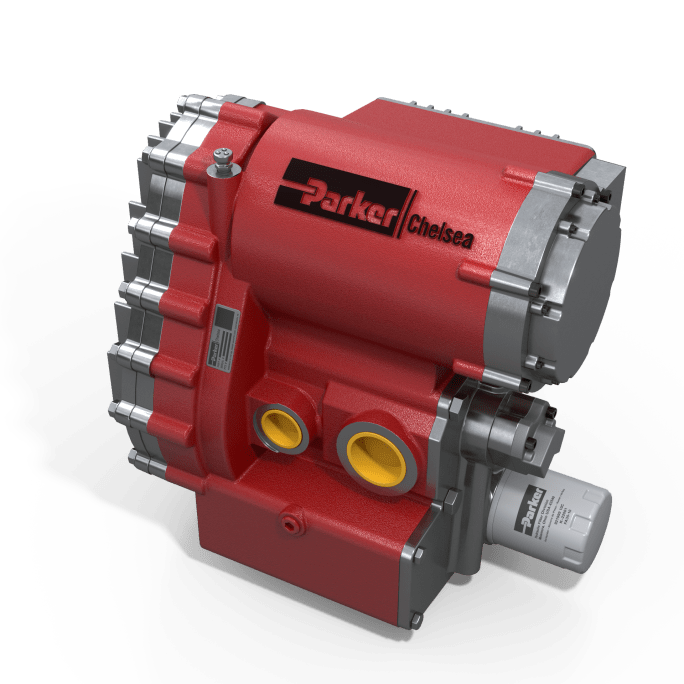
Parker Chelsea’s integrated ePTO is a simplified, integrated plug N Play Bolt-on design that optimizes efficiency for maximum performance.
Photo: Parker Chelsea
Why do ePTOs Matter?
It’s all about the power of green. Running auxiliary loads from the battery removes the need to idle the engine during PTO, effectively reducing fuel consumption and eliminating air and noise pollution.
Historically, the PTO output shaft has been part of the ICE or transmission, which requires the engine to idle during use. An idling engine can produce up to twice as many exhaust emissions as an engine while driving.
An ePTO makes the vehicle more environmentally friendly and is the first step towards hybrid and all-electric powertrains. Decoupling the work functions from the ICE allows independence with the speed of the diesel engine, ensuring work is carried out in the best yield zone with higher efficiency and less fuel consumption.
Another environmental benefit of an ePTO is that the diesel engine can be smaller, effectively enabling fuel savings. While working in towns with noise ordinances, the diesel engine can be switched off, and the ePTO can be used to reduce fuel and noise while the work is being performed. The reduced noise at the worksite improves communication as well as safety.
The rationale for ePTOs and related developments is clear. The strengthening of environmental regulation for respiratory irritants, GHG, and noise emissions imposes constraints for urban worksites, increasing the urgency to adopt new technology.
Beyond Environmental Benefits
Beyond environmental benefits, however, are the related financial considerations. Battery-electric systems may have a longer return on investment (ROI) of 5-10 years when compared to diesel efficiency improvement technologies targeting a 1.5-3-year ROI.
That’s because, despite major advances in design, batteries remain expensive. So the growing desire to electrify is increasingly about TCO and not about saving money upfront.
TCO can be lower because it considers reduced maintenance, fuel expense, and avoiding fines and penalties imposed in nonattainment areas. Initial cost can be offset by taking advantage of various governmental financial incentives.
Over the long-term uptime and reliability are key. ZEV reliability and equipment availability should increase because electric systems have significantly fewer moving parts.
Whereas a diesel power train may have roughly 20,000 moving parts, an electric power train has only about 10% of that amount, so roughly 2,000 moving parts.
An ePTO system will likely also last longer before needing to be replaced than the traditional transmission-driven hydraulic system because on-demand hydraulic flow enables faster movement of hydraulic systems.
How to Choose the Right ePTO For Your Application
The most important step in specifying an ePTO is understanding the power requirements for the work that needs to be done and then working backward.
One of the most surprising things we’ve learned at Parker while working alongside customers to identify the best solutions for electrifying their work trucks is how little the customer understands the energy demands to perform work.
This was never an issue with diesel-powered hydraulic systems because the energy source was more easily replenished. It’s easy to keep refilling the tank to continue working.
With battery-electric vehicles, however, you must be more aware of how much work you’re doing (energy used) so you don’t inadvertently drain the battery before your workday is done, in which case you either have to stop working or wait for the battery to recharge completely.
Determining Power Requirements
Determining the power requirements for the work you need to get done depends on the following considerations: (Note that a hybrid ePTO has similar sizing considerations, but its separate battery system changes the energy storage equation.)
Voltage of the chassis. Your chassis and motor must be compatible. After all, having a 350-volt chassis with a motor that only works with 650 volts won't work.
Propel. How much battery consumption is required to power a day’s work? The battery must be an adequate size to do the work and get the truck back home.
Space and weight. Until the market identifies ways to improve the energy density of batteries, space will continue to be a consideration, along with weight. These factors limit the amount of energy that can be stored on the vehicle.
Safety. Servicing HV equipment requires special tools, a dedicated space, and an educated workforce that can safely and confidently work with these HV components.
Noise. Work function noise is more noticeable on a battery-electric vehicle. Depending on the type of work your trucks are doing and in what location, you may need to choose a different hydraulic pump for quieter operation. Most people notice that both the quality and quantity of noise emanating from an ePTO is different. It is usually a lower volume (quantity) but with higher pitches (quality) which results in more squelching than a low dull hum.
Correctly specifying an ePTO is critical because the wrong one could result in reduced performance or early failure or add unnecessary costs.
How to Better Assess Work Needs
Data collection is key. This starts by knowing what questions to ask and what to monitor. How much pressure is being used? How long is the truck running? How many times a day is a lever is being pulled and for how long?
Newer ePTOs on the market allow us to monitor machine health better and identify new ways to perform old work.
When electrifying your work truck fleet, it’s important to partner with a supplier with extensive knowledge and product options to achieve a successful ePTO solution.
Unlike traditional PTOs, which were a single component, ePTOs often take more of a system approach because different components are required to convert the battery power into rotational energy.
At minimal, you will need a motor and inverter, but depending on the type of work being done, your system may be more complex and require additional components. So ensure your partner has all the necessary components to create an efficient, greener approach to powering your vehicles.
More Green Fleet

Fleet Forward Conference Introduces One-Day Passes for 2026
New one-day registration gives fleet professionals the flexibility to attend Tuesday, Wednesday, or Thursday, with passes available for $199 through Sept. 18.
Read More →
CALSTART Rebrands as Catalyst Mobility, Will Combine with Forth in 2027
CALSTART has rebranded as Catalyst Mobility and will combine with Forth at the start of 2027. The new organization said it is poised to become one of the world's largest, strongest, and most impactful clean transportation nonprofits.
Read More →
Electric Truck and Charging Programs to Boost Sustainability at NY & NJ Ports
Together, the Port Authority of New York and New Jersey and CALSTART will electrify drayage and terminal operations serving the East Coast’s busiest container port. A pair of incentive programs totaling $45 million has launched to accelerate adoption of zero-emission drayage trucks and terminal tractors.
Read More →
Xos Hub Surpasses One Gigawatt-Hour of Energy Delivered in the Field
A single Xos Hub has surpassed one gigawatt-hour of energy across more than 33,600 charging sessions in the field, demonstrating performance that supports Xos' expansion across new products and markets.
Read More →
Carrier Transicold Launches All-Electric Vector 8200 TRU for Diesel-Free On-Site Cold Storage
Carrier Transicold’s first engineless multi-temperature TRU helps fresh- and frozen-food fleets add supplemental cold storage capacity during seasonal peaks.
Read More →
Narro Trucks Introduces Electric Utility Vehicle
Narro Trucks officially launched its operations on Aug. 20 and hosted a ride and drive to showcase its electric truck, which will be produced in Virginia.
Read More →
Samsung SDI Takes Full Control of GM Battery JV as Indiana Plant Pivots to Energy Storage
Samsung SDI is taking full control of its Indiana battery plant with GM, marking a major shift from the EV-focused joint venture Charged Fleet first covered in 2023.
Read More →
NWSA Taps CALSTART to Administer Zero-Emission Drayage Assistance Program
CALSTART will provide free technical assistance services to drayage fleets serving the Ports of Seattle and Tacoma and looking to transition to cleaner technologies and help decarbonize freight hubs.
Read More →
EV Fleet Reality Check: What Operators Wish They Knew Before Electrifying Their Work Vans
Electric work truck upfits bring new compatibility questions. Learn how parts availability, OEM guidance, power demands, and route planning can affect fleet performance.
Read More →
Peterbilt Expands Sourcewell Partnership with Electric Vehicle Lineup
Peterbilt Motors Company’s cooperative purchasing agreement with Sourcewell and its Canadian partner, Canoe Procurement Group, now includes including Peterbilt's battery-electric vehicle lineup.
Read More →