





Dig Deeper: Tips to Comply with Entry-Level Driver Training Rule
Top 7 FAQs: CMV Emergency Equipment
Do know the answers to these frequently asked questions aboout emergency equipment on hand in all of your commercial motor vehicles?
July 26, 2022
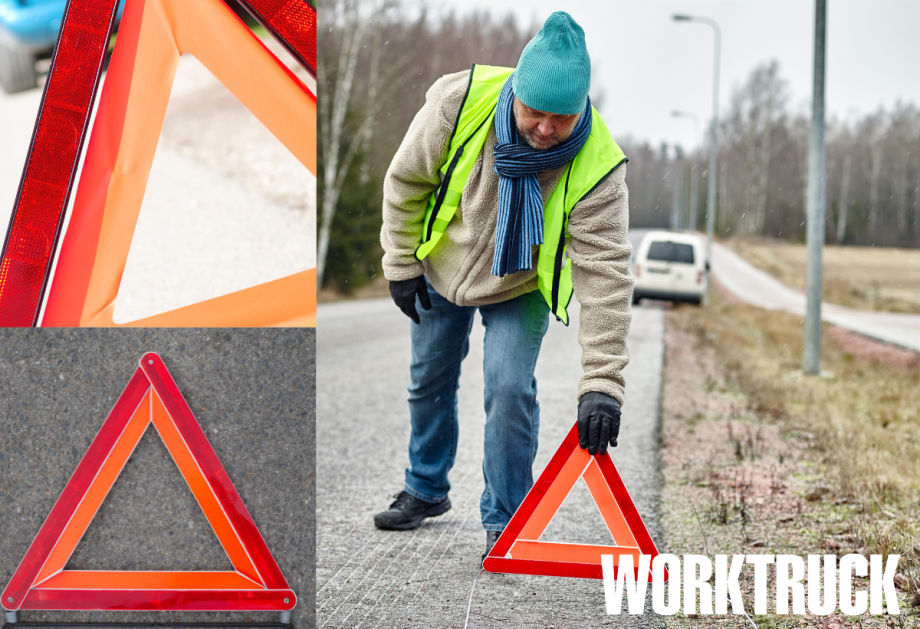
Do you know what the pieces of emergency equipment are?
Photo: Canva
3 min to read
Regulations issued by FMCSA are published in the Federal Register and compiled in the U.S. Code of Federal Regulations (CFR). What regulation covers emergency equipment that must be carrier in your truck? As part of those regulations, section 393.95 requires every bus, truck, and truck tractor to have specific emergency equipment.
Failing to provide this equipment puts the vehicle, driver, and public at risk, and the carrier can be cited and fined during a roadside inspection. So, what emergency equipment must be in your truck? Do you know what the necessary pieces of emergency equipment?
What Work Truck Fleets Need to Know About Emergency Equipment
The following frequently asked questions summarize the emergency equipment requirements:
1. Are non-CDL CMVs subject to the emergency equipment rule?
Yes. The rule applies to the general definition of commercial motor vehicle (CMV) in §390.5, representing several vehicle types, including those that do not require a commercial driver’s license.
2. What type of fire extinguisher do we need in our CMV?
The regulations require that you use either a single extinguisher with an Underwriter’s Laboratories rating of 5 B:C, or two extinguishers rated at 4 B:C or more. Regarding vehicles used in the transportation of placarded hazardous materials, the extinguisher rating must be 10 B:C or more. Exceptions exist for driveaway-towaway operations.
3. How often are CMV fire extinguishers inspected?
The driver must inspect fire extinguishers and other emergency equipment daily (§392.7, §392.8). The driver must be satisfied that the equipment is in good working order.
A fire extinguisher must have a visual indicator to determine if it is fully charged. Drivers must also check to ensure it is securely mounted in a location that is readily accessible.
4. What are acceptable warning devices?
Though reflective triangles are most common, the regulations allow the use of three types of warning devices for stopped vehicles:
3 bidirectional emergency reflective triangles;
6 road flares, each capable of burning for 30 minutes; or
3 liquid-burning flares, each capable of burning for 60 minutes.
Flame-producing devices are prohibited on vehicles carrying explosives, a flammable gas, a flammable liquid, or any vehicle using compressed gas as a motor fuel. Be sure you know how long you must deploy your warning devices if you are stopped on a road or shoulder (within 10 minutes of stopping).
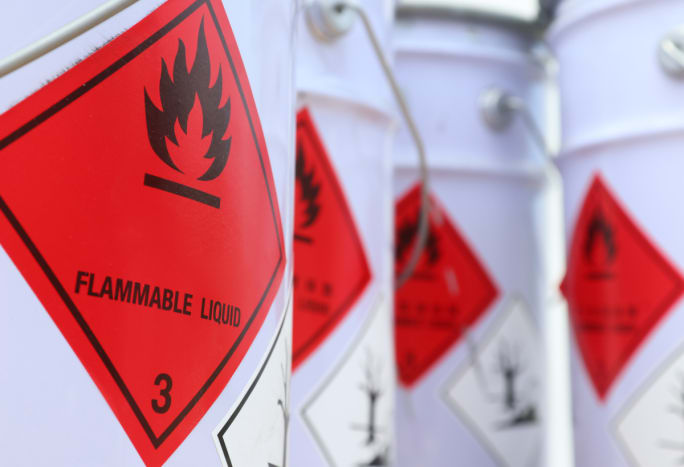
Flame-producing devices are prohibited on vehicles.
Photo: Canva
5. How are warning devices positioned?
The driver must set out emergency warning devices within ten minutes if the CMV is stopped on the traveled portion or the shoulder of a highway for any cause other than necessary traffic stops.
Placement of the warning devices varies according to the location...
Two-lane road:
On the traffic side of the vehicle about 10 feet from the front or rear, depending on traffic direction;
About 100 feet behind, and
About 100 feet ahead of the vehicle on the shoulder or in the lane the vehicle is in.
Two-lane road:
10, 100, and 200 feet from the rear of the vehicle, toward the approaching traffic.
Within 500 feet of a hill, curve, or obstruction:
The 100 or 200 feet can be extended to up to 500 feet for a hill, curve, or other obstruction.
6. Are spare fuses required?
Spare fuses must be kept in any power unit that uses fuses to operate any required equipment. There must be at least one spare fuse of each type/size needed to power accessories, such as lights and wipers.
7. Do the Federal Motor Carrier Safety Regulations require first-aid kits?
Although state requirements may vary, no federal regulations require first-aid kits in commercial motor vehicles.
Other considerations
As a best practice, many carriers have their vehicles carry additional emergency items, such as spare light bulbs, windshield washer fluid, coolant, and engine oil.
Subscribe to Our Newsletter
More Safety
When Work Trucks Under 26,001 Pounds Need IRP Registration
Think trucks under 26,001 pounds are automatically in the clear when it comes to IRP? Not always. Learn where lighter vehicles can still run into trip permit, apportioned registration, and IFTA compliance requirements when crossing state or provincial lines.
Read More →
Volvo Trucks Releases New Safety Recommendations for Traveling with Pets
One of the most important recommendations for professional drivers traveling with pets is to ensure pets are properly restrained while the truck is moving. Other tips are available in the new guide from Volvo Trucks North America and Center for Pet Safety.
Read More →
API Issues Refueling Safety Guidelines
The American Petroleum Institute offers a list of safe vehicle refueling guidelines, including ways to avoid potential problems with static electricity discharges in fall, winter, and early spring.
Read More →
Winter Fleet Prep: Expert Tips to Keep Vehicles Running Smoothly
Cold weather can expose weak batteries, tires, fuel systems, and maintenance gaps fast. Use this winter fleet checklist to prepare trucks and drivers before temperatures drop.
Read More →
When a Work Truck Breaks Down, the Job Can Stop, Too
A work truck breakdown can stop more than the vehicle. Discover how payloads, jobsites, and specialty equipment change the roadside response.
Read More →
What Stronger Long-Term Fleet Service Partnerships Actually Require
Fleet service partnerships rarely fall apart all at once. Learn the three warning signs that trust is eroding and what fleets and providers can do before downtime, frustration, and lost revenue follow.
Read More →
Applause & TRUCE Software Partner to Improve Driver Safety Through AI-Powered Telematics & Employee Performance Management
Applause has integrated TRUCE driving metrics directly into its employee-first performance and safety platform that transforms mobile devices into AI-powered telematics.
Read More →
How Detroit Assurance with Active Brake Assist Works
Do you want to see what it is like to experience Detroit Assurance’s Active Brake Assist? In this video, Work Truck will put you in the cab to see how it all works and then hear more details from DTNA’s Mike Young.
Read More →
Get Left of Loss: A 5-Step Workplace Violence Prevention Framework for Fleet Operators
Violence risks do not stop at the driver’s door. Learn five practical steps fleets can take to spot threats early and protect workers before loss occurs.
Read More →
Sponsored•July 17, 2026
How Better Visibility Cut Speeding Violations by 48%
Fleet leaders don't need more data, they need clearer visibility into what the data is saying. This case study explores how one utility replaced speeding-event counts with a single metric — miles driven in violation — to strengthen safety and significantly reduce speeding violations.
Read More →