





Fleet FAQ: Do I Need a U.S. DOT Number?
Second Chances: How to Upgrade Your Safety Rating
An unfavorable compliance review can result in a public relations nightmare, high insurance rates, and difficulty in attracting quality drivers. But motor carriers have an opportunity to ask for a do-over.
August 31, 2023
What you need to know to upgrade your safety rating.
Source: Work Truck
4 min to read
An unfavorable compliance review (CR) can result in a public relations nightmare, high insurance rates, and difficulty in attracting quality drivers. But all hope is not lost for those earning a poor safety rating.
Motor carriers have an opportunity to ask for a do-over.
Safety Rating Process
During a CR, the Federal Motor Carrier Safety Administration (FMCSA) scores a motor carrier’s compliance using a safety fitness standard. The agency looks at noncompliance with the regulations and the carrier’s overall safety management processes.
Following a CR, the FMCSA provides the motor carrier with:
A list of deficiencies discovered during the audit (with the expectation that the carrier will take corrective actions); and
A safety rating based on the safety fitness model.
The FMCSA assigns the motor carrier one of three possible ratings:
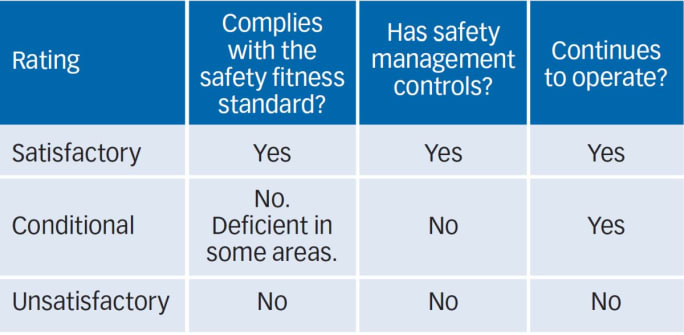
Safety ratings according to FMCSA.
Source: JJ Keller
The FMCSA will send a written notification of the safety rating to the motor carrier within 30 days following the completion of the compliance review. The ratings are also publicly available through the SAFER Website.
What Affects the Safety Rating
The following factors can determine the safety rating, according to FMCSA:
Adequacy of safety management controls.
Frequency and severity of regulatory violations.
Frequency and severity of driver/vehicle regulatory violations identified during inspections of motor carrier operations in commerce and, if the motor carrier operates in the United States, or in Canada and Mexico.
Number and frequency of out-of-service driver/vehicle violations of motor carrier operations in commerce and, if the motor carrier operates in the United States, or operations in Canada and Mexico.
Increase or decrease in similar types of violations discovered during safety or compliance reviews.
For motor carrier operations in commerce and, if the motor carrier operates in the United States, of operations in Canada and Mexico: frequency of accidents; hazardous materials incidents; accident rate per million miles; indicators of preventable accidents; and whether such accidents, hazardous materials incidents, and preventable accident indicators have increased or declined over time.
Number and severity of violations of CMV and motor carrier safety rules, regulations, standards, and orders that are both issued by a State, Canada, or Mexico and compatible with Federal rules, regulations, standards, and orders.
Second Chances for Unsatisfactory Ratings
If a motor carrier receives a conditional or unsatisfactory rating, it may request a rating change at any time. The motor carrier needs to submit a written request to the FMCSA Service Center responsible for the geographic region where the carrier's main business location is situated.
The FMCSA would expect to see a safety management plan to address the violations discovered during the CR.
Based on the contents of the plan, the FMCSA may issue an improved safety rating.
What is a Safety Management Plan?
There is no such thing as an “off-the-shelf” safety management plan. The needs of each carrier will be different, and plans vary depending on:
Reasons leading to the rating,
Steps taken to correct the issues, and
How far the carrier is into the process.
A safety plan should include:
Steps taken to identify the deficiencies;
Mechanisms put in place to correct shortcomings and stop the violations from recurring (e.g., policies and procedures, assigned roles and responsibilities, improved auditing, etc.);
Company training or use of outside experts to assist in training; and
A statement, accompanied by documentation, showing that a deficiency has been corrected.
Examples of documentation include:
An internal or external audit verifying that the violations are no longer occurring; and/or
Roadside inspection reports showing no violations in the area in question.
FMCSA’s Decision
The FMCSA provides its decision within 30 to 45 days of receiving a request for a rating change. The safety rating is upgraded if the FMCSA believes the carrier meets its safety standard due to corrective actions or remains in place if the carrier does not demonstrate problems have been corrected.
When a carrier is denied an upgraded safety rating, it can continue to make documented improvements to its safety program to ask for yet another review of its safety rating.
Editor's Note: This article was originall published on 3/0/20 and updated on 9/6/23.
Subscribe to Our Newsletter
More Safety

Volvo Trucks Releases New Safety Recommendations for Traveling with Pets
One of the most important recommendations for professional drivers traveling with pets is to ensure pets are properly restrained while the truck is moving. Other tips are available in the new guide from Volvo Trucks North America and Center for Pet Safety.
Read More →
API Issues Refueling Safety Guidelines
The American Petroleum Institute offers a list of safe vehicle refueling guidelines, including ways to avoid potential problems with static electricity discharges in fall, winter, and early spring.
Read More →
Winter Fleet Prep: Expert Tips to Keep Vehicles Running Smoothly
Cold weather can expose weak batteries, tires, fuel systems, and maintenance gaps fast. Use this winter fleet checklist to prepare trucks and drivers before temperatures drop.
Read More →
When a Work Truck Breaks Down, the Job Can Stop, Too
A work truck breakdown can stop more than the vehicle. Discover how payloads, jobsites, and specialty equipment change the roadside response.
Read More →
What Stronger Long-Term Fleet Service Partnerships Actually Require
Fleet service partnerships rarely fall apart all at once. Learn the three warning signs that trust is eroding and what fleets and providers can do before downtime, frustration, and lost revenue follow.
Read More →
Applause & TRUCE Software Partner to Improve Driver Safety Through AI-Powered Telematics & Employee Performance Management
Applause has integrated TRUCE driving metrics directly into its employee-first performance and safety platform that transforms mobile devices into AI-powered telematics.
Read More →
How Detroit Assurance with Active Brake Assist Works
Do you want to see what it is like to experience Detroit Assurance’s Active Brake Assist? In this video, Work Truck will put you in the cab to see how it all works and then hear more details from DTNA’s Mike Young.
Read More →
Get Left of Loss: A 5-Step Workplace Violence Prevention Framework for Fleet Operators
Violence risks do not stop at the driver’s door. Learn five practical steps fleets can take to spot threats early and protect workers before loss occurs.
Read More →
Sponsored•July 17, 2026
How Better Visibility Cut Speeding Violations by 48%
Fleet leaders don't need more data, they need clearer visibility into what the data is saying. This case study explores how one utility replaced speeding-event counts with a single metric — miles driven in violation — to strengthen safety and significantly reduce speeding violations.
Read More →
13 Safe Driving Tips for Commercial Vehicle Drivers
Make sure you are spending time on the road safely with these important tips.
Read More →