





Related News: SEA Electric Opens California-Based Operation
SEA Electric Puts Commercial Trucks Onto Cleaner Path
A maker of all-electric power systems, SEA Electric can customize new cab chassis or convert existing ones for the light-, medium-, and heavy-duty truck classes.
August 2, 2021
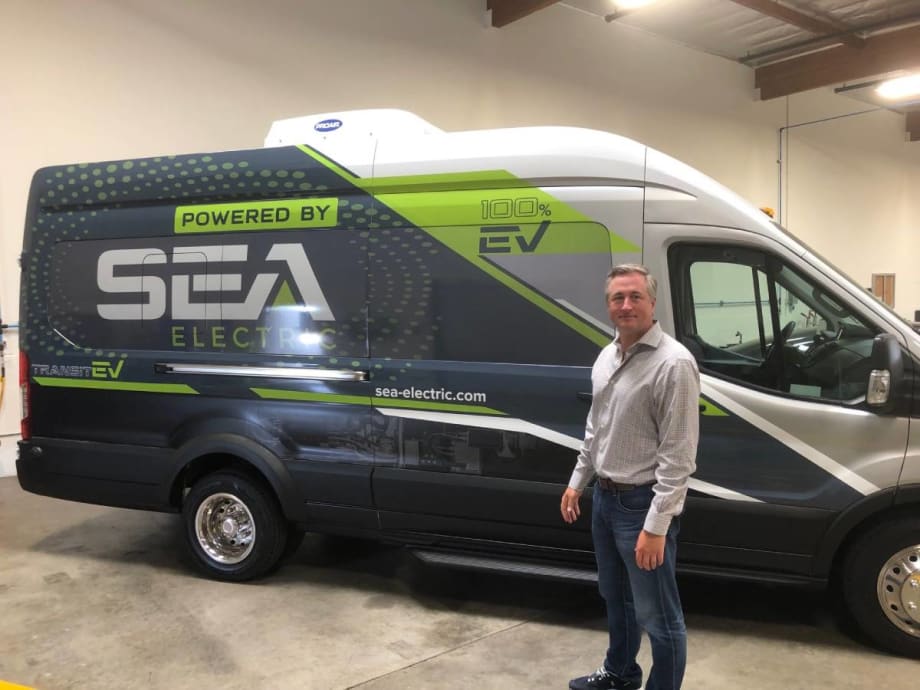
SEA Electric President of the Americas Mike Menyhart with a modified Ford Transit van that helps promote the company's battery-based power drive systems that can be adapted to and assembled within a variety of truck sizes and weights.
Photo: Martin Romjue / Charged Fleet
7 min to read
While new electric passenger vehicles command most of the industry attention, SEA Electric has developed products to electrify commercial trucks and buses that meet the specific needs of fleet customers.
Their power systems can be applied to most commercial truck and bus models, saving money for fleets pursuing electrification while helping them meet the goals of zero emissions.
Instead of building a new electric truck from scratch, SEA Electric specializes in the more direct and affordable alternative of providing efficient power-systems for electric trucks and buses while partnering with the OEMs. Its patented, proprietary SEA-Drive power-systems allow fleet customers the flexibility to convert most makes and models of commercial OEM trucks.
SEA Electric specializes in the more direct and affordable alternative of providing efficient power-systems for electric trucks and buses while partnering with the OEMs. Its patented, proprietary SEA-Drive power-systems allow fleet customers the flexibility to convert most makes and models of commercial OEM trucks.
Photo: SEA Electric
Lower-Cost EV Power
SEA Electric enables the customer to power new vehicles as well as repower existing vehicles, creating the ability to achieve electrification faster, especially during the current chassis and chip shortage worldwide.
Repowering meets the demand of a somewhat overlooked industry niche that prefers a specific or customized version of an EV without having to pay the higher prices of a full-on new electric vehicle. Electrifying a commercial truck by dropping an electric power system into the chassis is far less costly than buying an electric truck.
To accommodate the Class 3-7 trucks that comprise most of its market, the company offers four key patented proprietary power drive systems (branded as SEA-Drive 70,100, 120, and 180) that can be adapted to and assembled within a variety of truck sizes and weights.
SEA Electric estimates its power system can decrease total cost of ownership (TCO) by 50% over 10 years. When considering the price differential between electric and conventional chassis, the payback period is 1.6 years for one large fleet customer, with no incentives.
During a recent interview and tour of its California-based North American headquarters in Torrance, President of the Americas Mike Menyhart explained how SEA Electric applies scalable, proven solutions for the Class 3-7 truck range, where the company forecasts the most robust growth. SEA also can repower and convert existing trucks, which some clients prefer based on overall value and cost savings.
“There are many different types of trucks we can power, which allows us to electrify entire fleets for our customers across a diverse set of applications across multiple OEMs,” Menyhart said. “Our solution is highly modular, easily assembled, and powered by our differentiated proprietary software.”
To drive efficiencies in the supply chain, SEA uses the same power steering, braking, A/C and instrument cluster, and varies battery size depending on the use case. This reduces total cost of ownership for a wide variety of trucks.
SEA relies on assembly partners to scale its productivity and meet the growing demands for electric fleets in the delivery vehicle and school bus industries. The company now has an estimated backlog of about 600 orders. Two-thirds of the growth is coming from the U.S. Since 2017, it has put 200 vehicles on the road in six countries across four continents. That has generated 1 million+ miles of telematics data.
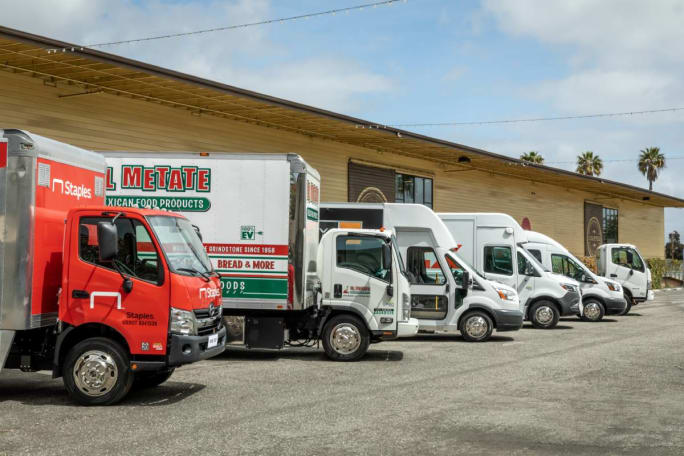
A SEA Electric lineup of trucks electrified by their power driven systems, which can be applied to most commercial truck and bus models.
Photo: SEA Electric
Fleet Options
Fleet companies often work on tight margins, so electrification has to fit within the economics of their business, Menyhart said. As battery prices continue to decline, electric options will become more competitive and feasible. Fleets and OEMs are looking to partner with SEA Electric, which has electric solutions that can accommodate multiple makes, models, and brands.
“Large fleet operators spend a lot of design time and money to develop how the truck is configured to support their drivers,” Menyhart said. “A lot of companies like the fact we play well within the ecosystem of OEMs they are familiar with. We don’t have to disrupt what is working for them today to work with us.”
For example, SEA will take a semi-knockdown cab kit from a manufacturer such as Hino and provide a fully assembled power-system to fit the chassis for electrification.
“We will continue to use upfitters to scale our business,” he said. “When we have strategic clients where we expect high volumes, we will build our own assembly facilities to support growth and drive efficiencies. Their products can roll off the assembly line right into ours for electrification.”
Among the companies using e-platforms from SEA Electric are FedEx Ground, UPS, and Woolworth’s in Australia.
School Bus Potential
One market with potential for SEA are school bus fleets, said Menyhart, adding a school bus is built on the type of medium-duty truck the company knows how to power.
With the average electric school bus costing hundreds of thousands of dollars, SEA Electric plans to pursue the market for powering new and existing buses from established OEMs, Menyhart said.
Recycling school buses into electric versions creates a viable, cleaner, and more reliable secondary market for them, while sparing the carbon emissions of older, used ICE and diesel school buses that may not always be kept up to standards, said Menyhart, citing the World Health Organization’s labeling of diesel as a carcinogen.

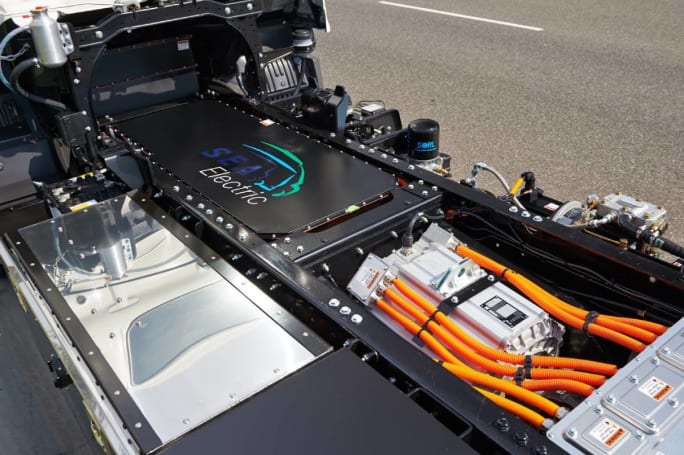
The largest component of the power drive systems is the battery, such as an SE120 battery that provides 138 k/w of power and is packed into two segments fitting within frame rails for safety.
Photo: SEA Electric
Power Systems
Each power system has a control box run with software that is the brains of the entire platform, Menyhart said. “The technology is the special sauce of what we’ve created. It’s an overarching power system that runs everything from steering to instrument clusters to the motor.”
The largest component is the battery, he said, while walking through the 12,000 square-foot Torrance facility. He pointed to an SE120 battery that provides 138 kilowatts of power and is packed into two segments fitting within frame rails for safety. By working with a medium voltage solution, SEA Electric has engineered out the need for thermal management, which reduces the costs and weight.
The software routes energy to all the ancillary components as needed. It only sends power to when it’s actually turning or running, such as power steering. “It allows us to get more out of the battery and range,” Menyhart said. “We also have a much smaller radiator than a lot of solutions in this space. The software treats every ancillary as a separate component, and it only sends a level of cooling required for that element.”
SEA Electric has one complete power system patent with 20 individual claims that covers its capabilities. The company has pursued it in 16 different jurisdictions, with approval in seven. It is still working on approvals in the U.S. and Europe.

Among the companies using e-platforms from SEA Electric are Fed Ex Ground, UPS, and Woolworth’s in Australia.
Photo: SEA Electric
Reducing Range & Repair Anxieties
SEA-Drive systems can provide up to 200 miles range under optimal conditions, but most of its commercial clients have duty cycles below 80 miles per day based on telematics data. While the company could provide trucks with 250+ mile ranges, it’s not needed and would require additional costs and equipment.
“We remove range anxiety by analyzing the telematics data and ensuring we are installing the system that will exceed the duty cycle requirements,” Menyhart said. “We could scale up batteries when needed but are focused on reducing and optimizing fleet costs.”
Last mile delivery is a defined duty cycle with known routes and weight requirements. To achieve the best economics, SEA Electric tries not to under engineer or over-engineer the power systems, he said. “We have built this solution for the medium-duty last-mile delivery space from day one. Everything is optimized and purpose built.”
SEA Electric’s telematics data helps accurately identify maintenance work and spare part needs. The company checks on its vehicles quarterly to evaluate connections and analyze telematics data. This helps minimize maintenance and maximize vehicle performance. “The data shows that EV trucks require a lot less service and general maintenance,” Menyhart said.
In one case, SEA engineers could remotely see battery modules on a truck weren’t charging properly, but it wasn’t an immediate setback to using the truck. One month later during a quarterly inspection, technicians needed only 15 minutes to replace the module. “There wasn’t a need to take the vehicle off the route,” Menyhart said. “You get more on-the-road time for electric vehicles when much of the servicing can be done in a depot with a laptop plugged into the vehicle.”
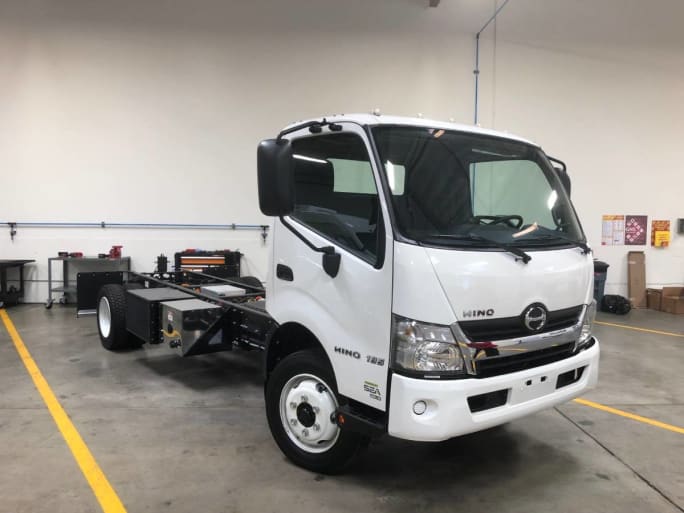
In one example, SEA will take a semi-knock down cab kit from a manufacturer such as Hino and provide a fully assembled power-system to fit the chassis for electrification.
Photo: Martin Romjue / Charged Fleet
Telematics Enhance EV Usage
In mining data, SEA uses a private-label telematics system which so far has provided 1 million miles of insights on client usages. “The data gets richer over time as it accumulates in the C-cloud and it’s well positioned to provide information to clients,” he said.
Likewise, the telematics helps inform the engineering process, which SEA uses to refine and enhance its products every day. “We’re 100% committed to offering the lowest total cost of ownership, the highest reliability and the lowest weight. And we look at all of the different factors on whether data telling us to do something better or more efficiently.”
He added, “We will be well positioned to provide additional services to fleets over time.”
Topics:Electric TrucksChassis CabTruck BatteriesMedium-Duty TrucksCargo VansGreen FleetVehicle ResearchSmall Fleet
Originally posted on Charged Fleet
Subscribe to Our Newsletter
More Green Fleet

Fleet Forward Conference Introduces One-Day Passes for 2026
New one-day registration gives fleet professionals the flexibility to attend Tuesday, Wednesday, or Thursday, with passes available for $199 through Sept. 18.
Read More →
CALSTART Rebrands as Catalyst Mobility, Will Combine with Forth in 2027
CALSTART has rebranded as Catalyst Mobility and will combine with Forth at the start of 2027. The new organization said it is poised to become one of the world's largest, strongest, and most impactful clean transportation nonprofits.
Read More →
Electric Truck and Charging Programs to Boost Sustainability at NY & NJ Ports
Together, the Port Authority of New York and New Jersey and CALSTART will electrify drayage and terminal operations serving the East Coast’s busiest container port. A pair of incentive programs totaling $45 million has launched to accelerate adoption of zero-emission drayage trucks and terminal tractors.
Read More →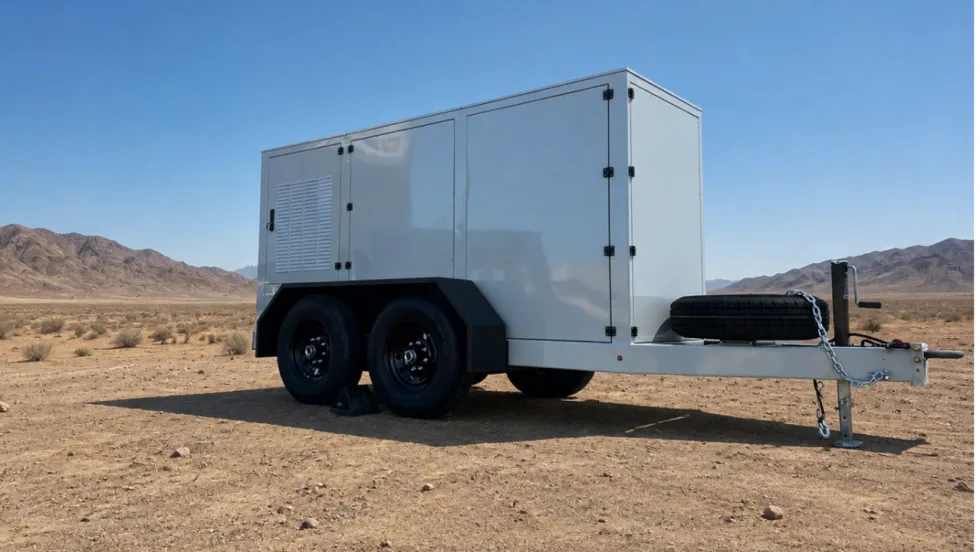
Xos Hub Surpasses One Gigawatt-Hour of Energy Delivered in the Field
A single Xos Hub has surpassed one gigawatt-hour of energy across more than 33,600 charging sessions in the field, demonstrating performance that supports Xos' expansion across new products and markets.
Read More →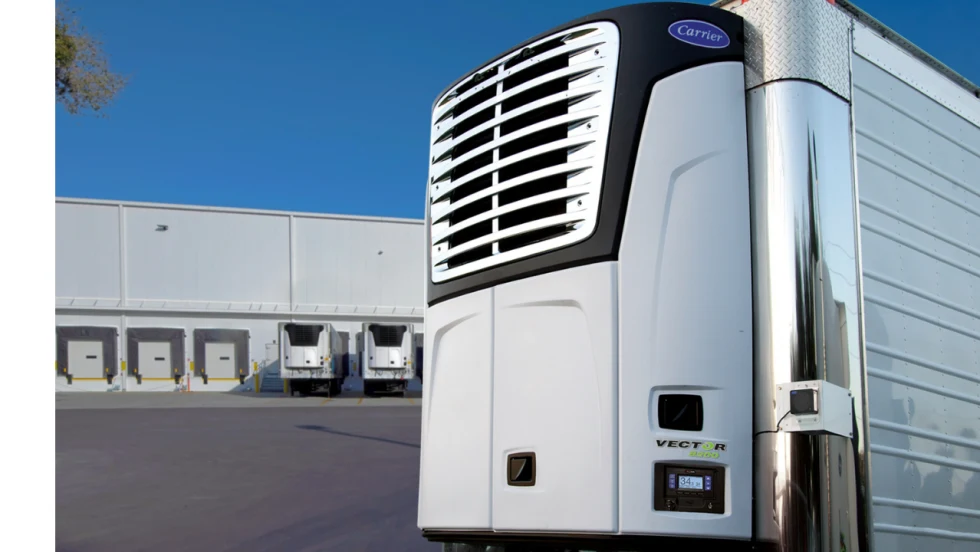
Carrier Transicold Launches All-Electric Vector 8200 TRU for Diesel-Free On-Site Cold Storage
Carrier Transicold’s first engineless multi-temperature TRU helps fresh- and frozen-food fleets add supplemental cold storage capacity during seasonal peaks.
Read More →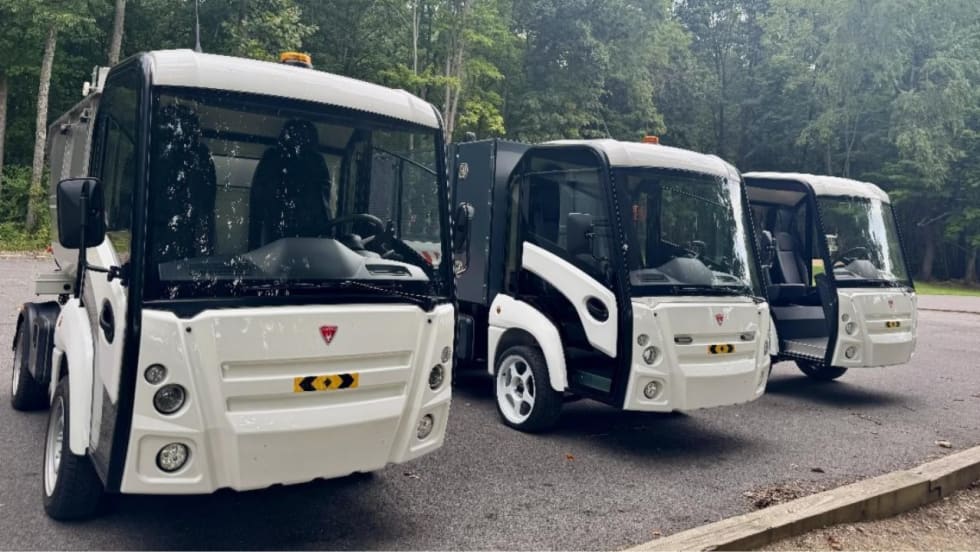
Narro Trucks Introduces Electric Utility Vehicle
Narro Trucks officially launched its operations on Aug. 20 and hosted a ride and drive to showcase its electric truck, which will be produced in Virginia.
Read More →
Samsung SDI Takes Full Control of GM Battery JV as Indiana Plant Pivots to Energy Storage
Samsung SDI is taking full control of its Indiana battery plant with GM, marking a major shift from the EV-focused joint venture Charged Fleet first covered in 2023.
Read More →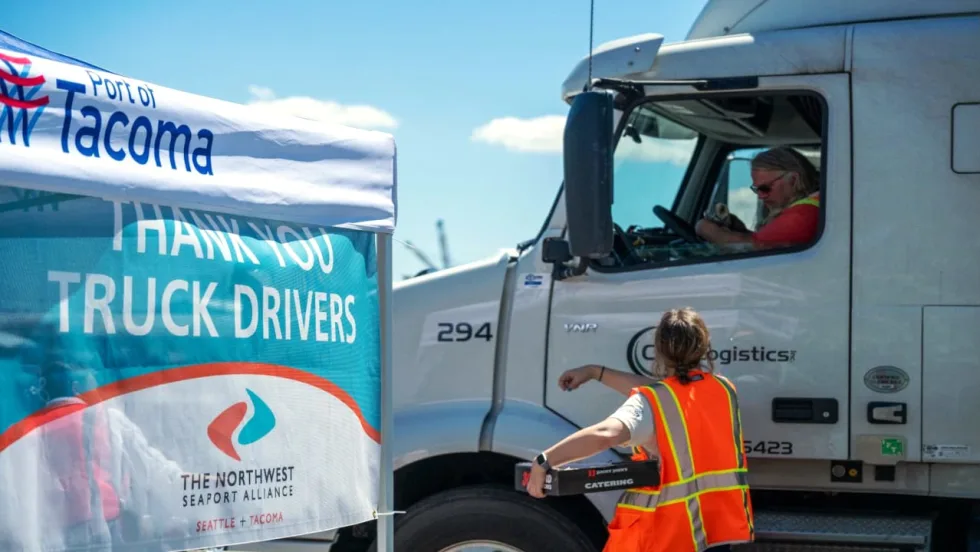
NWSA Taps CALSTART to Administer Zero-Emission Drayage Assistance Program
CALSTART will provide free technical assistance services to drayage fleets serving the Ports of Seattle and Tacoma and looking to transition to cleaner technologies and help decarbonize freight hubs.
Read More →
EV Fleet Reality Check: What Operators Wish They Knew Before Electrifying Their Work Vans
Electric work truck upfits bring new compatibility questions. Learn how parts availability, OEM guidance, power demands, and route planning can affect fleet performance.
Read More →
Peterbilt Expands Sourcewell Partnership with Electric Vehicle Lineup
Peterbilt Motors Company’s cooperative purchasing agreement with Sourcewell and its Canadian partner, Canoe Procurement Group, now includes including Peterbilt's battery-electric vehicle lineup.
Read More →