




Maintaining a Clear Perspective: 5 Tips for Safety
Easily forgotten, windshield wipers play a critical role in truck safety.

Proper wiper system maintenance shouldn’t be neglected. Research has shown that poor visibility is a significant contributor to many accidents.
Photo: Valeriia Miller from Pexels
Your drivers have probably all experienced that moment of panic while driving in traffic: clear day, dry roads, then suddenly a storm out of nowhere. The heavens open and it starts to rain. Hard. So hard, the windshield is overwhelmed by a wall of water, they are blinded, and panic sets in.
It’s at times like these that windshield wipers become a driver’s biggest ally. When they reach down to turn the wipers on, they expect them to clear all that water in a matter of seconds, all while praying they won’t rear-end the vehicle ahead. Which is why well-maintained wipers are so critical to safety and could even impact your fleet safety record.
Importance of Wiper Reliability
Wiper reliability is no accident. They’ve been around as long as trucks first started plying highways over a hundred years ago. Today, they are considered a safety device which must meet FMVSS requirements which includes testing conditions defined in SAE J903 that confirms speed, coverage and reliability for each type of vehicle system design.
Over the years, there have been many refinements to make them more efficient - better blade material, larger coverage area, and even automatic sensing to engage automatically and adjust speed to rain/spray volume.
Ultimately, the most important component for reliability is the motor. If it fails or underperforms, all improvements to the rest of the system don’t matter. Unfortunately, not all motors are the same. Due to the quantity of wiper motors on the market, they have become a commodity and many are built as cheaply as possible.
Ideally, motors and wiper systems are designed to suit the vehicle type. A well-designed system has the right gearing and motor rating to ensure it isn’t overtaxed by the size of the wipers. If you are having a lot of early failures of motors or wiper components, it could be a result of a poorly defined solution. That’s why our engineers spend a lot of time with vehicle manufacturers getting this specification right, and thoroughly testing it to FMVSS and SAE standards.
But proper wiper system maintenance shouldn’t be neglected. Research has shown that poor visibility is a significant contributor to many accidents. If one of your trucks was involved in an accident, your wiper maintenance records could be under scrutiny and you could be liable if wiper operation was a factor in the accident.
To ensure wiper reliability and reduce accident risk in wet and wintry driving conditions, here are five key things to focus on:
1. Maintain a Regular Testing Protocol
When trucks visit the shop for regularly scheduled maintenance, ensure wipers are checked and tested. This should include an inspection of blades for cuts or damage and running the wipers at each speed. Replace any damaged components. Also ask drivers to proactively report any issues they have with wiper operation or poor visibility. If you have repeat problems with some systems, consider retrofitting with a more reliable wiper motor/arm assembly suited to the vehicle and its windshield design.
2. Optimize Windshield Coverage
For best visibility, it’s important to maximize the windshield area the wipers will cover. When wipers are initially specified, engineers consider a number of factors:
The breakaway curve, or the place where the curve of windshield glass becomes too great to wipe.
The daylight opening (DLO), which is the total area of the windshield glass that you can see through from the inside edges of the moulding.
Whether to use a pantograph (where the wiper blade stays parallel to the side of the glass) or radial (arced sweep pattern) type. A radial sweep pattern is best when your glass is wider than it is tall, which is most common. A pantograph pattern works better on tall, narrow glass.
Ideally, the wiper length and sweep pattern covers as much of the daylight opening as possible when factoring in the curvature of the glass and the amount of breakaway curve you are dealing with. If the standard wipers on your trucks don’t provide good coverage, consider retrofitting with systems that increase it.
3. Spec the Right Blades
Wiper blades come in a wide range of styles and compounds. Just like tires, which come in different compounds, the softer the compound, the faster the wear. You need to balance the need for a good “clean” offered by softer compounds with the longer life of a harder compound. If you operate in colder parts of the country, consider using different blades during the winter which are better able to handle snow, sleet, and ice. At the end of winter, you can then replace with blades more suited to rain-only events.
4. Make Sure You Have Adequate Circuit Protection
Wiper motors will draw more power under load when driving in heavy snow or windy conditions. To avoid premature circuit breaks, use the right breakers. 12-volt DC motors draw about 5 amperes during normal use. We recommend you use a 10 amp circuit breaker for one 12-volt DC motor, or a 15 amp circuit breaker for a two motor system. For 24-volt DC motors, use a 5 amp breaker for one motor and a 7 amp breaker for two.
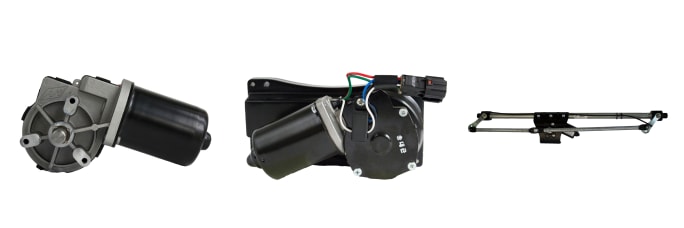
The most important wiper component for reliability is the motor. If it fails or underperforms, all improvements to the rest of the system don’t matter.
Photo: AM Equipment
5. Specify Motors Which Suit The Application
Wiper motors are rated by stall torque. This is usually expressed in Newton meters (Nm). It’s important to have motors with enough torque to handle the type of wiper application. Here are our recommendations:
A 38 Nm motor is recommended for arm and blade combinations of 28” (710 mm) and longer and for multiple arms and blades driven by one motor.
A 30 Nm motor is suitable for arms and blades in the 20” to 28” (500 mm to 710 mm) range.
A 12 Nm motor is appropriate for arms and blades in the 16” to 20” (400 mm to 500 mm) range.
An 8 Nm motor works well for small arm and blade combinations of 16” (400 mm) and under.
Note that motors of 20 Nm or less often have an internal linkage to make the necessary oscillating motion.
Good maintenance and specification of wiper systems serves the dual purpose of reducing accident risk and keeping drivers happy. Both of these go straight to your company’s bottom line, which should make quality wiper systems a high priority in your operation.
More Safety
When Work Trucks Under 26,001 Pounds Need IRP Registration
Think trucks under 26,001 pounds are automatically in the clear when it comes to IRP? Not always. Learn where lighter vehicles can still run into trip permit, apportioned registration, and IFTA compliance requirements when crossing state or provincial lines.
Read More →
Volvo Trucks Releases New Safety Recommendations for Traveling with Pets
One of the most important recommendations for professional drivers traveling with pets is to ensure pets are properly restrained while the truck is moving. Other tips are available in the new guide from Volvo Trucks North America and Center for Pet Safety.
Read More →
API Issues Refueling Safety Guidelines
The American Petroleum Institute offers a list of safe vehicle refueling guidelines, including ways to avoid potential problems with static electricity discharges in fall, winter, and early spring.
Read More →
Winter Fleet Prep: Expert Tips to Keep Vehicles Running Smoothly
Cold weather can expose weak batteries, tires, fuel systems, and maintenance gaps fast. Use this winter fleet checklist to prepare trucks and drivers before temperatures drop.
Read More →
When a Work Truck Breaks Down, the Job Can Stop, Too
A work truck breakdown can stop more than the vehicle. Discover how payloads, jobsites, and specialty equipment change the roadside response.
Read More →
What Stronger Long-Term Fleet Service Partnerships Actually Require
Fleet service partnerships rarely fall apart all at once. Learn the three warning signs that trust is eroding and what fleets and providers can do before downtime, frustration, and lost revenue follow.
Read More →
Applause & TRUCE Software Partner to Improve Driver Safety Through AI-Powered Telematics & Employee Performance Management
Applause has integrated TRUCE driving metrics directly into its employee-first performance and safety platform that transforms mobile devices into AI-powered telematics.
Read More →
How Detroit Assurance with Active Brake Assist Works
Do you want to see what it is like to experience Detroit Assurance’s Active Brake Assist? In this video, Work Truck will put you in the cab to see how it all works and then hear more details from DTNA’s Mike Young.
Read More →
Get Left of Loss: A 5-Step Workplace Violence Prevention Framework for Fleet Operators
Violence risks do not stop at the driver’s door. Learn five practical steps fleets can take to spot threats early and protect workers before loss occurs.
Read More →
How Better Visibility Cut Speeding Violations by 48%
Fleet leaders don't need more data, they need clearer visibility into what the data is saying. This case study explores how one utility replaced speeding-event counts with a single metric — miles driven in violation — to strengthen safety and significantly reduce speeding violations.
Read More →