




How to Know: Does My Driver Need a CDL?
To avoid fines and penalties for improper licensing, it’s imperative to understand the nuances behind which of your drivers need a commercial driver’s license. Here is a cheat sheet.

The best way to tell if a vehicle requires a CDL is its weight. Generally, all Class A, B, and C vehicles traveling on the interstate requires the license.
Photo: Lê Minh from Pexels
In order to protect your company from hefty fines, it’s essential to understand whether or not your drivers need a commercial driver’s license (CDL).
There’s a common misconception that CDLs only apply to tractor-trailers or large buses. In reality, the rules and regulations for who needs a CDL are more nuanced than that. They extend to many utility departments, municipalities, and more.
The penalties for driving without proper licensing can be severe for both driver and company. Not only that, but putting someone behind the wheel without the proper certification or training is extremely dangerous.
This article will explain what types of vehicles require a CDL, along with some ways you can ensure your drivers prevent accidents while behind the wheel.
What is a CDL & What are the Requirements?
Commercial driver’s licenses were made law on April 1, 1992. Since then, drivers of certain vehicles are required to obtain and hold a CDL from their state in order to drive interstate, intrastate, or foreign commerce.
Whether or not a vehicle requires a CDL is most often determined by weight. However, CDL requirements can also include hazardous materials and passenger capacity.
If a vehicle falls into any of the following categories, a driver needs the corresponding CDL license to drive it:
Class A - Any combination of vehicles that has a gross combination weight rating (GVWR) or gross combination weight of 26,001 pounds or more, inclusive of towed unit(s) with a gross vehicle weight rating or gross vehicle weight of more than 10,000 pounds.
Class B - Any single vehicle which has a gross vehicle weight rating or gross vehicle weight of 26,001 pounds or more, or any such vehicle towing a vehicle with a gross vehicle weight rating or gross vehicle weight that does not exceed 10,000 pounds.
Class C - Any single vehicle, or combination of vehicles, that does not meet the definition of Class A or Class B, but is either designed to transport 16 or more passengers, including the driver, or is transporting material that has been designated as hazardous under 49 U.S.C. 5103 and is required to be placarded under subpart F of 49 CFR Part 172 or is transporting any quantity of a material listed as a select agent or toxin in 42 CFR Part 73.
In sum, any vehicle that falls under Class A, B, or C (and is driven interstate, intrastate, or carrying foreign commerce) requires a CDL.
To obtain a CDL, a driver must pass a knowledge and skills test implemented by their state or state provider of CDLs. The test is usually done in the type of vehicle they will be driving for work.
What Is the Purpose Behind Requiring a CDL?
Based on the three license class types, a commercial vehicle is either:
Extremely heavy
Carrying a large number of people
Carrying hazardous materials
Any three of those spell disaster if an accident were to happen. Collisions involving them are more likely to be severe or even fatal. Therefore, it makes sense to ask more of these drivers.
However, just because a driver has their CDL does not mean they’re a safe driver. The test focuses heavily on rules and regulations. While that’s important for CDL drivers, it does not prepare them for being safe, defensive drivers.
Compliance Does NOT Equal Safety
Whether you have CDL or non-CDL drivers getting behind the wheel for you, you need to train them on specific safe driving techniques.
Remember, compliance does not equal safety. Safety training is about changing someone’s behavior. If you want to reduce your accidents, you should:
Assign online self-directed training at point of hire
Conduct in-person safety training for new-hires
Host monthly safety meetings focused on loss-leading indicators
Disperse frequent safety messaging to drivers in form of posters, safety e-blasts, etc.
Getting your driver’s the proper licensing and staying compliant is only half the battle. Preventing accidents, reducing your cost of loss, and saving lives is a whole different game all together.
About the Author: John Kuder is a senior instructional designer at Avatar Fleet, the creators of the non-CDL safety training course, The Fleet Safety Course.
Originally posted on Automotive Fleet
More Safety

Volvo Trucks Releases New Safety Recommendations for Traveling with Pets
One of the most important recommendations for professional drivers traveling with pets is to ensure pets are properly restrained while the truck is moving. Other tips are available in the new guide from Volvo Trucks North America and Center for Pet Safety.
Read More →
API Issues Refueling Safety Guidelines
The American Petroleum Institute offers a list of safe vehicle refueling guidelines, including ways to avoid potential problems with static electricity discharges in fall, winter, and early spring.
Read More →
Winter Fleet Prep: Expert Tips to Keep Vehicles Running Smoothly
Cold weather can expose weak batteries, tires, fuel systems, and maintenance gaps fast. Use this winter fleet checklist to prepare trucks and drivers before temperatures drop.
Read More →
When a Work Truck Breaks Down, the Job Can Stop, Too
A work truck breakdown can stop more than the vehicle. Discover how payloads, jobsites, and specialty equipment change the roadside response.
Read More →
What Stronger Long-Term Fleet Service Partnerships Actually Require
Fleet service partnerships rarely fall apart all at once. Learn the three warning signs that trust is eroding and what fleets and providers can do before downtime, frustration, and lost revenue follow.
Read More →
Applause & TRUCE Software Partner to Improve Driver Safety Through AI-Powered Telematics & Employee Performance Management
Applause has integrated TRUCE driving metrics directly into its employee-first performance and safety platform that transforms mobile devices into AI-powered telematics.
Read More →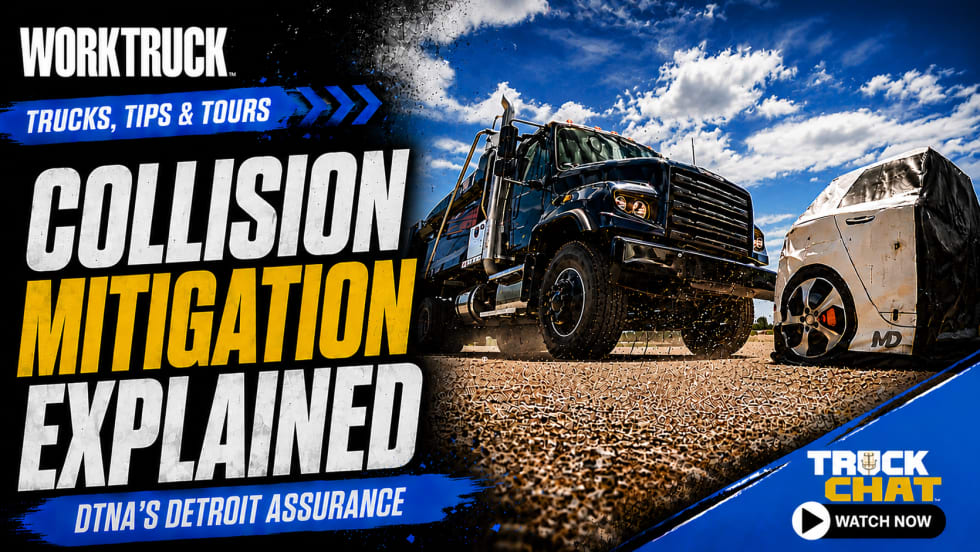
How Detroit Assurance with Active Brake Assist Works
Do you want to see what it is like to experience Detroit Assurance’s Active Brake Assist? In this video, Work Truck will put you in the cab to see how it all works and then hear more details from DTNA’s Mike Young.
Read More →
Get Left of Loss: A 5-Step Workplace Violence Prevention Framework for Fleet Operators
Violence risks do not stop at the driver’s door. Learn five practical steps fleets can take to spot threats early and protect workers before loss occurs.
Read More →
How Better Visibility Cut Speeding Violations by 48%
Fleet leaders don't need more data, they need clearer visibility into what the data is saying. This case study explores how one utility replaced speeding-event counts with a single metric — miles driven in violation — to strengthen safety and significantly reduce speeding violations.
Read More →
13 Safe Driving Tips for Commercial Vehicle Drivers
Make sure you are spending time on the road safely with these important tips.
Read More →