
Work Truck Logo
MenuMENU
SearchSEARCH

Forklift Safety Day: Do You Know These Top Tips?

National Forklift Safety day is June 13, 2023. It's important to prioritize safety for employees and the business. Here are the top forklift safety tips...

by Gavin Hale, PERC
June 13, 2023
Forklift Safety Day: Do You Know These Top Tips?

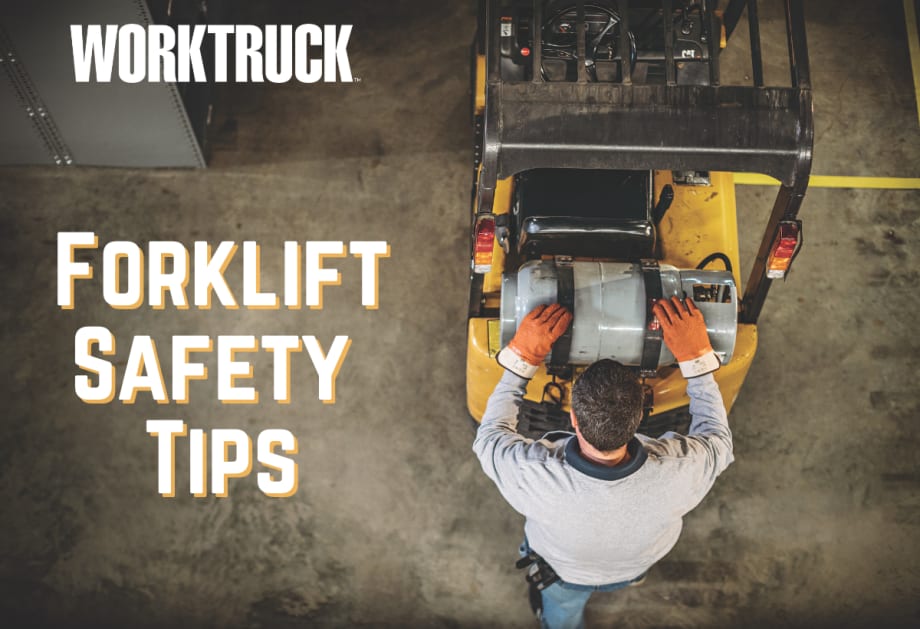
Keep safety a top priority when operating forklifts. 

Photo: PERC/Work Truck

4 min to read


Warehouses utilize forklifts daily to keep distribution networks operating efficiently — making forklift safety a top priority in the material handling industry.

When it comes to fueling the material handling markets, propane has a 90% market share of Class 4 and 5 forklifts.

Ad Loading...

Because of this, understanding proper propane safety practices should be a priority for crews across the country. With safety top of mind this June, below are tips for operators, floor workers, and truck drivers to stay safe around forklifts.

Universal Forklift Safety Tips

  • Complete routine equipment checks before operating and notify management of damages or problems.

  • Wear proper personal protective equipment (PPE) such as hard hats, protective footwear, eyewear, and high-visibility clothing on the warehouse floor and while operating a forklift.

  • Buckle up every time. Overturned forklifts are a leading cause of forklift-related accidents, according to the Occupational Safety & Health Administration. This may seem obvious, but it’s an essential tip to remember.

  • Move slowly and use the horn. Collisions could happen when vision is obstructed. Using the horn at every intersection will keep pedestrians and other operators safe.

  • Know your forklift’s weight capacity and adhere to it. Exceeding the weight capacity of a forklift significantly increases the risk of tipping and injury.

  • Lower, park, and set. Always lower the forks, use the parking brake, and set the controls to neutral when finished operating a forklift. Safely parking the machine reduces the risk of unintended movement and injury. Use wheel blocks to secure the forklift further, especially if parking on an incline.

  • Mind the ramp. Drivers should always carry a load pointing up an incline with their heads pointed in the direction they are going. If unloaded, keep the forks pointed downgrade.

  • Inspect forklift fleets regularly. Regular maintenance helps prevent unnecessary damage to the equipment and keeps employees safe.

  • Keep forklifts clean and free from excess oil and grease 

Warehouses, factory floors, and distribution centers have many moving parts as well as people coming and going. Managers can enhance their operations’ safety with bright floor markings, mirrors around corners, and ample signage throughout the property that identifies refueling stations. Additionally, regular safety reminders will keep employees safe.

Inspect the forklift and area regularly when operating the forklift.

Photo: Work Truck

Forklift Energy Sources

What are the forklift classifications?

Class I: Electric Motor Rider Trucks - Powered by electric motors and designed for indoor use on smooth surfaces.

Class II: Electric Motor Narrow Aisle Trucks - Designed for indoor use in narrow aisles or tight spaces. 

Class III: Electric Motor Hand Trucks or Hand/Rider Trucks - For indoor use in tight spaces to pallets or other materials short distances. 

Class IV: Internal Combustion Engine Trucks - Powered by gasoline, diesel, or propane engines and are designed for outdoor use on rough terrain. 

Class V: Internal Combustion Engine Trucks - Similar to Class IV forklifts but are equipped with cushion tires instead of pneumatic tires. 

Class VI: Electric and Internal Combustion Engine Tractors - Designed for towing trailers or carts in a warehouse or other indoor/outdoor setting. 

Class VII: Rough Terrain Forklift Trucks - Outdoor use on rough terrain, typically powered by gasoline, diesel, or propane engines, and have pneumatic tires.

There are three primary forklift energy sources — propane, diesel, and electric batteries — and each has a different set of considerations.

For example, diesel lifts can only be used outdoors due to dangerous exhaust emissions, whereas propane is safe indoors and out.

Ad Loading...

Both propane and electric lifts are safe to operate indoors, however, electric lifts require additional space considerations for recharging and battery maintenance, which can take up valuable space in the warehouse or distribution center.

Propane offers a quick, safe refueling process that does not require expensive infrastructure or charging equipment.

Refueling is as simple as swapping out an empty cylinder for a full one and getting back to work for crews operating propane forklifts.

Plus, well-maintained propane forklifts meet or exceed nationwide indoor air quality standards, which helps ensure operators’ safety.

Propane Forklift Safety Tips

Propane is one of the most common energy sources used to power forklifts. It’s important to note the following safety tips while operating with propane.

Ad Loading...
  • Inspect cylinders before operation. Check cylinders for rusting, dents, gouges, and leaks. Cylinders showing signs of wear or leaks shouldn’t be used and may need replacing, even within the cylinder’s requalification date.

  • Use proper lift techniques to place a cylinder onto a forklift and wear protective gloves. Carefully place the cylinder into the cradle, so the cylinder pin enters the locating hole in the cylinder collar. Once properly situated, secure the cylinder by tightening the brackets and check for leaks using a leak detection solution.

  • Secure the pressure relief valve on the cylinder. Before connecting, confirm the cylinder valve is closed. Once placed in the cradle, operators should check that the pressure relief valve fitting is roughly 180 degrees from the forklift’s locating pin. 

  • Firmly tighten the gas line to the service connection.

  • Close the service valves on cylinders when not in use. This helps prevent potential injury around internal combustion engines and unintended fuel loss. 

  • Store propane cylinders in a secure rack or cage. The cylinders should be stored horizontally with the pressure relief valves in the uppermost position, and operators should use proper lifting techniques when removing cylinders from storage and placing them onto a forklift. 

  • Propane cylinder storage racks must be located at a safe distance from heat or ignition sources, protected from the elements, and kept away from stairwells and high-traffic areas.

With proper signage, training, and storage, propane is a safe energy source to power forklifts year-round, indoors and out.

Remember to regularly review safety measures with forklift operators and workers, not just on Forklift Safety Day, but every day.

Strength Through Challenges: Bringing the Community Together

Want more safety tips for fleet management? Make sure to sign up for our Work Truck eNewsletters to get the latest info on safety, recalls, and more!  

About the Author: Gavin Hale is the vice president of business development for the Propane Education & Research Council. In his role, Hale leads business development efforts and directs the development of renewable fuel strategies for applications such as propane port tractors and forklifts. This article was authored and edited according to WT editorial standards and style. Opinions expressed may not reflect that of WT.

Subscribe to Our Newsletter

More Safety

Futuristic image of tractor trailer and sensors detecting a car it is approaching at dusk.
Safetyby News/Media ReleaseApril 24, 2026

Freightliner Expands Detroit Assurance Safety Features for Cascadia

Detroit Assurance with Active Break Assist 6 (ABA6) will be standard on Freightliner Cascadias built starting in December 2026 and will feature Cross Traffic Assist and Active Side Guard Assist 2 with left turn protection.

Read More →
Side view of a man in a truck cab with overlay of logo for LightMetrics.
Safetyby Wayne ParhamApril 22, 2026

LightMetrics Introduces ΦFP AI Layer Filter for Safety Alerts

LightMetrics has launched ΦFP, a new cloud AI layer that filters every driver safety alert before it reaches a fleet manager, eliminating the false alarms.

Read More →
A group of Atwell employees gather indoors for a team photo, standing together
Safetyby Lauren FletcherApril 21, 2026

What Fleets Can Learn from Listening to Drivers

What happens when drivers help shape specs, safety, and fleet programs? Atwell’s Crystal Zile shares how feedback led to smarter fleet decisions.

Read More →
Ad Loading...
Man talking in front of a blue tinted background image of a large truck with logos for Truck Chat and Work Truck and yellow headline Detroit Assurance & Upfitting.
Safetyby Wayne ParhamApril 15, 2026

How Detroit Assurance Adapts to Unique Upfits

Mike Young, of Daimler Truck North America, will walk us through how Detroit Assurance safety systems can adapt to work around upfits that could block the radar or cameras.

Read More →
Pavement background with double yellow lines and large text that says Recall, April, and Work Truck logo.
Safetyby Wayne ParhamApril 9, 2026

Recalls You Need to Know About in April 2026

If you have Altec, Braun, Chrysler, Ford, General Motors, Hino, Mack Trucks, Mitsubishi Fuso, Orange EV, Terex, Toyota, or Volvo Trucks vehicles in your fleet, you should check these important recalls issued by the National Highway Safety Administration.

Read More →
Computer screenshot showing two graphics and an image of a man.
Safetyby News/Media ReleaseApril 8, 2026

Samsara Launches New AI Coaching Features to Transform Fleet Safety at Scale

Now, drivers have holistic coverage provided by Samsara Coach before, during, and after their shift. This includes start-of-the-day audio briefings to help predict road risk, on-the-road support through two-way audio coaching, and post-trip support through AI Avatar.

Read More →
Ad Loading...
Background image of a rainy windshield and brake lights with logos for Truck Chat and Work Truck and a headline How Lytx Prepares Fleets for Severe Weather.
Safetyby Wayne ParhamApril 8, 2026

How Lytx Prepares Fleets for Severe Weather

Let’s learn more about how Lytx uses Dynamic Risk to provide real-time alerts, coaching, and operational support for fleets facing severe weather driving conditions. Brendon Hill, senior vice president of product at Lytx, walks us through how it all works.

Read More →
Darkened background image of congested traffic with large Nauto logo in front.
Safetyby News/Media ReleaseApril 2, 2026

Nauto Available as Order Now Partner on Geotab Marketplace

Nauto's AI-powered dash cam solutions are accessible via the Geotab Marketplace, enabling fleets to easily deploy its AI-enabled safety platform directly through Geotab.

Read More →
SponsoredApril 1, 2026

Future-Proofing Fleet Tech with Modular Mounting

Technology cycles move faster than vehicle rotations. Discover how modular mounting infrastructure protects your investment and reduces fleet-wide downtime.

Read More →
Ad Loading...
SponsoredMarch 30, 2026

Improving Jobsite Safety and Uptime with Advanced Driver-Assist Technology

Safer crews. Fewer incidents. Better uptime. Learn how driver-assist technology is changing the way vocational fleets operate.

Read More →