




7 Factors to Consider When Installing a Power Inverter
Inverters can help provide an extra measure of creature comfort for truck drivers. But, there are concerns about potential damage to a truck’s electrical system. Here are seven points to keep in mind.
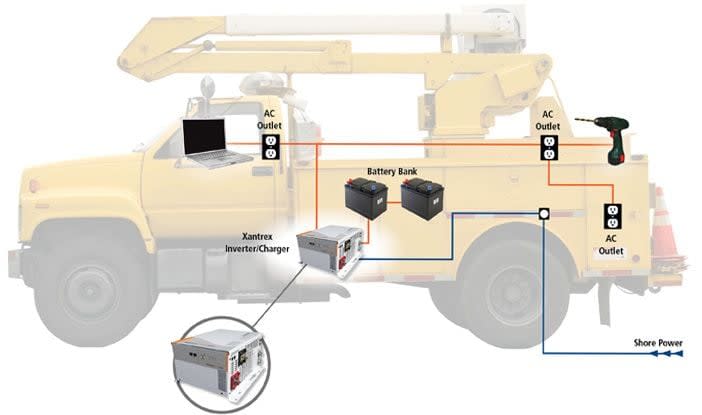
The illustration depicts a Xantrex inverter/charger installed on a utility/work truck. It takes store battery power and converts it to AC power.
Image courtesy of Xantrex
Power inverters — the devices that convert standard battery power (DC) to household power (AC) — are becoming more commonplace in the work truck industry. Depending on who you ask, it’s to the delight or chagrin of fleet and maintenance managers who often have a love-hate relationship with inverters.
“Inverters have always been a magnet of controversy,” said Steve Carlson, OEM sales manager for Xantrex, a supplier of inverters. “Fleets know drivers love them, as they provide an extra measure of creature comfort that helps with driver retention. But, they can be nervous about inverters and their potential to damage the truck’s electrical system.”
According to Carlson, inverter shipments have risen sharply since early 2012. The company expects this trend to continue over the next few years. “The distrust of inverters is really a thing of the past if, and I stress if, the right inverter and installation practices are followed. The key is for fleets to do their homework and know what’s best for their operation prior to making a purchase. One size does not fit all, and inverter quality varies greatly.”
Carlson shared a few questions that typically rise above all others when fleets try to determine which inverters to purchase:
1. Determine Inverter Size
Far and away, “what size inverter do I need” is the number one and most important question Carlson hears from fleets.
“Inverter sizes range from 300W cigarette lighter plug-in inverters to 5,000W units. Each fleet should do a survey on truck size and power usage and understand how their drivers will use an inverter — what items they want powered and what items will be used at the same time. That will help right-size the inverter for your operation,” he recommended.
For example, Carlson explained that work truck drivers often run numerous electronics, including a laptop, all at the same time.
“On each device you’ll see a wattage number,” he said. “A microwave might be rated at 1,000W, a TV at 250W, and a laptop at 95W. Add them up to see how much continuous power you’ll need, and then add 20 percent. In this case, you’ll need just more than 1,600W. Next, round up to find an inverter that meets your power needs.”
While determining continuous power is an important consideration, so is “surge power.”
“Whenever you power up any device, the initial load is more — and sometimes double — what the continuous power requirement is,” Carlson explained. “The surge rating on quality inverters should be about double. For example, an 1,800W inverter can handle a short 3,600W power surge requirement.”
Next, Carlson said to research how long the inverter can handle the surge.
2. What Power Type — Sine or Modified Sine Wave?
There are two types of inverters on the market, a sine wave and modified sine wave models.
“Both work well in a truck environment, but for those running sensitive electronics (such as continuous positive airway pressure machines) or products that are plugged into their own chargers — a drill or a toothbrush — sine wave is the preferred choice,” Carlson said. “Since sine wave is the same power as what you get at home, the voltage is consistent without spikes or drops. So, the device you’re powering reacts just as it would if you were plugged in at home.”
However, in most cases, modified sine wave power is just fine in operating most electronics and appliances with the exception of few sensitive applications, according to Carlson.
Regarding cost, the price gap has narrowed, and today most higher-wattage sine wave inverters cost about 15- to 20-percent more than a modified inverter. “With a sine wave unit, you’ll notice a slight decrease in the efficiency rating, since electronics within the inverter use power to keep electrical levels consistent,” Carlson said.
3. Can Fleets Install an Inverter?
Generally speaking, fleets can install inverters, according to Carlson. “Most technicians will have no problem handling installation and we offer fleet training programs to our customers,” he said. “Just remember, you’re working with electricity, and electricity can bite if you’re not careful. It’s our recommendation that inverters over 300W feature hard-wiring and fusing.”
Carlson said there is a bevy of considerations to make when installing an inverter, starting with where it should go and making sure there is adequate ventilation to allow heat to dissipate.
“And, you have to be cognizant of wire-sizing and the distance between the inverter and plug-ins that can be put in the sleeper, plus the distance between the battery and inverter. There’s a lot to consider,” he said.
According to Carlson, most fleets want the convenience of a factory-installed and warranted inverter. “We really recommend either an OEM install when you purchase a new work truck, or have the installation done by an authorized dealer,” Carlson said. “The OEMs have installation down to a science and it’s done on the line to rigid specs. Truck and aftermarket dealers also have the experience, so it’s worth spending a few extra bucks to have the installation done right, the first time, should your own staff not have the time or expertise.”
4. Confirm Reliability
“When it comes to reliability, the old adage, ‘you get what you pay for,’ comes into play,” Carlson said. “You will pay more for an inverter that has a ‘Regulatory Listed’ approval, such as Underwriters Laboratories (UL) or Electrical Testing Labs (ETL) with a UL458 rating. This means the inverter was inspected and approved by an independent agency which safeguards against issues with electricity,” Carlson explained.
[Editor’s Note: ETL was originally a mark of ETL Testing Laboratories, not a mark of Intertek Testing Services. The ETL Listed Mark is proof of product compliance (electrical, gas, and other safety standards) to North American safety standards.]
UL458 is the listing for inverters and chargers in mobile applications. They must meet strict vibration, environment, and thermal requirements that non-UL458 units do not.
“This is the most important safety point I can make, and, in fact, the Technology & Maintenance Council (TMC) RP163 calls out this UL listing for all inverters and chargers installed in a truck,” Carlson said.
[Editor’s Note: RP stands for recommended practice.]
Also, RP160 (which discusses DC and AC wiring in a work truck) has requirements that are automatically met by UL458-listed inverters. The main point being that the neutral and ground wires are bonded together within the inverter. All inverters that are not UL458 listed do not do this as it allows the inverter to be made at a much lower cost.
“Buying an inverter that is not regulatory listed tells you ‘buyer beware.’ We’ve seen these types of products actually shock users, plus, internally, they often can’t protect themselves against power surges,” he said, explaining that inverters installed by truck manufacturers are all UL approved, but inverters sold at truck stops are not.
Carlson also suggested looking at how inverters are internally tested for quality control.
Carlson noted that inverters will occasionally shut down, but quality inverters do so without damaging themselves. If dust or cat hair, for instance, gets inside the inverter, it can cause the inverter to overheat. Some higher watt inverters have an error code that shows what the problem is.
“And, if you overload the inverter, placing more wattage demands than it can handle, the inverter will shut down. The difference between a quality inverter and a low-end inverter is how they deal with a shut down,” Carlson noted. “A quality inverter is designed to shut down with no ill effects. A low-end inverter can ‘wear out’ after multiple overloads.”
5. Should Fleets Opt for an Inverter with a Built-In Battery Charger?
“The simple answer is yes, if you can use ‘shore power’ (electrical outlets at home or on the road at terminals, loading docks, or truck stops),” Carlson said. “When plugged in, you can run everything you’re running with your inverter for as long as you want, plus you can recharge and top off your batteries. The more you can use shore power, the better, as it prolongs the life of your batteries.”
In fact, Carlson said having the shore-power option and a charger in the system will add 20% to 30% to the life of the batteries if plugged into grid power whenever possible.
“It also has the potential to eliminate one battery swap out over the five- to six-years [life] of the truck. This happens by keeping batteries fully charged, offsetting parasitic loads, and reducing the number of cycles.”
According to Carlson, most installations use the inverter off the truck’s starting batteries, and quality inverters will have a low voltage disconnect (LVD) to shut down when voltage drops to 11.7 volts. This ensures the truck will have enough juice to start.
“Check on the LVD feature before you buy an inverter,” Carlson cautioned. “Many inverters on the market will run the batteries down to 10.5v, which will let drivers run electrical devices longer in the cab and sleeper. However, they won’t be able to start the truck unless the truck comes equipped with an LVD.
“Another option is to run two dedicated deep-cycle batteries and connect them to the inverter. They do add weight and cost to the vehicle. But, deep-cycle batteries were designed to be drawn down to a 50-percent state of charge, or 10.5 volts. This gives you double to triple the amount of continuous power to run hotel loads. Something your drivers will appreciate,” he said.
6. Determine a Company Driver Policy
According to Carlson, not knowing what kind of inverter your driver is bringing in is why fleets often have a policy of not allowing drivers to outfit company trucks with their own inverters.
“But, if you do allow drivers to bring in their own inverters, then we recommend you give them a list of approved devices, with the most important common denominator being UL458 listed. And, we suggest you make it mandatory that your shop or outside dealer perform the installation.”
7. Reduced Use of a Truck’s APU
The addition of an inverter to a truck’s electrical system will reduce hours of use on a diesel-fired auxiliary power unit (APU), assuming that the APU does not already have shore-power compatibility.
“And, it will reduce maintenance costs and increase APU life,” Carlson said. “An inverter can be used for hotel loads in the cab as long as environmental conditions do not require air conditioning. When those conditions happen, just power up the APU for air conditioning.”
With this set-up, the only time the APU would need to come on is if the batteries drop to a low level. Once the batteries are charged, the APU can shut off again. “This significant reduction in APU run time means a quick payback on the cost of the inverter,” Carlson said.
About the Authors
The Xantrex Industry Education team contributes educational articles for industry education and media reproduction. The objective is to conceive and create content that focuses on important aspects related to onboard AC power in mobile applications.
More Maintenance
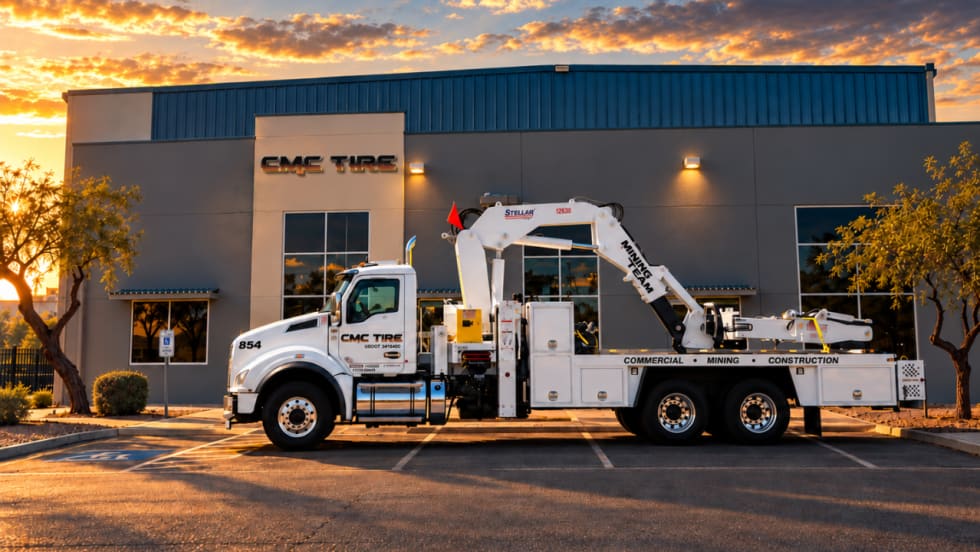
Les Schwab Expands Commercial Tire Footprint Into Arizona
Les Schwab Tires has expanded into Arizona with two commercial tire locations in Phoenix and Tucson, strengthening its fleet service footprint in the Southwest.
Read More →
Volvo Trucks’ 'Lock and Leave' Software Updates Go Live Across North America
Unattended over-the-air software updates are now available in Volvo trucks across the U.S. and Canada. The new capability lets trucks stay current with the latest software without interrupting operations or requiring a dealership visit.
Read More →
Why Technician Appreciation Can’t Be a Once-a-Year Thought
For fleets trying to keep skilled technicians, recognition cannot begin and end with Technician Appreciation Week. Learn what year-round appreciation really looks like and why the everyday technician experience matters just as much as pay when fleets are trying to keep good people.
Read More →
How Faster Driver Reporting Can Keep Small Truck Problems Small
When minor damage, warning lights, or equipment issues are reported late, small problems can quickly become bigger maintenance headaches. Conversational AI can help shorten the path from what a driver notices in the field to the person who can act on it.
Read More →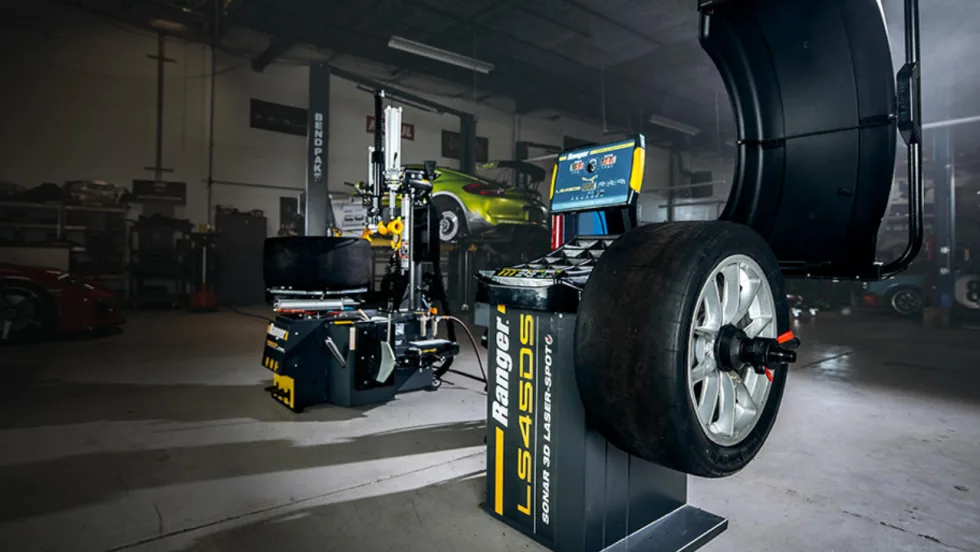
BendPak’s Ranger Wheel Service Equipment Achieves North American Safety Certification
BendPak’s full line of Ranger tire changers and wheel balancers has been ETL certified to UL and CSA standards to improve operator safety.
Read More →
Isuzu & U.S. Department of Labor Celebrate Milestone for Veterans Apprenticeship Program
The Isuzu Veterans Apprenticeship Program (IVAP) signing ceremony highlighted Isuzu’s long-term commitment to veterans, Isuzu dealers, and the skilled workforce supporting its customers and the commercial transportation industry.
Read More →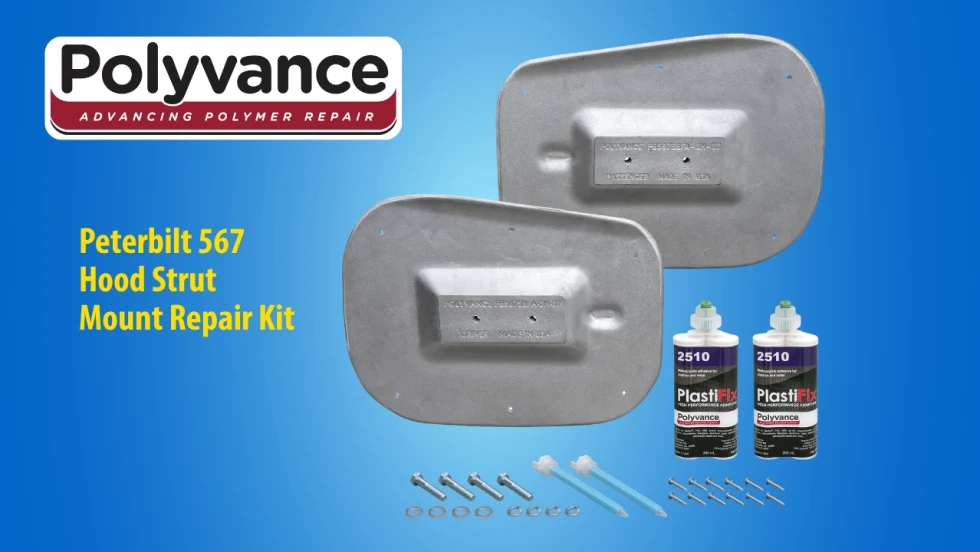
Polyvance Introduces New Peterbilt 567 Hood Strut Mount Repair Kit
Polyvance has launched a repair solution for Peterbilt 567 hood struts, helping truck owners and repair facilities avoid costly hood replacements.
Read More →
Cox Automotive Celebrates Technical Excellence at 2026 Top Tech Finals
The top technicians from Cox Fleet and Manheim tested their skills in Nashville, Tennessee, at Cox Automotive’s 2026 Top Tech Finals. The overall winners will advance to compete at the American Trucking Association’s TMC SuperTech competition.
Read More →
Grote Industries Appoints Vice President of North American Operations
Grote Industries has appointed Patrick Smith as vice president of North American operations as it celebrates 125 years of innovation and manufacturing excellence. He has more than 20 years of manufacturing leadership experience.
Read More →
Winter Fleet Prep: Expert Tips to Keep Vehicles Running Smoothly
Cold weather can expose weak batteries, tires, fuel systems, and maintenance gaps fast. Use this winter fleet checklist to prepare trucks and drivers before temperatures drop.
Read More →