Fleets of all sizes and types can use mobile maintenance, but the choice to use it depends on the fleet’s needs and goals.
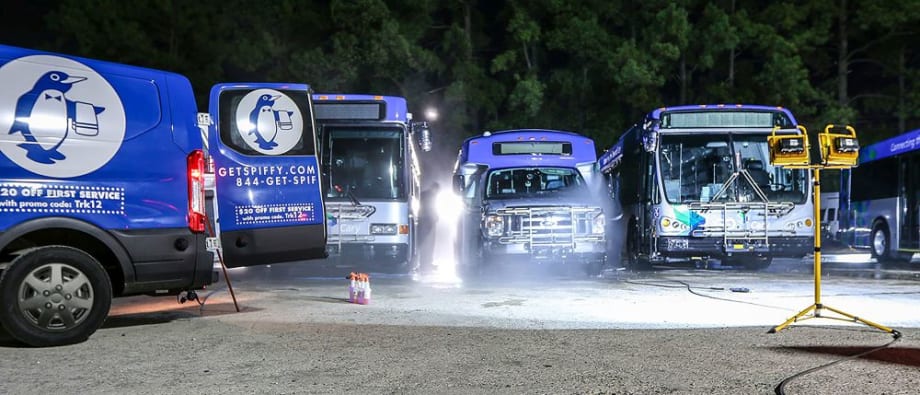
Photo: Spiffy
9 min to read
The article introduces mobile maintenance, which is a service that allows repairs and maintenance to be conducted on-site without needing a service center.
It discusses the growing trend of mobile maintenance in truck fleets, driven by the need for flexibility and efficiency in vehicle management.
Key considerations for transitioning to mobile maintenance include understanding service logistics and ensuring technicians are well-trained.
*Summarized by AI
When a driver must take a truck to the shop for maintenance and repairs, have you ever stopped to think about how much it costs?
Ad Loading...
There’s the obvious fuel and wear-and-tear, but there is also the time (and sometimes, overtime) spent shuttling the truck to the shop rather than performing core job duties. Those costs can add up while utilization goes down.
Ad Loading...
That’s where mobile maintenance comes in. With mobile fleet maintenance, the repair shop comes to you.
Mobile maintenance providers can perform preventive maintenance and repairs just about anywhere: at your facility, an off-site lot, in the field, or a driver’s home. They can also perform repairs and offer roadside assistance for breakdowns.
What Types of Fleets Can Use Mobile Maintenance?
Mobile maintenance might not be the perfect fit for every fleet — but it’s certainly an option. Fleets of all sizes and types can use mobile maintenance, but the choice to use it depends on the fleet’s needs and goals.
“It’s less a function of the size of the fleet or the truck and more about the fleet’s priorities,” said Scot Wingo, CEO and co-founder of Spiffy. “Fleets that benefit the most from mobile maintenance have prioritized fleet optimization and digital technologies such as telematics and fleet maintenance software. We work with fleets from rental cars and trucks to HVAC companies, general contractors, landscaping, transportation, logistics, autonomous fleets, car sharing, ridesharing, and everything in-between. The common theme is the fleets are trying to keep maintenance current, avoid expensive repairs, increase residual value, and make it clean and safe/COVID-free for drivers and customers.”
Dennis McGowan, manager, Towing & Roadside Operations for HONK Technologies, said fleets of all shapes and sizes could benefit from mobile maintenance programs.
Ad Loading...
Is Mobile Maintenance Right for Your Fleet?
If any of the following apply to your fleet, mobile maintenance might be worth a look:
Improving fleet utilization/decreasing truck downtime is ahigh priority.
Current maintenance and repair costs (including the associated vehicle and driver downtime) exceed the cost of a mobile alternative.
Your fleet units need service in the field or off-hours at fleet sites or drivers’ homes.
“On-site repairs and roadside assistance can greatly reduce fleets’ downtime, which can increase profitability for small and large fleets alike,” he said. “Larger, nationwide fleets especially rely on these types of programs because their fleets likely never return to one centralized facility for long. Having a service technician come to your location to diagnose and repair a downed vehicle can save hours, even days of wasted time.”
Anthony Rodio, CEO & president of YourMechanic.com, said that while fleets of all types can benefit from mobile maintenance, those with work trucks may have the greatest advantage.
“The fleets we’ve seen benefit the most from YourMechanic.com’s mobile maintenance have been businesses that own work trucks. These fleets tend to have revenue-generating vehicles, and for them, service off-hours, directly at drivers’ homes, helps maximize revenue and increase vehicle compliance,” he said.
In addition to maintenance, mobile providers can offer roadside assistance and repairs, which can be especially beneficial to field service fleets.
“There are some very serious repairs that require a heavy lift or specialized equipment. But for tires, brakes, batteries, belts, light engine repair, and light transmission repair, mobile trucks come with specialized equipment to do all those repairs and more,” Wingo said.
Ad Loading...
What Are the Benefits of Mobile Maintenance?
One of the most obvious benefits of mobile maintenance is skipping the trip to the shop and getting vehicles back on the road faster, which results in saved time and costs.
“The primary benefit of mobile maintenance and repair services is a reduction in downtime, which should be the single most important consideration when operating a fleet of any size,” said McGowan of HONK Technologies. “A vehicle sitting in a shop still has insurance payments. A driver stranded on the side of the road isn’t earning money. And, the customer they were on the way to help is likely unhappy now. The bottom line is the adage in trucking: ‘If your wheels ain’t turnin’, they ain’t earnin.’”
Additionally, McGowan noted that downtime can be a killer to fleets, factoring the added time now necessary to clean and sanitize equipment due to the current pandemic.
Mobile maintenance also turns a manual process into a more streamlined, digital one that can take place at any time.
“In addition to being very busy, most fixed locations are only open during limited hours and tend to have paper-style ‘analog’ billing and systems. Because of this, fixed maintenance is a drag on fleet utilization because the operator has to take the vehicle to the location, wait, and return to get the vehicle,” said Wingo of Spiffy.
Ad Loading...
Mobile maintenance applies the latest tech developments from e-commerce for a completely digital experience, which can positively increase the fleet’s efficiency.
“The operator doesn’t lose hours out of their day, the vehicle is maintained during downtime, and the service comes to the vehicle vs. the other way around,” Wingo added.
Ed Petersen, CEO, Wrench, said mobile providers bring the 21st Century “get-it-now” mentality to fleet maintenance.
“In today’s instantaneous world, we expect everything to be faster. This world of instant gratification has also translated into the fleet world. Wrench is applying this on-demand concept to the auto repair and maintenance industry,” he said. “Service can be scheduled online at any time. You’ll know immediately when your Wrench tech can come out, how long the job is expected to take, and how much it will cost. Close to 85% of your needs can be resolved right where you need it most — from no starts, brake repair, and parts replacement to mileage services.”
For instance, Wrench customer Rob Tetz, vice president of Fleet & Facilities at Monarch Landscape Companies, found repairs to his vehicles were taking up to two weeks with no visibility into the repair’s status. With Wrench, Tetz can get status updates on his vehicles’ repairs and get them back on the road within 72 hours.
Ad Loading...
“The transition to Wrench was easy and worth the change, as we’ve saved over 2,000 hours in labor and thousands of dollars that we can now redirect back into our commercial landscaping business to continue providing quality service to our customers,” Tetz said.
In general, mobile maintenance offers fleets benefits in three key categories: costs, safety, and convenience.
“YourMechanic.com’s mobile maintenance enables fleets to maximize revenue, decrease costs, increase vehicle uptime, and mitigate risks by enabling fleets by providing 96% of all mechanical vehicle services on-site, without a lift, at fleet managers’ locations of choice, seven days a week,” said Rodio of YourMechanic.com.
Mobile maintenance offers fleets benefits in three key categories: costs, safety, and convenience. During the pandemic, mobile services have seen an uptick in preventive maintenance services and cleaning services.
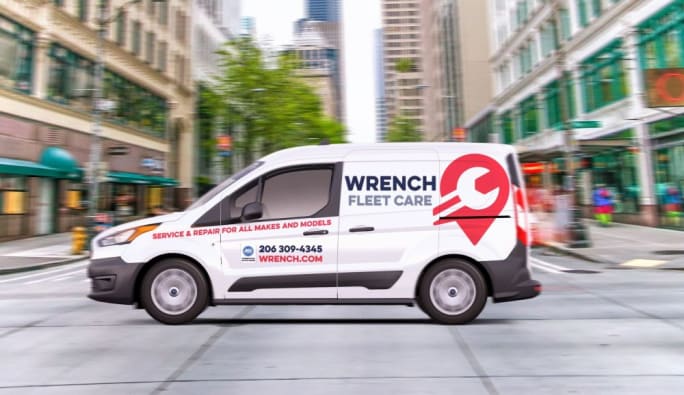
Photo: Wrench
Mobile Maintenance Advantages in the Age of COVID-19
Another advantage of mobile maintenance that quickly became of importance in 2020 was a contactless service.
“Like all businesses, COVID-19 has presented new challenges and opportunities for mobile maintenance providers. The demand for contactless service has increased across all industries, and roadside assistance, towing, and mobile repair services are no different,” said McGowan of HONK Technologies.
Ad Loading...
Mobile maintenance programs can reduce the amount of contact required between the driver and a service technician.
“Mobile maintenance can also reduce the number of people that handle the vehicle, thus reducing the risk of transmission of the virus. As long as technicians are being careful, wearing PPE, and following recommended CDC guidelines, the reduced number of hands that touch the vehicle is an added benefit for all parties involved during the current pandemic,” McGowan said.
Wingo said Spiffy has adapted to the new requirements in the face of COVID-19.
“During a pandemic, mobile maintenance has been in high demand because it reduces the person-to-person interaction, can be done touch-free and with PPE,” he said. “All of our services now include a 40-point vehicle disinfection that is EPA-approved against COVID-19.”
Wrench also experienced a major uptick in business since the onset of the pandemic.
Ad Loading...
“Wrench has seen a more than 300% increase in preventive maintenance service (mileage-based maintenance services) due to increase usage of delivery vehicles and a more than 1,000% uptick in cleaning services using a CDC-approved disinfectant in high-touch areas such as door handles (in/out), steering wheel, console, seat belts, and more,” Petersen said.
The increased demand Rodio has seen at YourMechanic.com has been attributed to one thing: safety.“COVID-19 has made contactless, on-site vehicle services the safest alternative to repair shops,” he said. “Fleets benefit from mobile maintenance during the pandemic because they’re able to keep their drivers and fleet managers safer while increasing vehicle uptime by ordering our services on evenings and weekends.”
Mobile maintenance services may cost more up-front that traditional service facilities, but the time savings and reduced vehicle wear-and-tear can save costs in the long run.
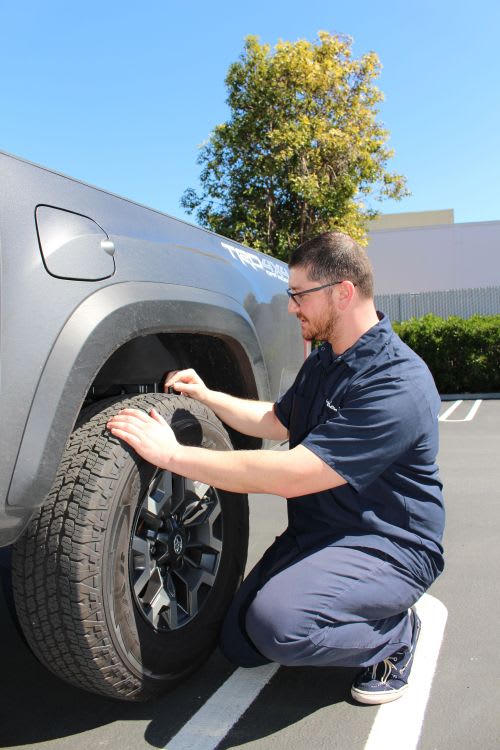
Photo: YourMechanic.com
Does Mobile Maintenance Come with Any Challenges?
While mobile maintenance comes with many benefits, it also has its challenges. Some challenges include:
Parts availability. “Mobile maintenance and repairs are still subject to constraints like parts availability. If a particular part is on backorder nationwide, the vehicle is still going to be down until the part can be located,” said McGowan of HONK Technologies.
Specialty equipment limitations. While most maintenance and repairs can be performed wherever vehicles are located, some repairs may require specialty equipment that isn’t available in the field. “YourMechanic.com performs most repair and maintenance services on-site without a lift,” Rodio said. “However, we can’t do a full engine replacement without a lift on-site. It’s important to know what a mobile repair provider can deliver before committing to a partnership.”
Change management. Shifting to mobile maintenance requires process changes to be successful, so it’s important to manage that change. “Like any significant new paradigm change, the biggest challenge is changing to the model,” said Wingo of Spiffy. “I recommend implementing mobile maintenance in two to three phases. For instance, moving from a pilot in one location, to one service in multiple locations, to full services in all locations.”
Does Mobile Maintenance Cost More Than Traditional Options?
At face value, mobile maintenance will probably cost more than traditional options. But when looking at the bigger picture, which includes downtime, customer satisfaction, driver satisfaction, safety, and convenience, it can pay off.
Ad Loading...
“Mobile maintenance likely costs more ‘out of the box’ than traditional options, but fleet owners and managers should look at the cost holistically and consider what the extra costs of downtime are,” advised McGowan of HONK Technologies. “If downtime is affecting customer satisfaction, you might consider the increased costs associated with mobile maintenance and repair to be negligible compared to losing customers.”
Wingo recommended fleets considering mobile maintenance should ask the following questions:
With fixed service, what’s the cost of the travel time to and back?
What’s the cost of the operator during the downtime?
What’s the opportunity cost of the vehicle being down for 1/2/3 hours during prime-time?“
On a pure price-per-service, mobile maintenance is frequently more expensive than the fixed alternative, but fleet operations should look at the ‘total cost of service,’” Wingo said. “When you evaluate things that way, based on what we’ve heard from fleets, well over 50% of the time, a mobile solution is superior.”
More Mobile Maintenance to Come?
The pandemic has driven more fleets to seek out mobile maintenance, which could result in fleets continuing with that model, even after contactless service isn’t top of mind.
Ad Loading...
Rodio of YourMechanic.com said technology could also warrant greater use of mobile maintenance into the future.
“The pandemic has shaped the industry like no other factor this year. As fleets have now become accustomed to decreased vehicle downtime and service on-site, they’re unlikely to return to a traditional shop model where they’ll encounter increased wait time and higher hike costs,” he said.
In the future, Rodio believes vehicles will be diagnosed remotely with telematics, allowing technicians to be sent out right at the precise point of need.
“This future would provide fleets with more visibility into their vehicles’ conditions in realtime, and ultimately enable better vehicle compliance and increased asset utilization,” Rodio concluded.
Mobile maintenance refers to services provided using mobile units like trucks or vans, which can perform maintenance and repair tasks on-site, rather than requiring equipment or vehicles to be brought to a fixed location.
The benefits include increased flexibility, reduced equipment downtime, cost savings from eliminating transport fees, and convenience as services are performed on-site.
Mobile maintenance fleets can handle various tasks such as oil changes, tire services, brake repairs, diagnostics, preventive maintenance, and minor mechanical repairs.
Unlike traditional maintenance models that require taking vehicles or equipment to a service facility, mobile maintenance provides on-the-go services that enhance convenience and efficiency, saving time and potentially costs for businesses.
Key factors include investment in equipped vehicles, hiring qualified technicians, understanding logistical challenges, ensuring compliance with local regulations, and establishing effective scheduling and communication systems.
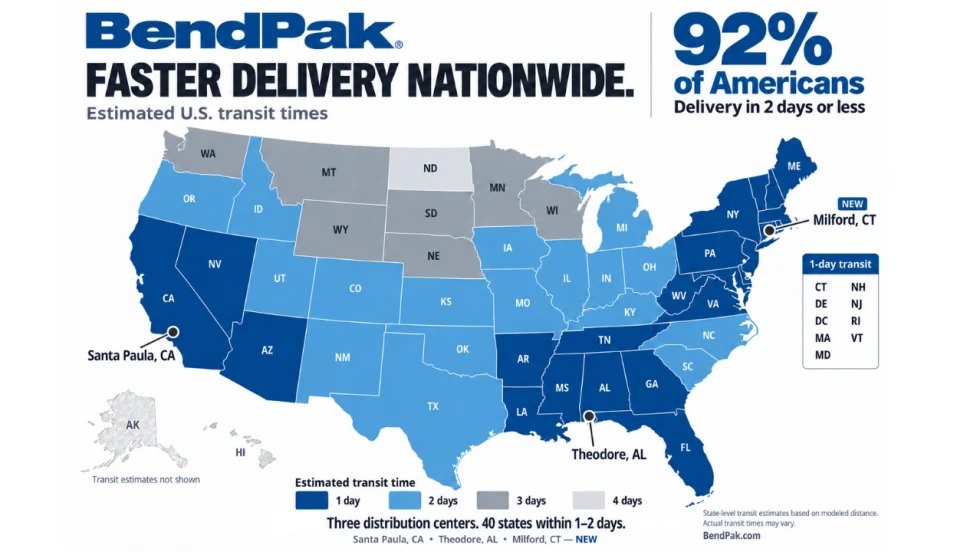
With the opening of a new distribution center in Milford, Connecticut, BendPak has expanded its network to deliver to 92% of Americans in two days or less. The company now operates three distribution centers.
Achieving the right balance of efficiency, durability, and electrical performance is critical in high-speed electric-vehicle drivetrains. The Society of Tribologists and Lubrication Engineers (STLE) released its new special report about EV lubrication.
As new A/C refrigerants enter the market, fleet shops may already have many of the tools they need to service them. Here’s why revisiting basic refrigerant service skills could save equipment costs and get trucks back on the road faster.
A new referral partnership connects on-site fueling and maintenance services, with a focus on reducing off-site trips and making better use of fleet downtime.
Unplanned downtime hurts efficiency and even profitability for work truck fleets, but catching potential problems early can help prevent it. Here is an inspection list that can help potentially prevent that downtime.
Hunter Engineering’s collaboration with Bosch enables ADASLink to connect directly with Bosch diagnostic experts through an integrated remote support platform, allowing shops to service more vehicles.
Mack Trucks introduced four system-specific chassis coverage plans, giving fleets more flexibility to manage repair costs for driveline, HVAC, electronics, safety systems, and other components.
The GM Automotive Service Technicians 30 Under 30 program honors GM service technicians under the age of 30 who demonstrate continuous technical training, exemplary customer service, mentorship, and leadership.
A strategic partnership between Kooner Fleet Management Solutions and Safe Truck Parking brings mobile maintenance and 24/7 repair services directly to Safe Truck Parking locations, beginning in San Diego, California, with nationwide expansion planned.