




The Snowbelt Is Shrinking, How Will it Impact Fleets?
According to new research, the average U.S. snowfall is projected to drop significantly through 2050. That shift is going to shake up how municipal and private fleets plan for winter.

The U.S. snowbelt is shrinking—and that’s not just a flurry of hype. New forecasts show how rising temps are changing winter fleet demands.
Photo: Work Truck
Let’s talk snow. Or, more accurately, less of it. A new long-range forecast is sounding the alarm for fleets that rely on snow and ice equipment: the snowbelt is on the move, and it’s heading north. If you’re managing trucks, plows, or pavement-clearing crews, you’re going to want to pay attention.
According to new research from Coherent Market Planning and Forecasting (CMPF), the average U.S. snowfall is projected to drop significantly through 2050. That shift is going to shake up how municipal and private fleets plan for winter.
“When I first started this report, I expected a straightforward analysis: Use snowfall data to forecast plow-mount registrations. But, like Robert Burns once said, 'the best laid schemes... often go awry.' It turns out that snowfall data isn’t as consistent or accessible as I assumed. What followed was a deep dive that gave me a whole new appreciation for meteorologists and statisticians who wrangle this kind of data every day," said Stephen Latin-Kasper, Economist & CEO, Coherent Market Planning and Forecasting, LLC.
The result, according to Latin-Kasper? "A surprisingly simple equation that strongly predicts pickup plow registrations, and a clearer understanding of just how much climate change is already reshaping the snow and ice industry.”
What’s Changing and Why It Matters
The big driver? Temperature. And no, it’s not just your imagination, winters are warming. The average winter temperature in the snowbelt has already crept past freezing in several regions. That’s not just a weather stat, it’s a fleet equipment game-changer.
Based on National Oceanic and Atmospheric Administration (NOAA) data and Great Lakes Integrated Sciences and Assessments (GLISA) temperature forecasts, CMPF’s report shows a direct link between rising winter temperatures and declining snowfall. And if snowfall decreases, so does the need for certain types of equipment, especially the good old plow-mount pickup.
CMPF forecasts a 31% to 60% decline in registered pickups with plow-mounts by 2050, depending on how quickly temperatures rise.
That's potentially 400,000 fewer pickups with plows in service across the nation.
Fleet Mix Is Already Shifting
In places like St. Louis and Indianapolis, the fleet mix is expected to look a lot more like Atlanta or Dallas in the next decade. That means fewer big plows, more salt spreaders, and a pivot toward equipment designed for freezing rain over snow.
The new winter battleground? Ice, not snow. Spreaders are sticking around longer, while plows are taking a hit.
The Great Lakes and Midwest Plainswill likely remain in the snow game the longest, but even these regions are looking at a slow and steady reduction in snowfall through 2050.

Not all snowbelt states are created equal. While colder states like Minnesota and North Dakota keep piling up snow, warmer states are seeing fewer plowable events.
Photo: Work Truck
What the Numbers Say
Here’s a snapshot of the current market and what’s projected:
In 2021, 1.1 million pickups had plow-mounts, a nearly 48% increase from 2002.
But by 2050, that number could drop to 686,000 in a moderate warming scenario, or even as low as 400,000 in a high-temperature scenario.
A forecast model using snowfall, temperature, and population shows a strong correlation to plow-mount registrations, especially when regional outliers are adjusted for.
This decline isn’t uniform across the board; urban regions with more surface parking lots will still need snow-clearing services, especially in areas that can’t justify building expensive parking structures.
But broadly speaking, fewer snow events mean less demand for traditional snowplow trucks.
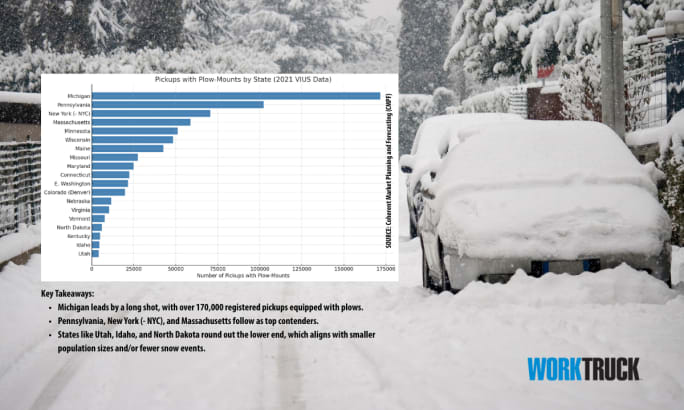
Michigan dominates when it comes to pickups with plow-mounts, but several snowbelt states are seeing registrations drop—especially as snowfall declines.
Photo: Work Truck
Who’s Impacted the Most?
Fleets that rely on pickups to clear snow from parking lots, alleys, and residential areas will feel the pinch first, especially smaller municipalities or contractors operating near the southern edge of today’s snowbelt. But plow manufacturers and distributors will also need to rethink product mixes, regional strategies, and long-term growth plans.
Expect more demand for tractors hauling brine tanks. Less for Class 3 trucks hauling steel plows.
Looking Ahead: What Fleets Can Do Now
If you're managing light- and medium-duty trucks in snow-prone regions, now's the time to start thinking long-term:
Review your winter equipment mix. Do you need to invest in more spreaders and fewer plows?
Look at regional snowfall trends, especially if you operate near the southern edge of the snowbelt.
Consider resale timelines. Fewer snow days could reduce plow truck demand and residual values.
Change is coming, and it’s coming on slushy tires. The fleets that stay nimble, adjusting vehicle specs, training drivers for ice versus snow, and planning for more variable winters, are the ones that’ll win.
More Safety
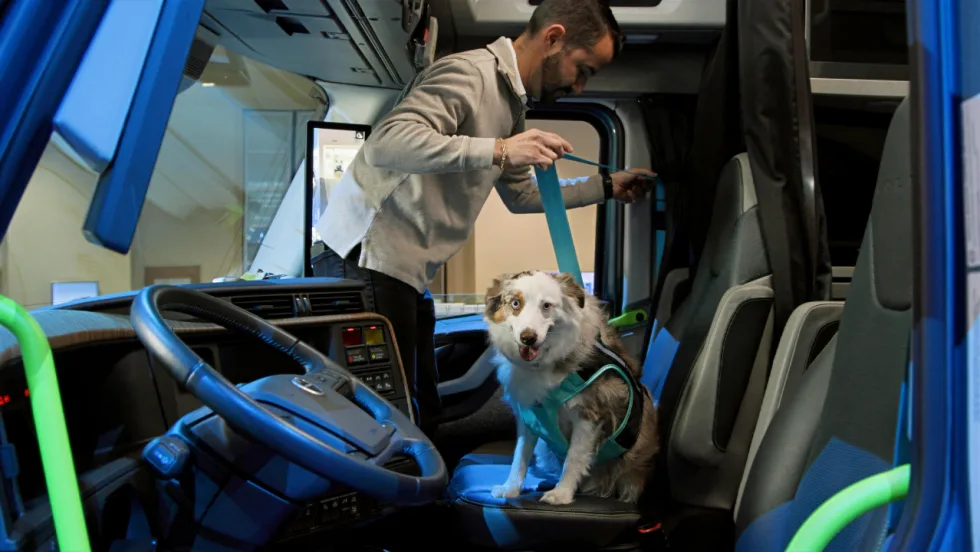
Volvo Trucks Releases New Safety Recommendations for Traveling with Pets
One of the most important recommendations for professional drivers traveling with pets is to ensure pets are properly restrained while the truck is moving. Other tips are available in the new guide from Volvo Trucks North America and Center for Pet Safety.
Read More →
API Issues Refueling Safety Guidelines
The American Petroleum Institute offers a list of safe vehicle refueling guidelines, including ways to avoid potential problems with static electricity discharges in fall, winter, and early spring.
Read More →
Winter Fleet Prep: Expert Tips to Keep Vehicles Running Smoothly
Cold weather can expose weak batteries, tires, fuel systems, and maintenance gaps fast. Use this winter fleet checklist to prepare trucks and drivers before temperatures drop.
Read More →
When a Work Truck Breaks Down, the Job Can Stop, Too
A work truck breakdown can stop more than the vehicle. Discover how payloads, jobsites, and specialty equipment change the roadside response.
Read More →
What Stronger Long-Term Fleet Service Partnerships Actually Require
Fleet service partnerships rarely fall apart all at once. Learn the three warning signs that trust is eroding and what fleets and providers can do before downtime, frustration, and lost revenue follow.
Read More →
Applause & TRUCE Software Partner to Improve Driver Safety Through AI-Powered Telematics & Employee Performance Management
Applause has integrated TRUCE driving metrics directly into its employee-first performance and safety platform that transforms mobile devices into AI-powered telematics.
Read More →
How Detroit Assurance with Active Brake Assist Works
Do you want to see what it is like to experience Detroit Assurance’s Active Brake Assist? In this video, Work Truck will put you in the cab to see how it all works and then hear more details from DTNA’s Mike Young.
Read More →
Get Left of Loss: A 5-Step Workplace Violence Prevention Framework for Fleet Operators
Violence risks do not stop at the driver’s door. Learn five practical steps fleets can take to spot threats early and protect workers before loss occurs.
Read More →
How Better Visibility Cut Speeding Violations by 48%
Fleet leaders don't need more data, they need clearer visibility into what the data is saying. This case study explores how one utility replaced speeding-event counts with a single metric — miles driven in violation — to strengthen safety and significantly reduce speeding violations.
Read More →
13 Safe Driving Tips for Commercial Vehicle Drivers
Make sure you are spending time on the road safely with these important tips.
Read More →