




Strongest-Ever Pollution Standards for Light- and Medium-Duty Trucks Finalized
The U.S. Environmental Protection Agency announced final national pollution standards for passenger cars, light-duty trucks, and medium-duty vehicles for model years 2027 through 2032 and beyond.


The latest updates to the EPA Emissions standards impact car, light,- and medium-duty truck fleets.
Photo: Work Truck
On March 20, 2024, the U.S. Environmental Protection Agency announced final national pollution standards for passenger cars, light-duty trucks, and medium-duty vehicles for model years 2027 through 2032 and beyond.
“These new standards will mean more choices. Better, faster, more fun, cheaper clean cars and passenger trucks of all kinds. American ingenuity will give families more options than ever before – and choosing an electric vehicle will save thousands in fuel costs in the process," said Amanda Leland, executive director of the Environmental Defense Fund (EDF) in a statement.
Taking Steps to Reduce Greenhouse Gas Emissions
One of the key takeaways for fleet managers is that, while the standards are more stringent than ever, they are giving automakers more time to comply with the updated standards. However, these standard updates do come as electric vehicle sales have started to slow down.
EPA’s new emissions standards recognize continued advancements in emission control technologies that enable significant reductions in harmful air pollutants. These advancements include a diverse suite of technologies that can reduce both greenhouse gas emissions and emissions that form ozone, PM2.5, and NOx (i.e., “criteria pollutants”), including:
Advanced gasoline vehicle technologies (e.g., advanced engines and transmissions)
Hybrid electric vehicles (HEVs)
Plug-in hybrid electric vehicles (PHEVs)
Battery-electric vehicles (BEVs)
Light- and Medium-Duty Vehicle Final Standards

This top table presents a summary of the projected industry average g/mile targets for the MY 2027-2032 standards for cars, trucks, and the overall light-duty fleet. The bottom table presents a summary of the projected industry average g/mile targets for mediumduty vans, pickups, and the overall medium-duty fleet.
Photo: Work Truck | EPA
The “Multi Pollutant Emissions Standards for Model Years 2027 and Later Light-Duty and Medium-Duty Vehicles,” build on EPA’s existing emissions standards for passenger cars and light trucks for model years 2023 through 2026.
For light-duty vehicles, the standards are projected to result in an industry-wide average target for the light-duty fleet of 85 grams/mile (g/mile) of CO2 in MY 2032, representing a nearly 50% reduction in projected fleet average emissions target levels relative to the existing MY 2026 standards.
For medium-duty vehicles, EPA is revising the existing standards for MY 2027 and establishing new standards for MYs 2028-2032, given the increased feasibility of greenhouse gas emissions-reducing technologies in this sector in this time frame.
EPA noted that these standards phase in over six years from MY 2027 through MY 2032. When fully phased in, the medium-duty vehicle standards are projected to result in an average target of 274 g/mile of CO2 by MY 2032, representing a 44% reduction in projected fleet average emissions target levels relative to the existing MY 2026 standards.
“The U.S. has leapt forward in the global race to invest in clean vehicles, with $188 billion and nearly 200,000 jobs on the way. Jobs in communities across the country, in places like Michigan, Nevada, and Kentucky. These clean car standards will help supercharge economic expansion and make America stronger. Ask the Air Force veteran who wants a powerful car that doesn’t run on foreign oil. Ask the third-generation auto dealer in Michigan who wants to be able to sell made-in-America clean cars," Leland added.
According to the EPA, the standards continue the technology-neutral and performance-based design of previous EPA standards for cars, pickups, and vans, and leverage advances in clean car technologies to further reduce both climate pollution and smog- and soot-forming emissions. The
EPA is finalizing the same standard proposed for MY 2032 while allowing additional time for the auto sector to scale up clean vehicle manufacturing supply chains in the first three years covered by the rule.
Making Regulatory Changes
Annually, the net benefits to society for the light- and medium-duty final rule are estimated to be $99 billion. The final rule is expected to avoid 7.2 billion tons of CO2 emissions through 2055, roughly equal to four times the emissions of the entire transportation sector in 2021.
It will also reduce fine particulate matter and ozone, preventing up to 2,500 premature deaths in 2055 as well as reducing heart attacks, respiratory and cardiovascular illnesses, aggravated asthma, and decreased lung function.
EPA received extensive feedback on the proposed rule, including through written comments, testimony at public hearings, and other stakeholder engagements. The best available data in the public record and rigorous technical assessments informed the final standards.
Like the proposal, EPA’s final rule gives manufacturers the power and flexibility to efficiently reduce emissions and meet the performance-based standards through the mix of technologies they decide is best for them and their customers.
EPA’s analysis considers a broad suite of available emission control technologies, and projects that consumers will continue to have a wide range of vehicle choices under the final rule, including advanced gasoline vehicles, hybrids, plug-in hybrid electric vehicles, and full battery electric vehicles.
Compared to the existing MY 2026 standards, the final MY 2032 standards represent a nearly 50% reduction in projected fleet average greenhouse gas emissions levels for light-duty vehicles and 44% reductions for medium-duty vehicles.
In addition, the standards are expected to reduce emissions of health-harming fine particulate matter from gasoline-powered vehicles by over 95%. This will improve air quality nationwide and especially for people who live near major roadways and have environmental justice concerns.
Why Institute More Stringent National Emissions Standards?
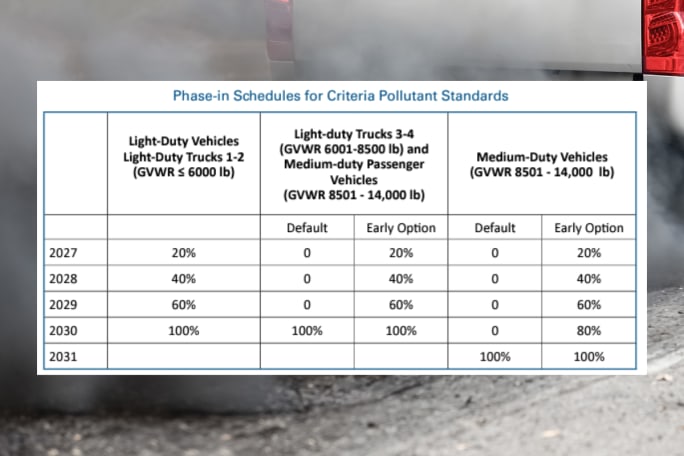
To provide manufacturers with additional time to adjust product plans and apply technologies to vehicles, EPA is finalizing gradual phase-ins for criteria pollutant standards shown in the table. For light-duty vehicles greater than 6000 pounds GVWR and medium-duty vehicles, manufacturers have the choice of either the default phase-in or an optional incentivized early phase-in schedule.
Photo: Work Truck | EPA
According to the EPA, these standards will avoid more than 7 billion tons of carbon emissions and provide nearly $100 billion of annual net benefits to society, including $13 billion of annual public health benefits due to improved air quality, and $62 billion in reduced annual fuel costs, and maintenance and repair costs for drivers.
"These standards provide the crucial regulatory certainty that will allow for long-term infrastructure planning and will spur new investments to further boost the clean transportation sector," said John Boesel, President and CEO of CALSTART. "For the benefit of the incentives in the IRA to be fully realized, and to spur North American EV manufacturing and supply chain, we needed a strong market signal in the form of standards. The Biden administration has taken the necessary actions to make U.S. companies globally competitive."
The final standards deliver on the significant pollution reductions outlined in the proposed rule, while accelerating the adoption of cleaner vehicle technologies. EPA is finalizing this rule as sales of clean vehicles, including plug-in hybrid and fully electric vehicles, hit record highs last year.
EPA projects an increase in U.S. auto manufacturing employment in response to these final standards, consistent with the broader Biden-Harris Administration commitment to create good-paying, union jobs leading the clean vehicle future. Strong standards have historically contributed to the U.S. leading the world in the supply of clean technologies, with corresponding benefits for American global competitiveness and domestic employment.
Since President Biden took office, companies have announced more than $160 billion in investment in U.S. clean vehicle manufacturing and the U.S. auto manufacturing sector has added more than 100,000 jobs.
These standards will provide greater certainty for the auto industry, catalyzing private investment, creating good-paying union jobs, and invigorating and strengthening the U.S. auto industry. Over the next decade, the standards, paired with President Biden’s historic Investing in America agenda and investments in U.S. manufacturing, will set the U.S. auto sector on a trajectory for sustained growth. Additionally, the final standards will lower costs for consumers.
Once fully phased in, the standards will save the average American driver an estimated $6,000 in reduced fuel and maintenance over the life of a vehicle.
“With transportation as the largest source of U.S. climate emissions, these strongest-ever pollution standards for cars solidify America’s leadership in building a clean transportation future and creating good-paying American jobs, all while advancing President Biden’s historic climate agenda,” said EPA Administrator Michael S. Regan. “The standards will slash over 7 billion tons of climate pollution, improve air quality in overburdened communities, and give drivers more clean vehicle choices while saving them money. Under President Biden’s leadership, this Administration is pairing strong standards with historic investments to revitalize domestic manufacturing, strengthen domestic supply chains and create good-paying jobs.”
Investing in America’s Clean Transportation Future with Renewable Energy Sources
The final rule reflects the significant investments in clean light-duty vehicle technologies that industry is already making domestically and abroad, as well as ongoing U.S. market shifts and increasing consumer interest in clean vehicles.
The Biden-Harris Administration is also directly supporting communities across America in moving towards a cleaner transportation future, including by building a national network of EV chargers and alternative-fuel stations; ensuring domestic manufacturers have the critical minerals and materials they need to make EV batteries; and funding clean transit and clean school buses, with priority for underserved communities.
President Biden’s Investing in America agenda is focused on growing the American economy from the bottom up and the middle out – from rebuilding our nation’s infrastructure, to creating a manufacturing and innovation boom, to building a clean-energy economy that will combat climate change and make our communities more resilient.
More Green Fleet

Fleet Forward Conference Introduces One-Day Passes for 2026
New one-day registration gives fleet professionals the flexibility to attend Tuesday, Wednesday, or Thursday, with passes available for $199 through Sept. 18.
Read More →
CALSTART Rebrands as Catalyst Mobility, Will Combine with Forth in 2027
CALSTART has rebranded as Catalyst Mobility and will combine with Forth at the start of 2027. The new organization said it is poised to become one of the world's largest, strongest, and most impactful clean transportation nonprofits.
Read More →
Electric Truck and Charging Programs to Boost Sustainability at NY & NJ Ports
Together, the Port Authority of New York and New Jersey and CALSTART will electrify drayage and terminal operations serving the East Coast’s busiest container port. A pair of incentive programs totaling $45 million has launched to accelerate adoption of zero-emission drayage trucks and terminal tractors.
Read More →
Xos Hub Surpasses One Gigawatt-Hour of Energy Delivered in the Field
A single Xos Hub has surpassed one gigawatt-hour of energy across more than 33,600 charging sessions in the field, demonstrating performance that supports Xos' expansion across new products and markets.
Read More →
Carrier Transicold Launches All-Electric Vector 8200 TRU for Diesel-Free On-Site Cold Storage
Carrier Transicold’s first engineless multi-temperature TRU helps fresh- and frozen-food fleets add supplemental cold storage capacity during seasonal peaks.
Read More →
Narro Trucks Introduces Electric Utility Vehicle
Narro Trucks officially launched its operations on Aug. 20 and hosted a ride and drive to showcase its electric truck, which will be produced in Virginia.
Read More →
Samsung SDI Takes Full Control of GM Battery JV as Indiana Plant Pivots to Energy Storage
Samsung SDI is taking full control of its Indiana battery plant with GM, marking a major shift from the EV-focused joint venture Charged Fleet first covered in 2023.
Read More →
NWSA Taps CALSTART to Administer Zero-Emission Drayage Assistance Program
CALSTART will provide free technical assistance services to drayage fleets serving the Ports of Seattle and Tacoma and looking to transition to cleaner technologies and help decarbonize freight hubs.
Read More →
EV Fleet Reality Check: What Operators Wish They Knew Before Electrifying Their Work Vans
Electric work truck upfits bring new compatibility questions. Learn how parts availability, OEM guidance, power demands, and route planning can affect fleet performance.
Read More →
Peterbilt Expands Sourcewell Partnership with Electric Vehicle Lineup
Peterbilt Motors Company’s cooperative purchasing agreement with Sourcewell and its Canadian partner, Canoe Procurement Group, now includes including Peterbilt's battery-electric vehicle lineup.
Read More →