




Research: How Talking Slows Eye Movements Behind the Wheel
Researchers from Fujita Health University have demonstrated that talking imposes a cognitive load strong enough to delay essential eye-movement responses, potentially affecting the fast visual assessments required for safe driving.

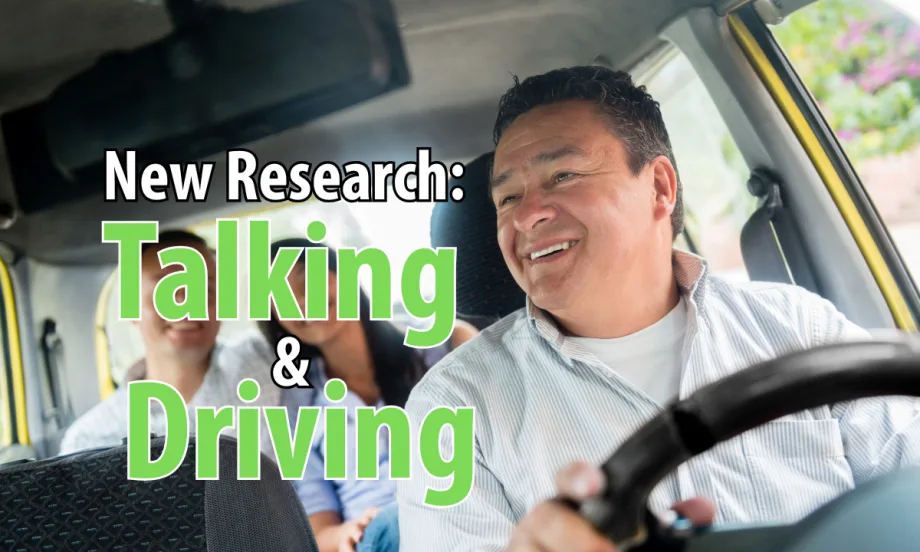
A new study found that everyday conversations can delay eye movements, essential for safe driving. In experiments comparing talking, listening, and control conditions, only talking caused slower reaction, movement, and fixation times during rapid eye-movement tasks
Photo: Work Truck
New research from Fujita Health University reveals that talking can subtly delay the eyes’ ability to detect and stabilize on visual information. Because driving depends heavily on fast gaze shifts, these delays may impair hazard detection and slow physical responses.
The findings highlight the hidden risks of engaging in conversation while driving. In experiments comparing talking, listening, and control conditions, only talking caused slower reaction, movement, and fixation times during rapid eye-movement tasks.
Cognitive Distraction While Talking
Talking while driving is widely recognized as a major source of distraction, but the specific ways conversation interferes with the earliest stages of visual processing have remained largely unclear. While previous research has shown that cognitive distraction can slow braking or reduce situational awareness, the question of whether talking disrupts the foundational gaze processes that precede physical reactions has remained unanswered.
Now, researchers from Fujita Health University have demonstrated that talking imposes cognitive load strong enough to delay essential eye-movement responses, potentially affecting the fast visual assessments required for safe driving.
A study led by Associate Professor Shintaro Uehara and the team, including Takuya Suzuki and Professor Takaji Suzuki, published online on Oct. 6, 2025, in PLOS ONE, examined how talking alters the temporal dynamics of gaze behavior.
Studying Gaze Behavior
Gaze behavior is especially significant because approximately 90% of the information used for driving is acquired visually, according to the report. Any delay in initiating or completing eye movements can cascade into slower recognition of hazards, reduced accuracy of visual scanning, and delayed motor responses.
“We investigated whether the impact of talking-related cognitive load on gaze behavior varies depending on the direction of eye movement,” said Uehara.
To investigate this, the researchers asked 30 healthy adults to perform rapid center-out eye-movement tasks under three different conditions:
Talking
Listening
A no-task control
Participants were instructed to look as quickly and accurately as possible toward a peripheral visual target presented in one of eight directions.
In the talking condition, participants answered general knowledge and episodic questions adapted from the Wechsler Adult Intelligence Scale, as well as additional custom prompts.
In the listening condition, participants listened to passages from the Japanese novel “I Am a Cat.” The order of conditions was randomized across three separate days.
3 Areas of Consistent Delays
Across all participants, talking produced clear and consistent delays in three key temporal components of gaze behavior:
The time needed to initiate the eye movement after target appearance (reaction time)
The time needed to reach the target (movement time)
The time needed to stabilize gaze on the target (adjusting time)
None of these effects were observed during listening or control conditions, suggesting that the act of talking and the cognitive effort required to search for and produce verbal answers create meaningful interference with gaze control mechanisms.
Researchers said these delays appear small in isolation, but during driving, they may accumulate into slower detection of hazards and delayed initiation of physical responses.
Even hands-free conversations may introduce a cognitive load strong enough to interfere with the neural processes that initiate and guide eye movements. Because drivers often need to look downward toward pedestrians, debris, or objects on the road, these delays highlight the broad risks of conversation during visually demanding driving scenarios.
Talking Not the Sole Factor
The authors note that their findings do not imply that talking is the sole or dominant cause of slowed physical reactions behind the wheel. Driving performance is influenced by multiple cognitive and perceptual factors, including inattentional blindness, divided attention, and the broader interference that occurs when the brain is forced to manage two demanding tasks at once.
Even so, researchers said the study demonstrates that talking introduces delays at the earliest stage of visual processing before recognition, decision-making, or physical action, which means it may quietly undermine driving performance in ways that are not immediately obvious to drivers themselves.
“These results indicate that the cognitive demands associated with talking interfere with the neural mechanisms responsible for initiating and controlling eye movements, which represent the critical first stage of visuomotor processing during driving,” Uehara added.
These insights carry meaningful implications for public safety. By understanding that the cognitive effort involved in conversation can degrade gaze accuracy and timing, drivers may become more mindful about when and how they choose to talk while driving. Over time, this knowledge could support safer driving behaviors, inform driver-training frameworks, inspire improvements in vehicle interface design, and guide policymakers in shaping future recommendations around cognitive distraction.
More Safety

Volvo Trucks Releases New Safety Recommendations for Traveling with Pets
One of the most important recommendations for professional drivers traveling with pets is to ensure pets are properly restrained while the truck is moving. Other tips are available in the new guide from Volvo Trucks North America and Center for Pet Safety.
Read More →
API Issues Refueling Safety Guidelines
The American Petroleum Institute offers a list of safe vehicle refueling guidelines, including ways to avoid potential problems with static electricity discharges in fall, winter, and early spring.
Read More →
Winter Fleet Prep: Expert Tips to Keep Vehicles Running Smoothly
Cold weather can expose weak batteries, tires, fuel systems, and maintenance gaps fast. Use this winter fleet checklist to prepare trucks and drivers before temperatures drop.
Read More →
When a Work Truck Breaks Down, the Job Can Stop, Too
A work truck breakdown can stop more than the vehicle. Discover how payloads, jobsites, and specialty equipment change the roadside response.
Read More →
What Stronger Long-Term Fleet Service Partnerships Actually Require
Fleet service partnerships rarely fall apart all at once. Learn the three warning signs that trust is eroding and what fleets and providers can do before downtime, frustration, and lost revenue follow.
Read More →
Applause & TRUCE Software Partner to Improve Driver Safety Through AI-Powered Telematics & Employee Performance Management
Applause has integrated TRUCE driving metrics directly into its employee-first performance and safety platform that transforms mobile devices into AI-powered telematics.
Read More →
How Detroit Assurance with Active Brake Assist Works
Do you want to see what it is like to experience Detroit Assurance’s Active Brake Assist? In this video, Work Truck will put you in the cab to see how it all works and then hear more details from DTNA’s Mike Young.
Read More →
Get Left of Loss: A 5-Step Workplace Violence Prevention Framework for Fleet Operators
Violence risks do not stop at the driver’s door. Learn five practical steps fleets can take to spot threats early and protect workers before loss occurs.
Read More →
How Better Visibility Cut Speeding Violations by 48%
Fleet leaders don't need more data, they need clearer visibility into what the data is saying. This case study explores how one utility replaced speeding-event counts with a single metric — miles driven in violation — to strengthen safety and significantly reduce speeding violations.
Read More →
13 Safe Driving Tips for Commercial Vehicle Drivers
Make sure you are spending time on the road safely with these important tips.
Read More →