





Related: GM to Invest Nearly $800 Million for New EV Production in Canada
GM & Navistar Partner on Development of Fuel-Cell Semi Trucks
Navistar, Inc. is introducing a hydrogen fuel-cell semi truck for customer implementation through a new zero-emission long-haul system in collaboration with General Motors and OneH2.
January 27, 2021
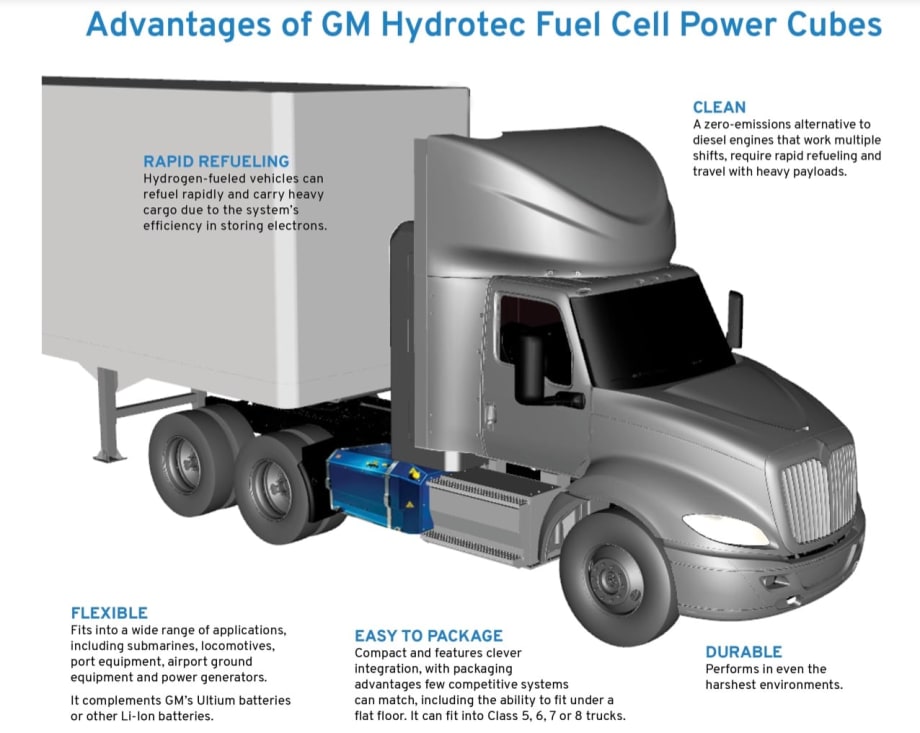
Photo: GM
3 min to read
Navistar is introducing a hydrogen fuel-cell semi truck for customer implementation through a new zero-emission long-haul system in collaboration with General Motors and OneH2.
Navistar plans to make its first production model International RH Series fuel cell electric vehicle (FCEV) commercially available in model year 2024, according to Navistar. Test vehicles are expected to begin the pilot phase under the new, complete solution at the end of 2022. The integrated solution will offer a target range of more than 500 miles and a hydrogen fueling time of less than 15 minutes.
General Motors will supply its Hydrotec fuel cell power cubes to Navistar for use in the International RH Series, the automaker siad. Navistar's FCEV will get energy from two GM Hydrotec fuel cell power cubes.
The system will be initially piloted by J.B. Hunt Transport, Inc., a subsidiary of J.B. Hunt Transport Services, Inc.
"Hydrogen fuel cells offer great promise for heavy duty trucks in applications requiring a higher density of energy, fast refueling and additional range," said Persio Lisboa, Navistar president and CEO. "We are excited to provide customers with added flexibility through a new hydrogen truck ecosystem that combines our vehicles with the hydrogen fuel cell technology of General Motors and the modular, mobile and scalable hydrogen production and fueling capabilities of OneH2."
Each Hydrotec power cube contains 300-plus hydrogen fuel cells along with thermal and power management systems. They are compact and easy to package into many different applications.
The combined propulsion system within the International RH Series FCEV will feature better power density for short-range travel, better short-burst kW output and a per-mile cost expected to be comparable to diesel in certain market segments, according to the companies.
"GM's vision of a world with zero emissions isn't limited to passenger vehicles. We believe in EVs for everyone," said Doug Parks, GM executive vice president of Global Product Development, Purchasing and Supply Chain. "We're thrilled to work with like-minded companies like Navistar and OneH2 to offer a complete solution for progressive carriers that want to eliminate tailpipe emissions with a power solution that can compete with diesel."
Under its partnership agreement with Navistar, OneH2 will supply its hydrogen fueling solution, which includes hydrogen production, storage, delivery and safety. In addition, Navistar is taking a minority stake in OneH2. Through its affiliates, OneH2 plans to kickstart substantial hydrogen heavy truck refueling infrastructure by incorporating more than 2,000 International RH Series FCEVs into existing truck fleets in the near term.
These newly announced collaborations with General Motors and OneH2 represent new milestones in Navistar's phased development of hydrogen fuel cell solutions. These technologies leverage Navistar's battery electric vehicle platforms and provide the customer with a single-source, fully integrated zero-emission solution that includes vehicles, fueling and service, according to the company.
Topics:Hydrogen Fuel Cell VehiclesGeneral MotorsHeavy-Duty TrucksNavistarGreen FleetVehicle Insights
Originally posted on Automotive Fleet
More Green Fleet

Fleet Forward Conference Introduces One-Day Passes for 2026
New one-day registration gives fleet professionals the flexibility to attend Tuesday, Wednesday, or Thursday, with passes available for $199 through Sept. 18.
Read More →
CALSTART Rebrands as Catalyst Mobility, Will Combine with Forth in 2027
CALSTART has rebranded as Catalyst Mobility and will combine with Forth at the start of 2027. The new organization said it is poised to become one of the world's largest, strongest, and most impactful clean transportation nonprofits.
Read More →
Electric Truck and Charging Programs to Boost Sustainability at NY & NJ Ports
Together, the Port Authority of New York and New Jersey and CALSTART will electrify drayage and terminal operations serving the East Coast’s busiest container port. A pair of incentive programs totaling $45 million has launched to accelerate adoption of zero-emission drayage trucks and terminal tractors.
Read More →

Xos Hub Surpasses One Gigawatt-Hour of Energy Delivered in the Field
A single Xos Hub has surpassed one gigawatt-hour of energy across more than 33,600 charging sessions in the field, demonstrating performance that supports Xos' expansion across new products and markets.
Read More →
Carrier Transicold Launches All-Electric Vector 8200 TRU for Diesel-Free On-Site Cold Storage
Carrier Transicold’s first engineless multi-temperature TRU helps fresh- and frozen-food fleets add supplemental cold storage capacity during seasonal peaks.
Read More →
Narro Trucks Introduces Electric Utility Vehicle
Narro Trucks officially launched its operations on Aug. 20 and hosted a ride and drive to showcase its electric truck, which will be produced in Virginia.
Read More →
Samsung SDI Takes Full Control of GM Battery JV as Indiana Plant Pivots to Energy Storage
Samsung SDI is taking full control of its Indiana battery plant with GM, marking a major shift from the EV-focused joint venture Charged Fleet first covered in 2023.
Read More →
NWSA Taps CALSTART to Administer Zero-Emission Drayage Assistance Program
CALSTART will provide free technical assistance services to drayage fleets serving the Ports of Seattle and Tacoma and looking to transition to cleaner technologies and help decarbonize freight hubs.
Read More →
EV Fleet Reality Check: What Operators Wish They Knew Before Electrifying Their Work Vans
Electric work truck upfits bring new compatibility questions. Learn how parts availability, OEM guidance, power demands, and route planning can affect fleet performance.
Read More →
Peterbilt Expands Sourcewell Partnership with Electric Vehicle Lineup
Peterbilt Motors Company’s cooperative purchasing agreement with Sourcewell and its Canadian partner, Canoe Procurement Group, now includes including Peterbilt's battery-electric vehicle lineup.
Read More →