




Watch: Sawatch Labs Guides Fleets Through the Transition to Electrification
CALSTART Adds 64 New Sites and Features to Its Medium- and Heavy-Duty Zero-Emission Infrastructure Map
CALSTART’s interactive National Medium- and Heavy-Duty Zero-Emission Infrastructure Map now locates approximately 1,500 ports at 162 total public, semi-public, and shared electric vehicle (EV) charging and hydrogen refueling facilities for Class 2b-8 trucks.
from News/Media Release
May 5, 2026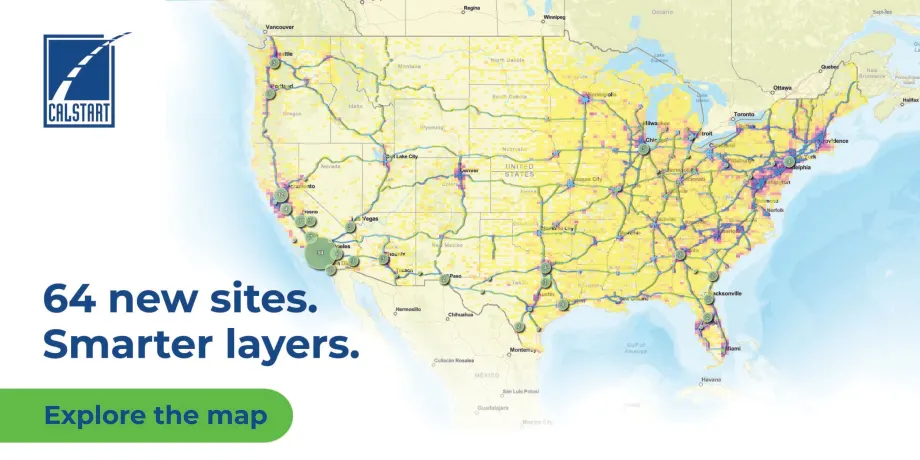
CALSTART has added more charging and hydrogen fueling locations to its National Medium- and Heavy-Duty Zero-Emission Infrastructure Map.
Credit:
CALSTART
3 min to read
- CALSTART has expanded its National Medium- and Heavy-Duty Zero-Emission Infrastructure Map with 64 new sites and features.
- The map now identifies approximately 1,500 ports across 162 public, semi-public, and shared charging and refueling facilities.
- Facilities cater to Class 2b-8 trucks, enhancing support for medium- and heavy-duty zero-emission vehicles.
*Summarized by AI
CALSTART, a leading clean transportation nonprofit, has updated its National Medium- and Heavy-Duty Zero-Emission Infrastructure Map, which now lists approximately 162 total infrastructure facilities in 17 states for medium- and heavy-duty trucks.
These additions are consistent with trends noted in CALSTART’s latest Zeroing in on Zero-Emission Trucks report, co-written by Trucks Project Manager Jacob Richard.
Enhancements to the map include:
- The addition of 64 new EV charging and hydrogen refueling sites.
- A new phasing-in strategy overlay showing how current charging availability compares with the broader network buildout projected in CALSTART’s Phasing in U.S. Charging Infrastructure Strategy. This is also consistent with the American Council for an Energy-Efficient Economy’s recent Pathways to Zero-Emission Freight report.
- Grid-capacity scenario layers showing projected peak load in 2026, 2030, and 2035, with managed and unmanaged charging scenarios that highlight where charging demand may place greater pressure on the grid and where additional planning or investment may be needed.
"This isn’t just a map of available ports; it’s a map of progress towards publicly available charging, which the industry needs to transition. The most detailed and accurate map on site features specific to trucking, it allows fleets and shippers confidence that these solutions will work with their needs,” said CALSTART’s program manager, Corridor Planning, Michael Joseph, lead author of the Phasing in U.S. Charging Infrastructure Strategy. “Fleets and shippers can also use it to shift plans to electrify sooner: They can connect with a public site developer to use their site if their own depot facilities are hampered by utility delays."
With this engaging tool, truck drivers can see where to access over 1,500 total EV charging plugs and 32 hydrogen refueling nozzles from leading operating organizations with a click of the mouse.
Background on the Infrastructure Map
Public and private charging networks are still maturing, making this a challenge to overcome for the next wave of zero-emission truck adoption, according to the latest Zeroing in on Zero-Emission Trucks report. While some key travel corridors, such as the I-5 or I-10, are ramping up public infrastructure development, other major highway systems, including I-80 and I-95, are still undergoing planning. Priority hubs based on freight volumes in Phase 1 are identified in the National Zero-Emission Freight Corridor Strategy.
Launched in 2024, CALSTART’s Medium- and Heavy-Duty Infrastructure Map helps truck drivers easily locate electric charging and hydrogen refueling stations from coast to coast and remains one of the leading publicly available U.S. resources for tracking key features related to truck charging; by doing so, this tool offers a more complete picture of charging availability.
“We work with the infrastructure providers to keep this map up to date,” said Jacob Richard. “Fleets need to know what charging or refueling stations are out there so that they can make informed decisions about acquiring zero-emission trucks for their fleet. We make sure that every station is quality-checked to be accessible for zero-emission trucks. Every station listed is available for fleets to use with confidence, and this is the only centralized map that truly provides that.”
More Green Fleet

Fleet Forward Conference Introduces One-Day Passes for 2026
New one-day registration gives fleet professionals the flexibility to attend Tuesday, Wednesday, or Thursday, with passes available for $199 through Sept. 18.
Read More →
CALSTART Rebrands as Catalyst Mobility, Will Combine with Forth in 2027
CALSTART has rebranded as Catalyst Mobility and will combine with Forth at the start of 2027. The new organization said it is poised to become one of the world's largest, strongest, and most impactful clean transportation nonprofits.
Read More →
Electric Truck and Charging Programs to Boost Sustainability at NY & NJ Ports
Together, the Port Authority of New York and New Jersey and CALSTART will electrify drayage and terminal operations serving the East Coast’s busiest container port. A pair of incentive programs totaling $45 million has launched to accelerate adoption of zero-emission drayage trucks and terminal tractors.
Read More →

Xos Hub Surpasses One Gigawatt-Hour of Energy Delivered in the Field
A single Xos Hub has surpassed one gigawatt-hour of energy across more than 33,600 charging sessions in the field, demonstrating performance that supports Xos' expansion across new products and markets.
Read More →
Carrier Transicold Launches All-Electric Vector 8200 TRU for Diesel-Free On-Site Cold Storage
Carrier Transicold’s first engineless multi-temperature TRU helps fresh- and frozen-food fleets add supplemental cold storage capacity during seasonal peaks.
Read More →
Narro Trucks Introduces Electric Utility Vehicle
Narro Trucks officially launched its operations on Aug. 20 and hosted a ride and drive to showcase its electric truck, which will be produced in Virginia.
Read More →
Samsung SDI Takes Full Control of GM Battery JV as Indiana Plant Pivots to Energy Storage
Samsung SDI is taking full control of its Indiana battery plant with GM, marking a major shift from the EV-focused joint venture Charged Fleet first covered in 2023.
Read More →
NWSA Taps CALSTART to Administer Zero-Emission Drayage Assistance Program
CALSTART will provide free technical assistance services to drayage fleets serving the Ports of Seattle and Tacoma and looking to transition to cleaner technologies and help decarbonize freight hubs.
Read More →
EV Fleet Reality Check: What Operators Wish They Knew Before Electrifying Their Work Vans
Electric work truck upfits bring new compatibility questions. Learn how parts availability, OEM guidance, power demands, and route planning can affect fleet performance.
Read More →
Peterbilt Expands Sourcewell Partnership with Electric Vehicle Lineup
Peterbilt Motors Company’s cooperative purchasing agreement with Sourcewell and its Canadian partner, Canoe Procurement Group, now includes including Peterbilt's battery-electric vehicle lineup.
Read More →