





Want More? The Impact of CAFE on Fleet Procurement
Understanding the Upcoming Truck CAFE Standards
Following the successful adoption and implementation of the National Program for greenhouse gas (GHG) and fuel economy standards for 2012-2016 model-year vehicles, the federal government is stepping up the program’s goals.
March 12, 2014
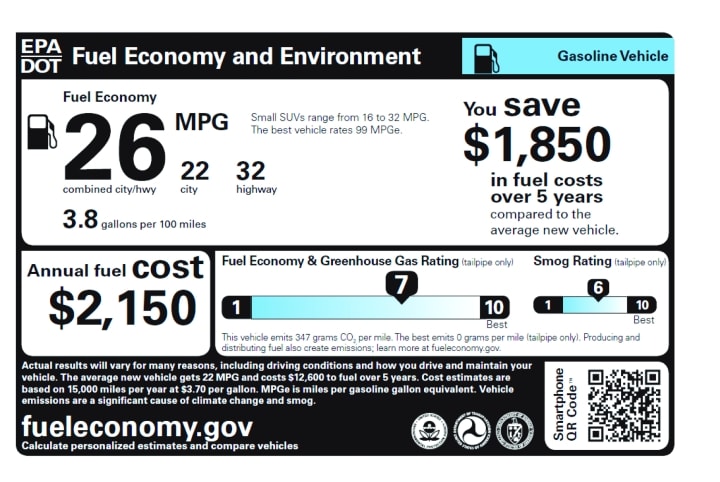
As vehicle fuel economy becomes increasingly important to both consumers and fleet managers, the upcoming CAFE standards are requiring manufacturers to take a very close look at how they can impact these numbers.
Photo: Fueleconomy.gov
6 min to read
Increased corporate average fuel economy (CAFE) standards are coming, with new goals for 2017-2025 model-year light- and medium-duty vehicles. While final details are yet to be set in stone, a regulatory announcement from the U.S. Environmental Protection Agency (EPA) helps outline a few of the coming changes, and discusses what automakers will most likely be doing to help meet these more stringent regulations.
The CAFE standards are set by the EPA and the National Highway Traffic Administration (NHTSA), and will apply to passenger cars, light-duty trucks, and medium-duty passenger vehicles model-years 2017-2025. According to the Federal Register, generally, the term ‘‘light-duty vehicle’’ means a passenger car, the term ‘‘light-duty truck’’ means a pickup truck, sport/utility vehicle, or minivan of up to 8,500-pounds GVWR, and ‘‘medium-duty passenger vehicle’’ means a sport/utility vehicle or passenger van from 8,500- to 10,000-pounds GVWR.
Considering the recent announcements regarding several 2015 model-year vehicles coming shortly, 2017 model-year vehicles are right around the corner. Work Truck magazine has summarized these findings to help fleet managers understand how this could impact fleet operations moving forward.
What are the CAFE Standards?
The final rules will extend the National Program for greenhouse gas (GHG) and fuel economy standards, originally issued for 2012-2016 model-year vehicles, to 2017-2025 model-year units. The EPA is establishing GHG emissions standards under the Clean Air Act, and NHTSA is establishing CAFE standards under the Energy Policy and Conservation Act, as amended by the Energy Independence and Security Act.
The 2012-2016 CAFE standards is projected to result in an average light-duty vehicle tailpipe CO2 level of 250 grams per mile by MY-2016, or an equivalent of 35.5 mpg, if achieved exclusively through fuel economy.
As of press time, the final 2017-2025-MY standards are projected by the EPA to result in an average industry fleet-wide level of 163 grams per mile of CO2 in the 2025-MY. This is the equivalent to 54.5 mpg, if achieved exclusively through fuel economy improvements, according to the EPA, which also noted that light-duty vehicles are responsible for nearly 60 percent of U.S. transportation-related petroleum use and GHG emissions.
So, how are the CAFE standards calculated? According to the EPA, CAFE standards are based on CO2 emissions-footprint curves. Each vehicle has a different CO2 compliance target, depending on its footprint value related to the size of the vehicle.
This plan results in the “burden of compliance” being distributed across all cars and light-duty trucks, and all manufacturers.
There are many benefits to the upcoming CAFE standards. The main, and most obvious, being cleaner air and less transportation-related pollution (a reduction of 2 billion metric tons in GHG emissions over the lifetime of all 2017-2025 MY vehicles sold). This is followed closely by overall savings at the fuel pump, fleets’ No. 1 overall operating cost.
The changes manufacturers will be required to make to meet these upcoming standards will add to the final cost of a new vehicle; however, the EPA forecasts these costs will be offset by overall fuel cost savings.
These updated standards will also result in an overall reduced dependency on foreign oil sources, with the EPA projecting a savings of approximately 4 billion barrels of oil over the lifetime of the vehicles sold under the program.
Achieving the 2017-2025 Goals
While automakers are hesitant and most often unable to discuss future product plans, it’s likely that many of the technologies currently in use or being pioneered today will be large factors in how OEMs will meet these increasingly stringent standards.
The EPA is projecting that manufacturers will be utilizing a wide-range of the following technologies to comply with the upcoming standards, including:
Continual advances in gasoline engines and transmissions.
Vehicle weight reduction (lightweighting).
Lower rolling resistance tires.
Tightening of vehicle aerodynamics.
Use of diesel engines and advancements in the internal combustion engine (ICE).
Fleet elctrification, hybrid/plug-in vehicles.
Stop-start technology.
More efficient vehicle air conditioning systems.
Use of alternative refrigerants with lower hydrofluorocarbon emissions.
Just about every manufacturer is marketing lightweight, high-strength materials, mostly on the pickup truck side of the equation.
Beyond tangible and physical changes to the vehicle and related technologies that will be made to meet the upcoming standards, provisions called “compliance flexibilities” are also offered to OEMs. These provisions are available to assist OEMs to gather sufficient lead time to make necessary technological changes and reduce the overall cost of the program, as well as provide incentives to facilitate market penetration of more advanced vehicle technologies, according to the EPA.
Credit Banking and Trading. This program is unchanged from the 2012 to 2016-MY. Credits may be carried forward or banked for five years, or carried back three years to cover a previous year deficit. An OEM can transfer credits across all vehicles it produces, both cars and light trucks. Trading between companies is also permitted. A further provision to extend carrying credits forward beyond five years is currently under review.
Air Conditioning Improvements. Manufacturers will be able to generate CO2-equivalent credits to comply with CO2 standards for improvements in A/C systems that reduce tailpipe CO2 through efficiency improvements and for reduced refrigerant leakage through better components and/or use of alternative refrigerants with lower global warming potential.
Off-Cycle Credits. These off-cycle technologies achieve CO2 reductions that are not reflected in current test procedures, according to the EPA. Such technologies can include solar panels on hybrids, engine stop-start, or active aerodynamics.
Incentives for Electric Vehicles (EVs), Plug-In Hybrid Vehicles (PHEVs), Fuel-Cell Vehicles (FCVs), and Compressed Natural Gas (CNG) vehicles. The EPA is finalizing an incentive multiplier for compliance purposes for all aforementioned alternative-fuel vehicle types sold in the 2017 to 2021-MY. Each of these vehicles will count as more than one vehicle in the OEMs’ compliance calculations.
Incentives for Advanced Technologies. The EPA is finalizing an additional CO2 per vehicle credit for mild and strong hybrid electric full-size pickup trucks, if the advanced technology is utilized across a designated percentage of an OEM’s full-size pickups.
Treatment of CNG, PHEV, and Flexible Fuel Vehicles (FFV). The EPA is also finalizing a methodology for determining CO2 levels for PHEVs and dual-fuel CNG vehicles. As proposed, the EPA is not establishing a utility factor for FFVs using E-85 and gasoline.
Provisions for Intermediate and Small Volume OEMs. The EPA provided less stringent CO2 standards (through MY-2016) for OEMs with U.S. sales of less than 50,000 vehicles under the Temporary Lead time Allowance Alternative Standards (TLAAS) program. For the 2017 to 2025-MY, the EPA is proposing an additional lead-time flexibility to intermediate volume OEMs to help ease the transition, available through the 2020-MY.
The EPA is allowing small volume manufacturers (SVMs) with U.S. sales of less than 5,000 vehicles to petition the EPA for alternative CO2 standards, which will be established for eligible OEMs on a case-by-case basis. Finally, if an OEM is able to demonstrate that it is operationally independent from its parent company and has U.S. sales of less than 5,000 units, it will be eligible for the SVM GHG provision.
Subscribe to Our Newsletter
More Fuel

The Smart Way to Build a Mixed-Energy Fleet Isn’t About Picking a Side
Mixed-energy fleets aren’t about picking a winning fuel. Sarah Booth of WEX explains how vehicle data, duty cycles, charging strategy, and real-world costs can help fleets choose the right energy source for each job.
Read More →
Ignoring This Dashboard Warning Could Cost Your Fleet Thousands in Fuel
New research suggests neglected diesel aftertreatment systems could waste up to $30 in fuel per vehicle each day. Here's why vocational fleets should pay attention.
Read More →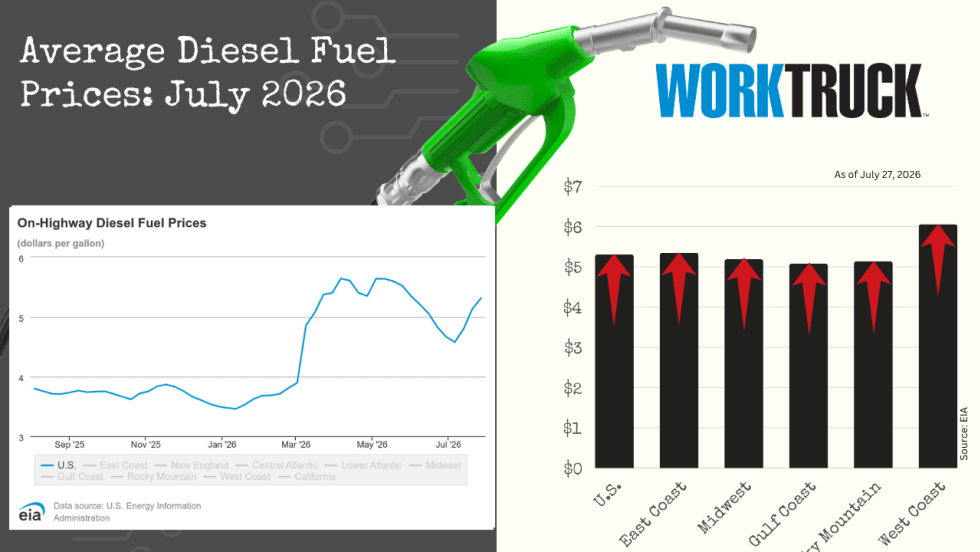
July Diesel Trends Update
The average price of a gallon of diesel increased again this week, and the EIA reported a new national average of $5.31 at the start of the week.
Read More →
WEX Brings Standard Fleet's Connected Vehicle Platform to Fleet Customers
This week’s product launch with Standard Fleet’s connected vehicle platform reflects WEX Venture Capital's strategy of turning startup innovation into customer solutions. Standard Fleet is now available to WEX fleet customers.
Read More →
Teletrac Navman Adds Mixed-Energy Fleet Tools to TN360
The new Energy Hub combines fuel transactions, EV charging data, vehicle range, and energy costs in one dashboard for fleets operating multiple vehicle and energy types.
Read More →
WEX DriverDash adds CITGO, Expands Nationwide Access for Fleets
The DriverDash mobile payment app, by WEX, has been integrated into the CITGO merchant network, which means WEX has expanded its U.S. station footprint with the addition of approximately 4,000 CITGO locations.
Read More →
Mixed Energy Fleet Tips for Balancing EVs, Gas and Diesel Vehicles
Mixed energy fleets are becoming the new normal. Learn how fleet managers are balancing EVs, gas and diesel vehicles while controlling costs and planning for the future.
Read More →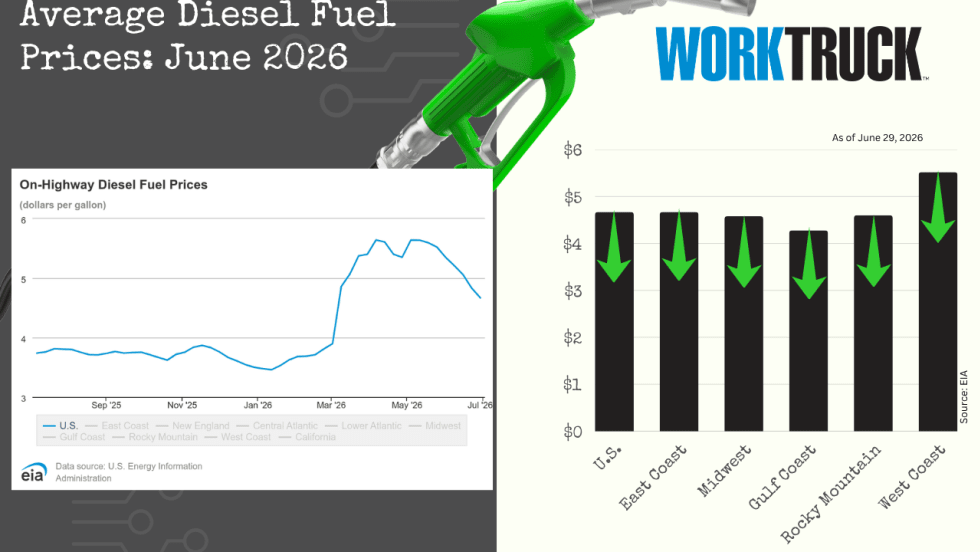
June Diesel Trends Update
The national average price of a gallon of diesel has dropped again, this week by more than 16 cents. All five regions reported lower average prices, ranging from almost 13 cents to more than 28 cents cheaper than a week ago.
Read More →
RoadFlex Launches RoadFlex Direct Open API Platform
RoadFlex Direct connects fuel cards, controls, and data to the telematics and fleet management systems fleets already run, from Geotab and Samsara to Fleetio and RTA, with no separate dashboard or double data entry.
Read More →
The Key to Fuel Efficiency Sits in the Cab
Learn how driver behavior, telematics, coaching, and fuel data can help fleets improve fuel efficiency, lower costs, and reduce emissions.
Read More →