




Small Delivery Fleet Chooses Full-Service Leasing Option
This delivery service fleet opted for full-service leasing to maintain its trucks and reduce the stress of unexpected repairs.

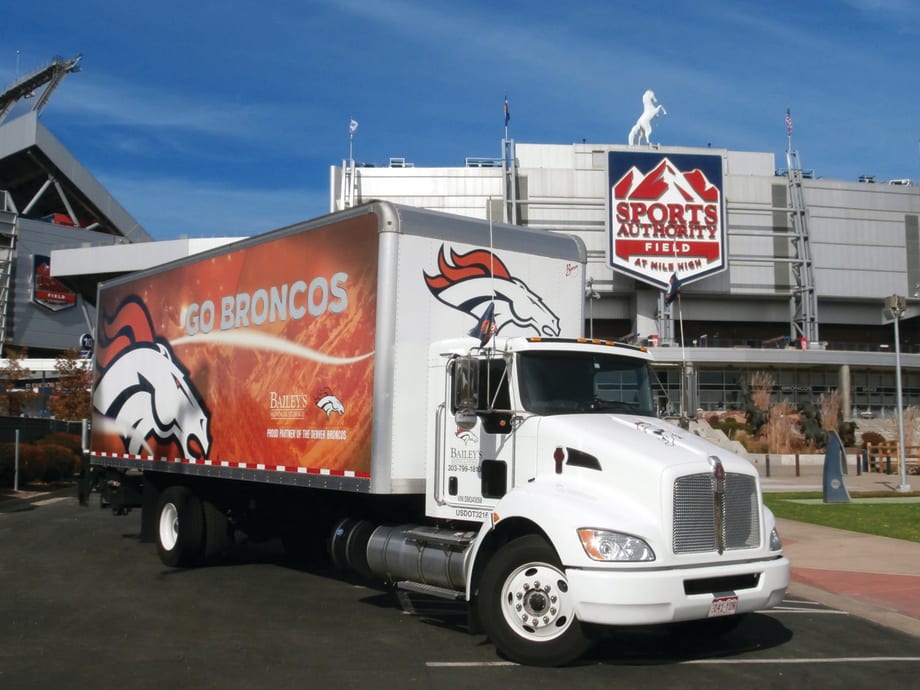
One of Bailey's trucks has become a popular photo-op for Denver Broncos fans. Decorated with the Broncos colors and logo, this Kenworth truck delivers the team's equipment.
Photo: Bailey
With 18 to 25 deliveries per day, regular maintenance is essential to keeping Bailey’s Logistics’ delivery trucks on the road.
Part of Bailey’s Moving and Storage, the logistics department’s 50-vehicle fleet is spread between its four U.S. locations, including Denver, Oklahoma City, Salt Lake City and Birmingham, Ala.
Initially owning all of its trucks, the wear and tear from stop-and-go driving was leading to serious maintenance issues by 200,000 miles — or in some cases 175,000 miles. For Chad Johnson, this meant more instances of breakdowns and higher maintenance expenses.
“Our mechanics couldn’t keep up and trying to budget for transportation became a guessing game — repairs were getting out of hand,” says Johnson, who serves as Bailey’s executive manager. “And equipment reliability began to affect our performance. If we missed a delivery day due to an out-of-service truck, that meant calling customers and working with them to reschedule.”
Leaning into a Full-Service Lease
To reduce maintenance costs and better meet DOT regulations, Johnson decided to go with a full-service lease.
Additionally, leasing helps from a budgeting perspective.
“We have our lease payment and can budget appropriately,” says Johnson. “Before, we couldn’t really budget. If one of our trucks broke down, we’d have to call around and get the vehicle towed and then find a replacement vehicle. And who knew what the monthly repair bills could be?”
Currently, Bailey’s Logistics’ fleet is made up of all leased vehicles — a 50/50 split of Hino 268s and Kenworth T270 trucks.
In the face of several potential leasing companies and truck options, how did Bailey’s choose a lender and the appropriate trucks to fit its delivery needs?
After using one truck leasing company for several years, Johnson wasn’t completely satisfied with the service provided. To begin the selection process, he started reaching out to other vehicle leasing companies.
MHC, a PacLease franchise in Denver, provided Bailey’s with Hino and Kenworth trucks as long-term rentals. These “test drives” provided drivers with the opportunity to drive the trucks during their daily deliveries and then report their feedback, according to Johnson.
By test driving several truck models — including International, Freightliner, Hino and Kenworth — for three to six months, Bailey’s was able to assess each truck’s performance, maintenance expenses and miles per gallon.
In the end, the Kenworth T270 Class 6 truck topped the competition with the fewest maintenance issues and highest miles per gallon — while hauling Bailey’s daily delivery weight.
After renting the Kenworths for six months, Bailey’s signed a lease contract with MHC for three Kenworth T270s. In 2013, Bailey’s added 10 more Kenworth T270s to the Denver fleet, two more to the Salt Lake City fleet and five more in Oklahoma City.
Working with MHC, Bailey’s closed-end, 48-month leases include a two-year opt-out clause, according to Johnson. “Most of our work involves contracts, so we don’t want to be tied into a lease for an extended amount of time.”
To keep the trucks up and running during the lease period, MHC’s full-service lease includes regular scheduled maintenance checks.
Every two weeks, MHC comes out to Bailey’s work site to take care of smaller maintenance issues, such as replacing windshield wipers or light bulbs, according to Johnson. For more thorough maintenance checks, MHC will take the trucks off-site for repairs.
Additionally, MHC provides Bailey’s with metrics and data on each truck after a trip to the shop. “It gives information on miles per gallon, idle percentage readings and hard-braking reports,” says Johnson. “If we can increase miles per gallon and decrease idling time, overall it helps us to reduce expenses.”
More Leasing & Management
Wheels Names Matthew Cole President to Advance Fleet Technology and Growth
Matthew Cole brings more than 30 years of automotive and technology leadership to Wheels, including experience with connected and software-defined vehicle technologies.
Read More →
Why Fleets Need More Flexibility in Financing and Asset Strategy
Vehicle costs, resale values, and demand keep shifting. See how fleets can balance leasing, financing, ownership, and rentals without adding unnecessary complexity.
Read More →
What Mike Albert Fleet Solutions’ New CEO Says Will Change for Fleets
Martin Kuhn explains why investments in technology and people are coming, but access to personal customer service must remain the same for fleets of every size.
Read More →
Inside AP Fleet Management’s Move From Financing to Fleet Services
AP Fleet Management President Alex Coveney explains how the company grew from equipment financing into fleet services and what shaped its customer-first approach.
Read More →
Mike Albert CEO Marty Kuhn Sees Technology and Upfitting Driving Fleet Success
New CEO Marty Kuhn highlights work-ready upfitting, fleet technology, and AI-powered insights as key parts of Mike Albert's strategy.
Read More →
Union Leasing Announces New Identity as Moventum Fleet Management
Union Leasing becomes Moventum Fleet Management, reflecting its expanded focus on full-service fleet management and growth.
Read More →
Merchants Fleet Evolves FleetShare
Merchants Fleet’s upgraded FleetShare platform boosts efficiency with keyless access, real-time data, telematics integration, and tools for smarter, scalable fleet management.
Read More →
Element and Motus Team Up to Offer Smarter Mobility Options for Fleets
The goal? Help companies optimize costs, simplify compliance, and support drivers, no matter what they’re driving.
Read More →
Fleet Managers: It's Time to Evaluate Your FMC!
Help shape fleet services! Share your insights in the 2025 Fleet Management Company Research survey. Quick, anonymous, and impactful for fleets of all sizes.
Read More →
PacLease News: PacLease Celebrates 45th Anniversary
Paccar Leasing’s PacLease marks 45 years of full-service leasing operations, growing from 17 franchises to a global network supporting nearly 41,000 vehicles across five countries.
Read More →