




Related: 6 Questions to Consider When Evaluating Lightweight Materials for Truck Upfits
Lightweighting for Fleet: Less is More
The process of lightweighting a fleet of vehicles involves more than simply moving down a vehicle class or removing weight from an overloaded vehicle.
by Greg Thompson
May 16, 2016
The lightweight, Reading aluminum CSV comes equipped with such features as Dual-Pro door seals, stainless steel SMART Latch rotary paddle locks, and patented hidden hinges.
Photo: Reading
9 min to read
A time-tested way to save money has long been to do the same job with a lighter vehicle. When done properly, reducing poundage in small to medium trucks via lightweighting can improve fuel efficiency, reduce wear-and-tear, and boost available payload.
The trick, according to Kevin Trainor, director of sales at Dejana Truck and Utility Equipment Companies, is to know what clients truly need.
“Qualification of the customer is important,” said Trainor, a veteran of more than four decades in the truck business. “If you sell a fleet manager an aluminum dump body, it’s always best to know what it’s intended use and the expected payload will be.”
For those who are not going to “abuse” their trucks, Trainor confirmed that lighter alloys, such as aluminum, have become much tougher and stronger and are trending on the medium-duty side.
“There are also some companies coming up with a honeycomb panel for a side wall in a van,” Trainor added. “For a full-size van, that will be lighter per square foot than a fiberglass reinforced plywood (FRP) wall. At Dejana, we are being asked to build a traditional body, which is either FRP or an aluminum sheet and post version.”
Dejana accommodates the steel-to-aluminum interior trend with its proprietary Katerack and DuraRack interiors.
“People have downsized from ¾-ton vans to ½-ton pickups (Ford F-150 or GM/Ram 1500 series). Another recent development was the designing of a 1500 GM chassis that a lightweight service body could be installed on. This gives the potential of going to a smaller motor, something that gets better fuel economy, can carry more people, and offer the option of four-wheel drive. Pickups can also be upfitted with work caps or toppers, such as the KnapKap. This lightweight fiberglass cap goes over the bed of the truck and can have side access doors and shelving for easy storage of equipment tools,” Trainor said.
Fueling Fleet Efficiency
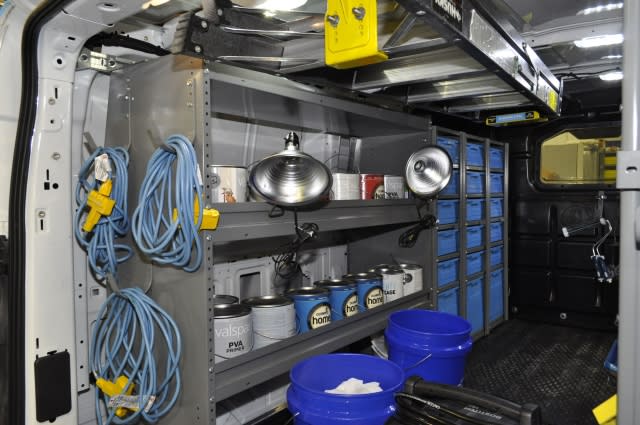
Adrian Steel uses a variety of materials in its design such as steel shelving; composite partitions; and composite parts, cases, and bins. The ladder rack is all aluminum.
Photo: Adrian Steel
Despite lower fuel costs, lightweighting continues to feed the familiar trend toward fuel efficiency, but efficiency in time spent per job is also high on the list.
Unnecessary storage equipment not only adds weight, it adds extra time spent looking for tools. Todd Goldmeyer, marketing manager, national fleets at Adrian Steel Company, has seen the cargo vans filled to the ceiling, making it difficult for technicians to quickly find what they need.
“Just think, if they could find that piece of inventory 5, 10, or 15 minutes faster,” Goldmeyer said. “We work with fleets to identify workflow, cargo, and how often they need that cargo. That allows us to design a solution around their needs. It’s not only lightweighting, but also having the right amount of inventory and making access to the inventory more efficient.”
The fleet business is built around efficiency, with fleet managers trying to “wring every dollar of profit out of their operations,” according to Greg Randolph, vice president of marketing at Decked.
In response, Decked “created a product that is really durable and very light in weight, but heavy in duty,” Randolph said.
Specifically, the company’s in-vehicle storage and organization system is made of high-density polyethylene with a galvanized steel subframe structure.
“It’s an engineered product designed to give you payload capacity without compromising overall payload capacity of the vehicle,” Randolph explained. “Decked drops into your truck and weighs between 200 and 220 pounds. It is capable of carrying 2,000 pounds. Also, it’s not a special build. Our products fit every full-size truck and van made since the late 1990s. An experienced installer can put in a Decked system in 90 minutes, because there is no need to alter the vehicle.”
Considering All Commercial Vehicle Variables
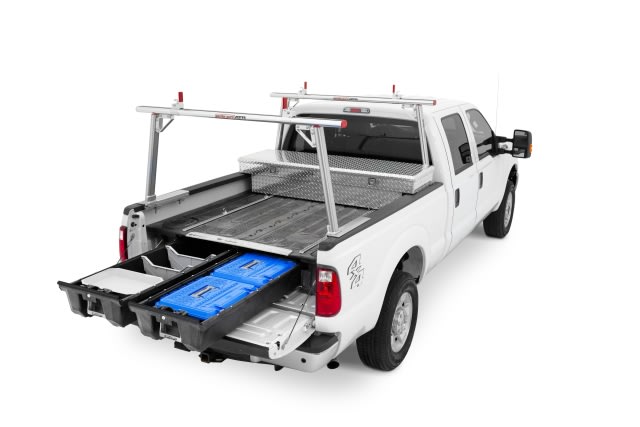
The Decked in-vehicle storage and organization system is made of high-density polyethylene with a galvanized steel subframe structure.
Photo: DECKED
Whether it’s relatively quick and easy, or more involved, any commitment to lightweighting or rightsizing a fleet will involve time and money. Carla Anglin, vice president of sales and marketing at BrandFX Body Company, noted that the right decision depends on looking at all the variables.
“Within the work truck industry, the trend is primarily rightsizing the chassis — reducing the weight of equipment via composites and aluminum, telematics, and management of daily loads,” Anglin said. “Rightsizing the chassis encompasses load management, lighter equipment, and spec’ing trucks strategically for specific jobs, rather than having a fleet of all-around work trucks. These are all tactics for accomplishing efficiency.”
In previous eras, fleet managers may have been unwilling to make changes, but not anymore.
“I would attribute this to oil prices,” Anglin said. “Although we’re in a slump, everyone expects prices to go back as high as we’ve seen them in 2007. The other driver would be the CAFE standards.”
When fuel prices went up, the BrandFX selling proposition changed to meet market demand — shifting from corrosion resistance and longer lifecycle to weight reduction and fuel and maintenance savings. And, the shift may well be permanent. “Gone are the days of ‘bigger is better’ and ‘steel tough.’ They were misnomers, anyway,” Anglin said.
Current lightweight offerings at BrandFX include standard under-structures made of aluminum or sometimes steel. The material lends itself well to the flexing and bending of aerial or under-structures applications, as well as high corrosive environments.
“We have composite applications that are able to flex a full 33 degrees on center without incurring any damage,” Anglin said. “If you can imagine the stress applied across a metal body during use of an aerial apparatus, you can see how that flexibility would be beneficial and extend lifecycle.”
BrandFX recently used its experience in composite applications to effectively move fleets from a Ford F-450 to F-350 chassis with light aerial applications — keeping 2600 pounds of workable payload by using a composite body with aluminum under-structures. And, the effects were noticeable.
“A large national fleet utilizing our 60CA composite body for aerial applications tracked their overall miles-per-gallon across their fleet to be 8 mpg on their lightweight body specification chassis versus 5 mpg on steel body applications,” Anglin said.
While admitting a certain bias, Anglin believes composite is the right answer virtually every time due to its strength-to-weight ratio and corrosion-free service.
“I predict more composites manufacturers will come into the market and that lightweight steel, magnesium, and aluminum will continue to increase,” she said. “Aluminum is by far the easier material for most manufacturers to adapt to; however, I do not believe it fits all applications. Composite is more durable and versatile, but it is a very challenging manufacturing process for a startup line. For both reasons, I expect aluminum and composite will own the future space of lightweight materials.”
Ensuring Legal Compliance
Additional reasons for “going lighter” inevitably include legal concerns.
“Particularly among fleets operating vehicles over 10,000 pounds, compliance and liability are legitimate concerns,” noted Joe Foster, national fleet sales manager at Auto Truck Group. “An overweight truck taking longer to brake, and potentially causing an accident is a serious liability that fleets don’t want to encounter,” he said.
Foster added that most fleet managers involved in weight analysis are also looking at long-term marketability at resale, and usually only when changing to a different OEM or chassis specification.
“If the lightweight components don’t exceed a premium of 20 to 25% over existing components, fleets have been more inclined to make lightweighting a priority,” he said.
The lightweighting process can pay dividends, according to Foster, particularly because service technicians are gradually taking on more job functions, while their vehicle remains the same.
“Technicians have added tools, parts, and equipment to perform all job functions. The challenge is understanding what parts and tools are really necessary to do the job and assess what equipment is needed to carry those parts and tools,” he explained.
According to Foster, the second-largest challenge is the migration to procurement-driven fleet decisions.
“Lightweight typically costs more, but may save the overall fleet in increased fuel economy, reduced maintenance, and potential liability. Understanding the operational benefits do not make it into the front-end financial considerations, but typically in the procurement decision methodology,” he said.
Companies looking to make relatively small adjustments may consider changing from metal to poly fenders, a change that Jacob Peterson, outside sales for National Fleet Products said can make an immediate impact.
“If they can take 200 pounds off in metal fenders, and put 100 pounds back on with poly, they save 100 pounds, and they can haul 100 more pounds of payload,” Peterson said. “That’s the payoff.”

With a pull-out shelf, such as the Katerack or Durarac, Dejana provides drivers with a lightweight option for easy access to their tools and equipment.
Photo: Dejana
Customizing Fleet Vehicle Concerns
With so many variables to consider, Brad Anderson, regional sales manager, Ranger Design Inc., stressed the importance of customization in any lightweighting effort.
“Whether it’s aluminum or steel, which would be a heavier option, it is highly customizable,” Anderson said. “We have a ton of options. People are looking to get the most out of their van, so they need to customize it to what their specific task is in that van, and the different products they are storing in it.”
Beyond the lightweight question, customization is a bigger one. “The other consideration is longevity,” he said.
“Not all composites are created equal, so yes it’s light, but is it going to last as long, has it been engineered properly? It comes back to crash testing, which is a good indicator of how good the product is. Until you actually start asking the right questions, you can’t really tell the difference,” Anderson noted. “The misunderstanding about lightweight is that it is weak. Take an aluminum product versus a steel product. Aluminum can be twice as strong by weight. You have to use a thicker material to get the same strength as steel, but it will be much lighter.”
Whether using aluminum or composites, many vocational truck fleets, and large fleets such as telecoms, are beginning to look at the whole truck upfit, not only the truck body.
Fleet managers are leaning toward lower GVWR chassis to address concerns about licensing requirements, driver reporting, and internal pressures to improve fuel efficiency, productivity, and safety, according to Eric McNally, VP, sales & business development at Reading Equipment & Distribution.
“The lighter chassis requires a lighter vocational body upfit to be able to maintain capacity requirements,” McNally said. “Chassis OEMs are seeing this same pressure, and we are seeing increased use of lighter weight materials in both light- and medium-duty products.”
While there are multiple lightweight materials to use for vocational truck upfits, aluminum is again a popular solution because it is lightweight, inherently corrosive resistant, and easily recyclable. In line with this demand, Reading offers open utility/service bodies, as well as enclosed service vans.
“Through our company-owned upfit group, we also offer the organizational solutions that the industry demands,” McNally said. “Van interiors and pickup trucks are turning to aluminum for racks, bins, and shelving, as well as toolboxes. And, still the industry needs to overcome the common misconception that lighter weight means ‘light duty.’ Aluminum is a very strong and durable material, all the way from lighter gauge doors and shelving systems to the heavy-duty under-structures. One of the ways Reading is able to educate the marketplace is to back its aluminum products with a 10-year structural warranty.”
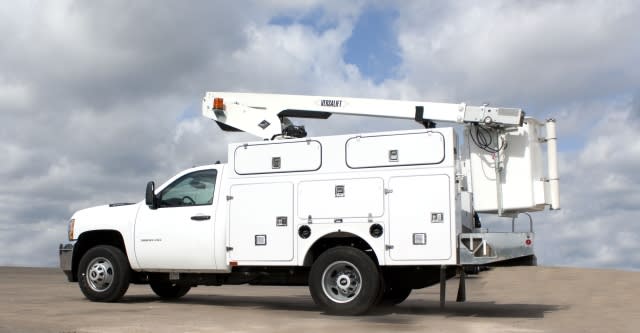
One lightweight upfit offered by BrandFX incudes a standard 9-foot Telecom Aerial Body with Top Box and Tailshelf Option and Versalift Tel29 aerial apparatus.
Photo: BrandFX
Subscribe to Our Newsletter
More Upfitting
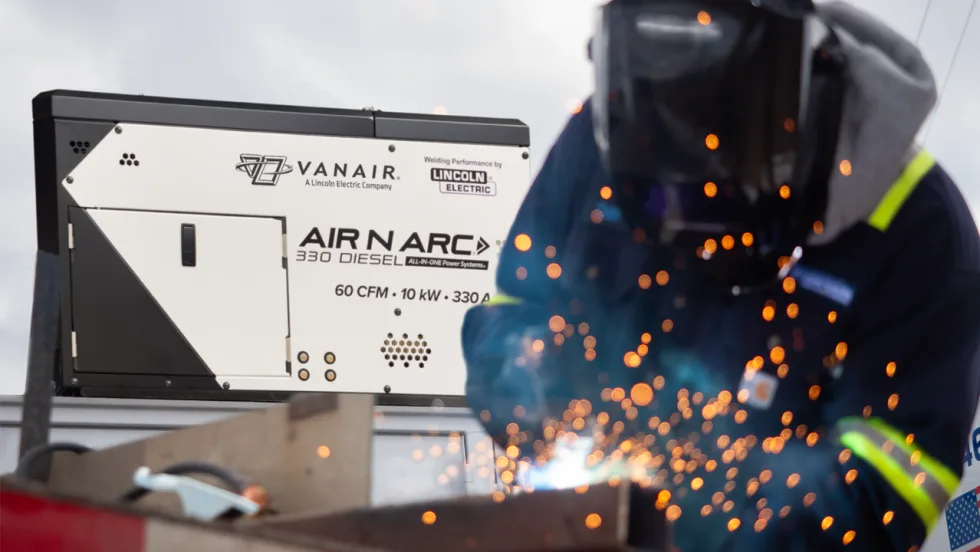
Multitasking: Vanair’s Air N Arc 330 Diesel 60 CFM All-In-One Power System
The Air N Arc 330 Diesel 60 CFM from Vanair consolidates a welder, generator, rotary screw air compressor, battery booster, battery charger, and EV charger into a single 750-pound enclosure driven by one 24.8-horsepower Kubota diesel engine.
Read More →
Buyers Products Awarded Sourcewell Cooperative Purchasing Contract for Snow & Ice Equipment
Buyers Products has been awarded a Sourcewell contract for a wide range of winter maintenance equipment and accessories, including snowplows, municipal plow systems, wing plows, spreaders, and more.
Read More →
Hilltip Introduces the SnowStriker SFT Flex Expandable Box Plow
Hilltip’s new SnowStriker SFT Flex expandable box plow features hydraulically extendable sections that allow operators to adapt the clearing width to changing conditions and applications on the go.
Read More →
Harbinger Part of Effort to Deliver Autonomous Logistics Capabilities for U.S. Army
American Rheinmetall received an 18-month U.S. Army contract to deliver autonomous, hybrid-powered uncrewed ground vehicles. Harbinger is providing the truck platform for those vehicles.
Read More →
Thinking Outside of the Box: Choosing the Right Truck Body for Your Fleet
Choosing the right truck body can have a major impact on loading efficiency, cargo protection, downtime, and long-term operating costs. Here’s how dry vans, platforms, and curtainsiders compare, plus what fleets should consider before spec’ing their next truck.
Read More →
Fourth Annual Upfit Package of the Year Awards Open for 2027 Entries: One Month Left!
Think your upfit deserves industry recognition? Enter the 2027 Work Truck Upfit Package of the Year Awards before the Sept. 30 deadline. There is less than a month left to get your submissions in!
Read More →
Reading Truck Equipment & Masterack Unite as One of North America's Largest Commercial Vehicle Upfit Networks
Reading Truck Equipment and Masterack have integrated operations to create one of North America's largest and most comprehensive commercial vehicle upfit organizations.
Read More →
Kinedyne Launches Heavy Duty Logistic Shoring Strap
Kinedyne’s new Heavy Duty Logistic Shoring Strap features a patent-pending four-point design to deliver greater cargo stability, increased strength, and easier handling for rolling and shifting freight.
Read More →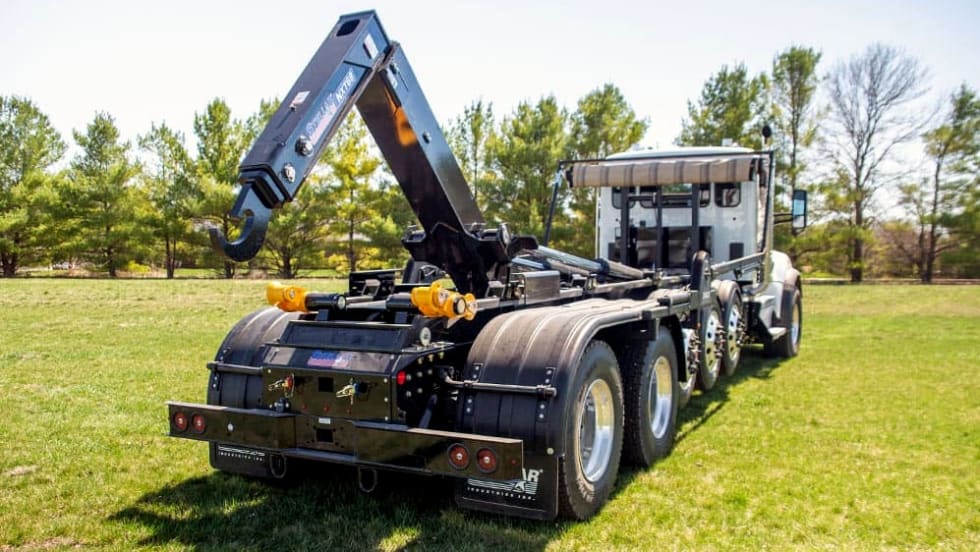
Hooklift Bumper Design from Stellar Showcases Strength & Versatility
Stellar Industries’ new bumper for the NZT Series Hooklifts come in two capacity options: the 20K, designed for Class 3 – 6 chassis with a 20,000-pound pull capacity, and the 90K, built for Class 7 and 8 chassis with a 90,000-pound pull capacity.
Read More →
Maxon Lift Awarded the Wabash Platinum Award for Supply Chain Performance
Maxon Lift, a liftgate manufacturer since 1957, received the Wabash Platinum Award for supply chain performance in 2025. Each year, Wabash presents awards to top suppliers for excellence in supply chain performance.
Read More →