





Buying Cargo Vans and Delivery Vans: Questions & Decision Points
8 Mistakes to Avoid When Ordering Medium-Duty Box Trucks
Reduce the risk of error when spec’ing and ordering box trucks, from Isuzu N-Series to the Mitsubishi Fuso Canter, don’t forget to consider the floor type.
May 7, 2012
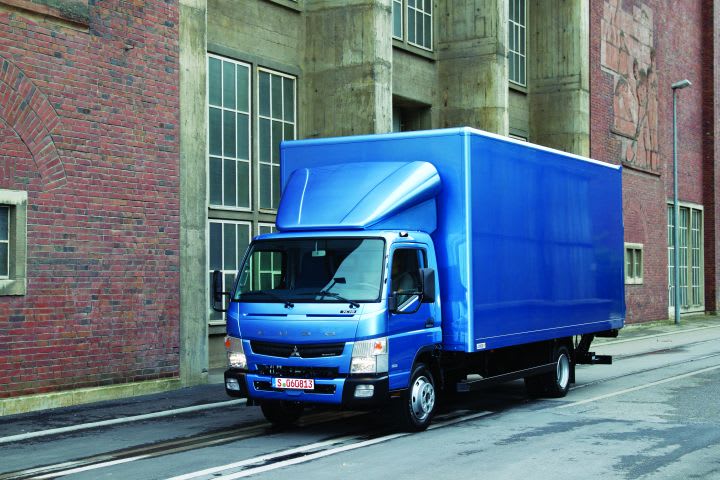
When spec’ing a box truck, such as Mitsubishi Fuso’s Canter, don’t forget to consider the floor type.
Photo: Mitusibshi Fuso
7 min to read
The truck body is too short or too long, the chassis is too light, the truck sits too low — these are just a few examples of where truck ordering specs can go wrong with medium-duty box trucks (also known as “dry van” or “dry freight” trucks).
It only takes one miscue to significantly impede employee productivity and drive up box truck costs, either to correct the mistake after the fact or to deal with premature maintenance issues caused by trying to operate the truck “as-is.”
How can fleet managers reduce their risk of error when spec’ing and ordering medium-duty box trucks? Avoid these eight mistakes:
1. Don't Select an Underweight Chassis
The objective is to achieve a balance between required cargo space and weight.
“You can put a large body on a 26,000-lb. GVW chassis to accommodate more cargo, but, if the content is heavy, you’ll max out on weight before you run out of space,” said Chris Foster, manager, vehicle acquisition services, Automotive Resources International (ARI). “So, required space should not be the only deciding factor. You need to also make sure the chassis is compatible with cargo weight at full load.”
Joseph DeMaria, owner of TruckMax, a Miami-based medium-duty truck dealership, agreed.
“Often, we‘ll have a customer call or come in and say that he needs a 24-foot box truck. When we ask, ‘What are you hauling?’ the typical response is, ‘Why do you need to know that? That’s how much space we need.’ But, it’s one thing if you’re hauling boxes of plastic beverage cups; it’s another thing if the truck will carry pallets of heavy stone or lead bars. The type of cargo could mean that you have to go higher with the GVW of the truck,” DeMaria said.
2. Problems with Mismatched Chassis & Box Lengths
The issue when reviewing mismatched chassis and box lengths is improper weight distribution relative to the rear axle.
“We’ll take a truck in on trade and the box has a huge overhang past the rear wheels,” DeMaria said. “The larger box was mounted without rolling the rear axle back, so the weight distribution was wrong. So, your front wheels get light and you start wearing out tires. The tires start cupping. It’s amazing — we see box trucks like this come in all the time.”
DeMaria advised fleet managers purchasing box trucks from dealer stock to confirm, upfront, that the chassis cab-to-axle (CA) or wheelbase length can safely accommodate the length of the body to be mounted. One way to verify this is by contacting the body’s original equipment manufacturer (OEM).
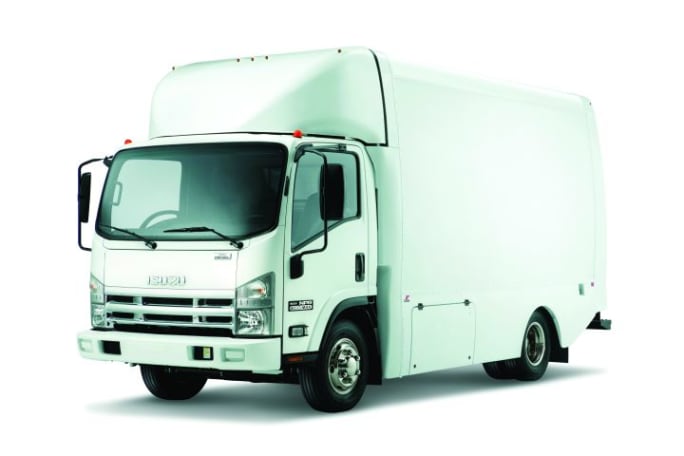
Isuzu Commercial Truck of America also offers a box truck version of its popular NPR series.
Photo: ICTA
3. Why You Shouldn't Overlook Box Height
ARI’s Foster recommended fleet managers consider any potential clearance issues in areas where the truck will be loading and unloading.
“The overall height is not always thought of in regard to low ceiling warehouses with low-hanging conduits. But, this can create major productivity issues if not taken into account,” said Foster.
4. Don't Forget About Interior Lighting
Fleet managers must know when goods will be delivered.
“If you deliver primarily at night, we need to make sure you have proper lighting inside the box. But, if you deliver during the day, a translucent roof is useful to allow natural light into the box,” DeMaria advised.
Without proper lighting inside the box, it may take employees longer to find the cargo for a specific delivery, which can slow down the job.
5. Forget About Trying to Spec a ‘One-Size-Fits-All’ Truck
Some fleets try to do too much with the wrong specification, such as purchasing a box to accommodate a variety of loads, according to Foster. Fleets know that often, from spec'ing to idle reduction efforts and beyond, one size doesn't fit all.
“Oversized trucks cost more to purchase, license, operate, and maintain. Too small a truck means it will be overweight and over-used (because it requires more trips to deliver loads comparable to a larger truck), causing higher operating costs. You need to determine how the truck’s primarily used, and then spec the proper truck,” he said.
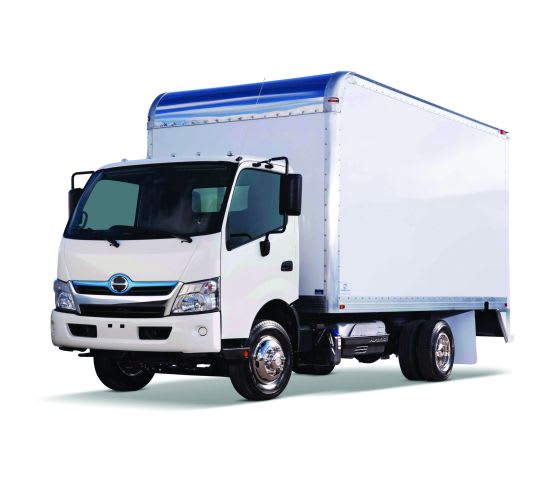
The 2012 Hino 155 box truck is one of many box truck options. When spec’ing a box truck for fleet, ensure the chassis won’t be overloaded once products or materials are loaded.
Photo: Hino
6. Don't Forget About Cargo Containment Considerations
How will a load be secured in the cargo area?
“Shifting loads will cause damage to the load and the truck interior,” Foster said. “Logistic load locks must be considered, as well as determining how many rows (of e-track or tie-downs or slats) are needed to keep the load secure.”
And, it’s not just the type of tie-downs, but also their location that fleet managers must take into account said TruckMax’s DeMaria. “You want to know how far off the floor each row of e-track should be to ensure the most efficient and productive way to secure the load,” he recommended.
7. Remember, Box Truck Floor Type Matters
Floor selection can make quite a bit of difference when ordering a medium-duty box truck, according to DeMaria, citing one of his fleet customers, a North American food, and beverage chain, as an example.
“Before the fleet came to us, it was regularly buying box trucks with hardwood floors. The fleet manager complained that, after only a few years, the hardwood would start getting rotten. I asked if he had water in these box trucks, to which he replied, ‘Yeah, actually one to two times a week we go in with a pressure cleaner and pressure wash the floor and get all food residue off and rinse it out the back,’ ” DeMaria recalled. “But, if you soak the wood and don’t dry it completely, you’re going to have a rotten floor.”
The solution: “We put in a diamond plate aluminum floor (which is corrosion resistant) and brought it up the sides [of the box] about 18 inches. In the front of the box, we put in two pipes where the water would drain,” DeMaria said. “Now, when they rinse the inside of the box, water just drains out and doesn’t damage the aluminum floor.”
8. Never Overlook Specs for Efficient Dock Delivery
If the box truck is intended for loading and unloading at a dock, this impacts three key areas of specification:
Rear door type. “Are you going to deliver the goods dock-high?” asked DeMaria of TruckMax. “If yes, a roll-up rear door (versus swing-out door) is the most viable and efficient option because if you use a swing-out door, when the driver backs up to the dock, he can’t open the doors.”
Chassis wheel size. “Light GVW trucks with boxes usually have small (19.5-inch) tires and sit lower to the ground at the back of the body, which makes it too low for dock loading and unloading,” said ARI’s Foster.
Forklift package. If a forklift will be used, which requires the truck be dock-high, this typically requires a Class 6 or larger truck with 22.5-inch wheels and tires. Choose the tire size that offers the best load height for your application. If a forklift will be used to load cargo onto the truck from a dock, spec a forklift package. This will reinforce the floor with added crossmembers, a threshold plate, and reinforced rear-end plate.
Questions to Answer When Specifying Box Trucks
The following 12 questions should be answered before placing an order:
What products or materials are being hauled?
How much do the materials weigh?
How will the product be loaded and unloaded from the body?
What are the length, width, and height requirements of the body?
Do you need interior lining for the body?
How will cargo be secured in the body?
Is a side door needed?
Will the body be hand-loaded and unloaded?
Will a forklift be used to load and unload?
Is a special type of bumper required for the body?
Is more natural light needed inside the body?
What other lighting needs are required for the body?
Types of Floors for Box Trucks
There are four typical floor options to consider with box bodies. These include, but are not limited to:
The lowest-cost option, pine floor can handle most light-duty, dry-freight applications; however, it is not recommended for heavy-duty use. Using a forklift on pine flooring is not a good fit.
Laminate hardwood is an upgrade to the pine floor and designed for heavier-duty applications.
Extra floor protection is provided by aluminum (overlaid on wood), especially important if the vehicle is carrying liquids that might spill onto the floors. Also, the aluminum counteracts corrosion for greater longevity. The downside is higher up-front cost, compared to other floor options.
Like aluminum, the steel floor (overlaid on wood) offers extra protection compared to pine and hardwood, but at a lower cost than aluminum. The downside is the steel floor must be painted, unlike aluminum, and is vulnerable to corrosion.
The Bottom Line
By steering clear of these eight mistakes, fleet managers can greatly improve the odds of spec’ing a box truck that eliminates unpleasant surprises, maximizes employee productivity, and ensures the lowest total cost of ownership.
Subscribe to Our Newsletter
More Upfitting
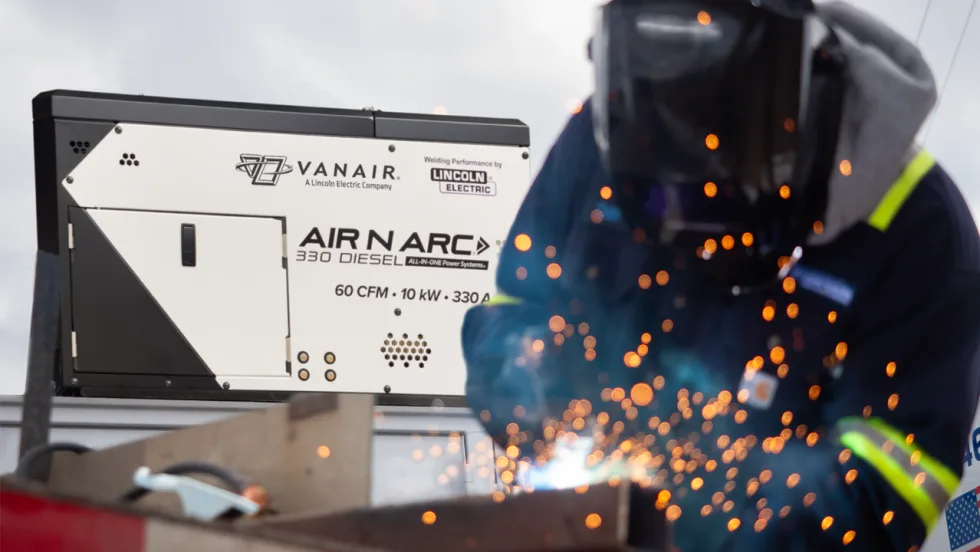
Multitasking: Vanair’s Air N Arc 330 Diesel 60 CFM All-In-One Power System
The Air N Arc 330 Diesel 60 CFM from Vanair consolidates a welder, generator, rotary screw air compressor, battery booster, battery charger, and EV charger into a single 750-pound enclosure driven by one 24.8-horsepower Kubota diesel engine.
Read More →
Buyers Products Awarded Sourcewell Cooperative Purchasing Contract for Snow & Ice Equipment
Buyers Products has been awarded a Sourcewell contract for a wide range of winter maintenance equipment and accessories, including snowplows, municipal plow systems, wing plows, spreaders, and more.
Read More →
Hilltip Introduces the SnowStriker SFT Flex Expandable Box Plow
Hilltip’s new SnowStriker SFT Flex expandable box plow features hydraulically extendable sections that allow operators to adapt the clearing width to changing conditions and applications on the go.
Read More →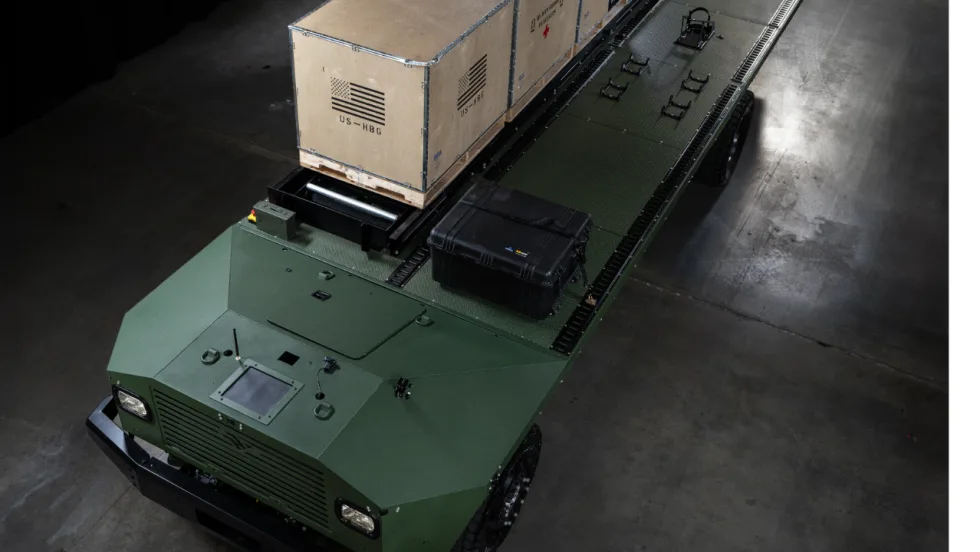
Harbinger Part of Effort to Deliver Autonomous Logistics Capabilities for U.S. Army
American Rheinmetall received an 18-month U.S. Army contract to deliver autonomous, hybrid-powered uncrewed ground vehicles. Harbinger is providing the truck platform for those vehicles.
Read More →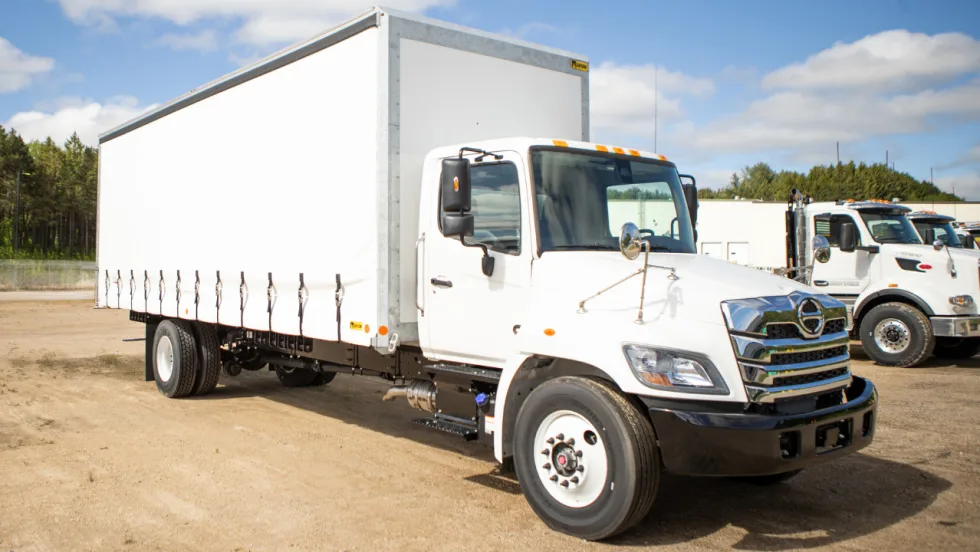
Thinking Outside of the Box: Choosing the Right Truck Body for Your Fleet
Choosing the right truck body can have a major impact on loading efficiency, cargo protection, downtime, and long-term operating costs. Here’s how dry vans, platforms, and curtainsiders compare, plus what fleets should consider before spec’ing their next truck.
Read More →
Fourth Annual Upfit Package of the Year Awards Open for 2027 Entries: One Month Left!
Think your upfit deserves industry recognition? Enter the 2027 Work Truck Upfit Package of the Year Awards before the Sept. 30 deadline. There is less than a month left to get your submissions in!
Read More →
Reading Truck Equipment & Masterack Unite as One of North America's Largest Commercial Vehicle Upfit Networks
Reading Truck Equipment and Masterack have integrated operations to create one of North America's largest and most comprehensive commercial vehicle upfit organizations.
Read More →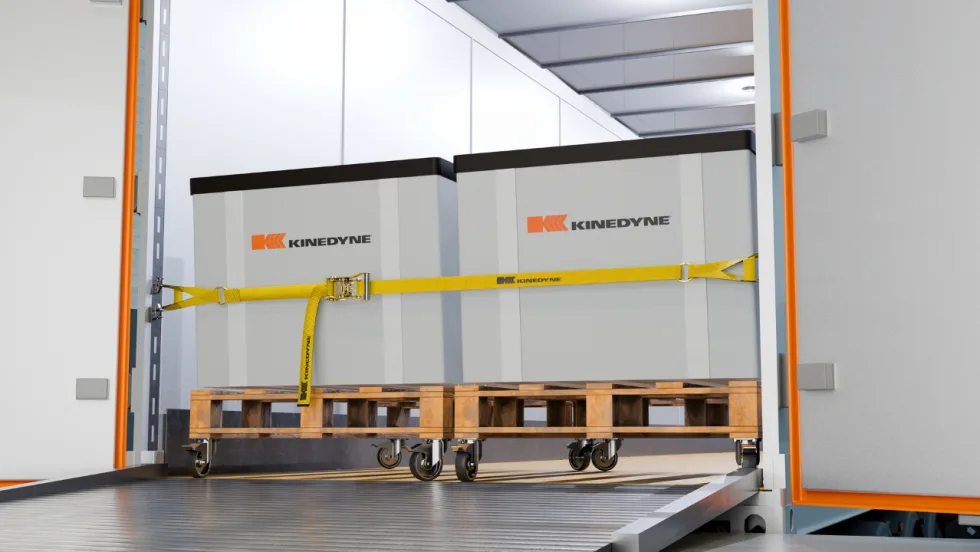
Kinedyne Launches Heavy Duty Logistic Shoring Strap
Kinedyne’s new Heavy Duty Logistic Shoring Strap features a patent-pending four-point design to deliver greater cargo stability, increased strength, and easier handling for rolling and shifting freight.
Read More →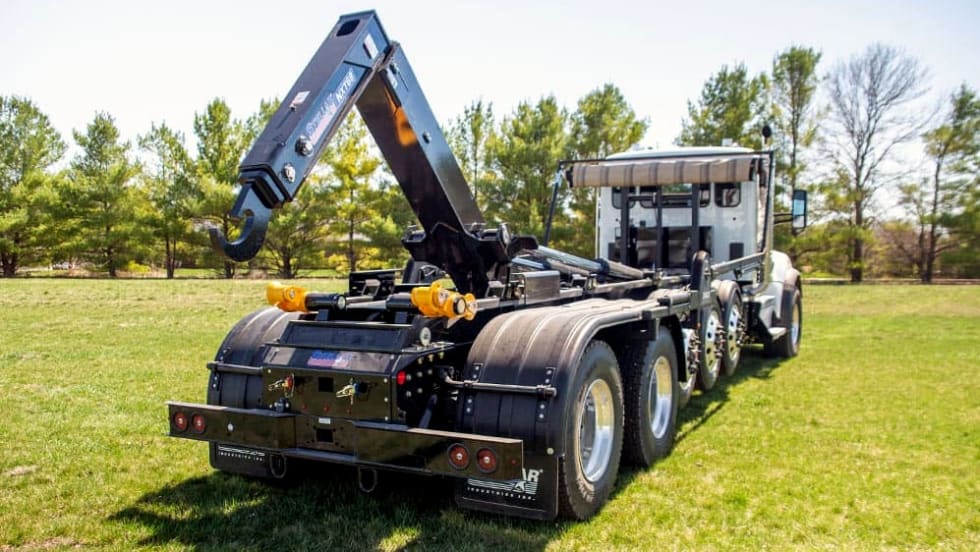
Hooklift Bumper Design from Stellar Showcases Strength & Versatility
Stellar Industries’ new bumper for the NZT Series Hooklifts come in two capacity options: the 20K, designed for Class 3 – 6 chassis with a 20,000-pound pull capacity, and the 90K, built for Class 7 and 8 chassis with a 90,000-pound pull capacity.
Read More →
Maxon Lift Awarded the Wabash Platinum Award for Supply Chain Performance
Maxon Lift, a liftgate manufacturer since 1957, received the Wabash Platinum Award for supply chain performance in 2025. Each year, Wabash presents awards to top suppliers for excellence in supply chain performance.
Read More →