




5 Things to Know When Selecting Charging Solutions for Work Truck Fleets
So, you are considering the electrification of your work truck fleet, what do you need to know before you start spending money? John Thomson, global head of sales for Ampure, provides 5 things you need to consider.

What 5 things do you need to know when considering electric work truck charging?
Photo: Ampure/Work Truck
As work truck fleets explore electrification options, there are many considerations and decisions a fleet manager will face. Becoming knowledgeable in advance can ease the transition. What does someone need to know?
But first, where are work truck fleets currently in the transition to electric?
“It's a mixed bag of where people are on their journey today. You have fleets that either they've really stepped into the water, or some are just dipping their toe in and trying to find their way,” said John Thomas, global head of sales for Ampure.
Ampure is a leader in electric vehicle and industrial charging solutions with more than 20 years of industry expertise. The company is trusted by original equipment vehicle manufacturers (OEMs), charge point operators (CPOs), fleet operators, airports, and plant operators as a manufacturer of innovative and high-quality EV charging technologies.
Thomas pointed out that for some fleets, a transition to electrification can pose a challenge in a number of ways. For those fleets with a common yard, the location may not be ready to support electrification.
A fleet must engage the utility company early to learn if they can provide adequate power on-site for charging needs. Fleets should get ahead of the curve by consulting with a certified electrical contractor who can evaluate and recommend the correctly sized switchgear, transformer, and other assets needed to support the fleet's electrical needs today and tomorrow.
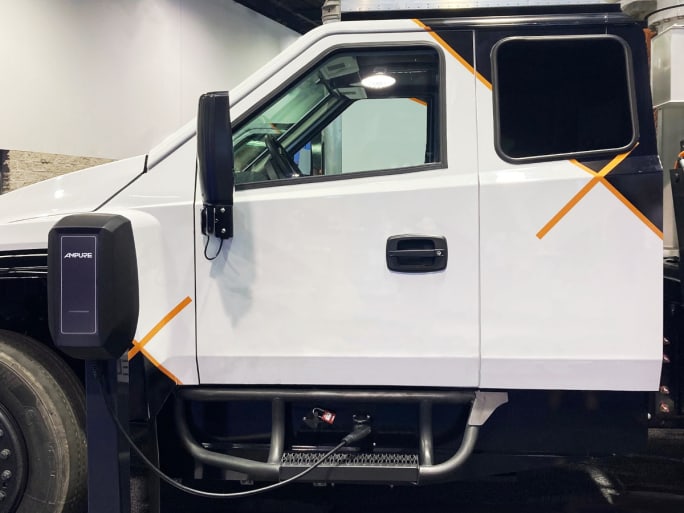
Work truck fleets need to know their specific charging needs.
Photo: Ampure
Thomas points to an example of how a fleet may contact the utility provider, only to find the infrastructure needed to support fleet charging is still three miles away. In that case, the power company may ask the fleet to pay to run the additional lines to reach the charging location. Having ample power to support charging must be planned, but Thomas said in some situations, the infrastructure may not be in place for another two or three years away. It is best to always know the status early.
“Those are all the considerations if you’re a fleet owner on this journey,” he said. “Let's start at the foundation. The foundational level is, can I get enough power for my fleet, and how many trucks, or how many vehicles do I need to electrify? The second step in this discussion is what do I need?”
If the truck fleet sits overnight at a company yard, they can be charged more slowly with a low-power solution, like AC charging. But, there still can be a need for DC fast charging at times. Another consideration would be home charging, another area of expertise for Ampure.
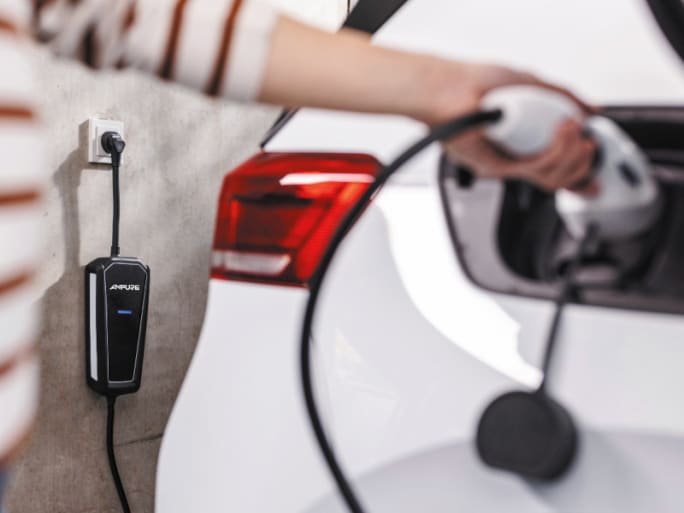
Home chargers are now compact and easy to use.
Photo: Ampure
“I would say DC charging in the work truck space is more applicable to a situational event where I have the truck, somebody forgot to plug it in last night, or I brought the truck back to the depot and I need to charge it to run back out again in a very quick and timely manner,” he explained.
Thomas said in the work truck space, most people will go for an AC charging solution that offers 32, 48, or 80 amps. However, you must be sure to pair your trucks with your chargers. With AC charging, there’s an onboard charging device. It allows you to transfer energy from the grid to the vehicle and convert it back to DC for the battery.
“That conversion device in the vehicle is a certain size. You can only put so much power through that device. So, if that device only allows you to put 48 amps of power into the battery, then hooking it up on an 80-amp system doesn't have any benefit. You just spent a lot more money on your infrastructure and didn't get the benefit for the vehicle and the charge time.”
He said fleet managers need to fully understand what they are buying, why they are buying it, and the power availability from the grid.
There are specific considerations any fleet manager should keep in mind when planning for the electrification of a fleet, or even part of a fleet.
Thomas suggested the need to consider 5 things, which are:
1. Maximize Operational Readiness
Efficiency, charging capacity, charging speed, and maximizing operational readiness involve carefully selecting the right balance between Level 2 chargers for overnight charging and DC fast chargers for rapid turnarounds. Evaluate your fleet's routes, sizes, and dispatch schedules to determine which vehicles should transition from gas to electric first.
Consider dwell times. If they are six to eight hours, Level 2 chargers are ideal; for shorter dwell times, DC fast chargers are more appropriate. Additionally, offering at-home charging solutions can be beneficial, but ensure they are reliable and consider reimbursement for energy costs.
2. Total Cost of Ownership (TCO) and Incentives
Analyzing the total cost of ownership involves looking at installation, maintenance, and energy costs. Investigate available government incentives, rebates, and grants to help offset these expenses. The operational efficiency improvements from reduced fuel and maintenance costs with electric vehicles can significantly impact your overall budget.
Level 2 charging stations are typically more efficient and cost-effective for fleet operators compared to DC fast chargers.
3. Fleet Management, Data Integration & Telematics
Opt for charging solutions that seamlessly integrate with fleet management software, allowing for comprehensive monitoring of charging status, vehicle readiness, and energy consumption. This integration is crucial for streamlining fleet operations and enabling predictive maintenance.
Platforms that provide real-time insights, usage analytics, and automated reports help optimize charging schedules and reduce costs. Such integration is particularly important for mission-critical vehicles, where immediate access to data is essential for operational efficiency.
4. Infrastructure, Location, and Safety
Assess the current infrastructure to determine if additional power supply installations or upgrades to existing electrical systems are needed. Choose optimal locations for charging stations to minimize downtime and enhance fleet productivity.
As your fleet grows, ensure your charging infrastructure can scale accordingly. Adherence to safety standards and local regulations is critical. Ensure charging solutions meet fire safety and electrical codes and establish safety protocols for operating and maintaining the stations.
5. Load Balancing and Energy Management
Select charging solutions with intelligent load-balancing capabilities to manage energy demand efficiently across your fleet's charging stations. Load balancing software prevents circuit overloads and reduces energy costs, which is crucial when multiple vehicles are charging simultaneously.
Look for energy management tools that allow setting charging priorities and optimizing times based on operational needs and peak electricity rates. Factors such as accessibility, user-friendliness, and maintenance requirements of charging stations significantly impact the overall efficiency and effectiveness of the EV fleet.
Summary: Environmental and Sustainability Goals
Thomas said you should ensure the chosen charging solutions align with your company's sustainability goals. Consider using renewable energy sources or offset programs to mitigate the environmental impact of your charging stations.
Implement policies to encourage energy efficiency and responsible charging practices within your fleet. By investing in Level 2 charging stations and ensuring proper installation, fleet operators can build a reliable and efficient charging infrastructure that supports the growth and sustainability of their electric vehicle fleet. Prioritizing these key elements will promote a greener image and contribute to long-term operational success.
"Innovations in EV infrastructure are at the heart of our vision for the future," said Michael Schoenberger, chief technology officer at Ampure. "We are continuously exploring opportunities to enhance the accessibility and sustainability of EV charging solutions. As part of our commitment, we aim to develop solutions that reduce installation costs and accelerate the convenience for EV owners. Our focus remains on leveraging advancements such as cloud-based load-balancing networks to drive widespread adoption and contribute to a greener, more sustainable transportation landscape.”
More Green Fleet

Fleet Forward Conference Introduces One-Day Passes for 2026
New one-day registration gives fleet professionals the flexibility to attend Tuesday, Wednesday, or Thursday, with passes available for $199 through Sept. 18.
Read More →
CALSTART Rebrands as Catalyst Mobility, Will Combine with Forth in 2027
CALSTART has rebranded as Catalyst Mobility and will combine with Forth at the start of 2027. The new organization said it is poised to become one of the world's largest, strongest, and most impactful clean transportation nonprofits.
Read More →
Electric Truck and Charging Programs to Boost Sustainability at NY & NJ Ports
Together, the Port Authority of New York and New Jersey and CALSTART will electrify drayage and terminal operations serving the East Coast’s busiest container port. A pair of incentive programs totaling $45 million has launched to accelerate adoption of zero-emission drayage trucks and terminal tractors.
Read More →
Xos Hub Surpasses One Gigawatt-Hour of Energy Delivered in the Field
A single Xos Hub has surpassed one gigawatt-hour of energy across more than 33,600 charging sessions in the field, demonstrating performance that supports Xos' expansion across new products and markets.
Read More →
Carrier Transicold Launches All-Electric Vector 8200 TRU for Diesel-Free On-Site Cold Storage
Carrier Transicold’s first engineless multi-temperature TRU helps fresh- and frozen-food fleets add supplemental cold storage capacity during seasonal peaks.
Read More →
Narro Trucks Introduces Electric Utility Vehicle
Narro Trucks officially launched its operations on Aug. 20 and hosted a ride and drive to showcase its electric truck, which will be produced in Virginia.
Read More →
Samsung SDI Takes Full Control of GM Battery JV as Indiana Plant Pivots to Energy Storage
Samsung SDI is taking full control of its Indiana battery plant with GM, marking a major shift from the EV-focused joint venture Charged Fleet first covered in 2023.
Read More →
NWSA Taps CALSTART to Administer Zero-Emission Drayage Assistance Program
CALSTART will provide free technical assistance services to drayage fleets serving the Ports of Seattle and Tacoma and looking to transition to cleaner technologies and help decarbonize freight hubs.
Read More →
EV Fleet Reality Check: What Operators Wish They Knew Before Electrifying Their Work Vans
Electric work truck upfits bring new compatibility questions. Learn how parts availability, OEM guidance, power demands, and route planning can affect fleet performance.
Read More →
Peterbilt Expands Sourcewell Partnership with Electric Vehicle Lineup
Peterbilt Motors Company’s cooperative purchasing agreement with Sourcewell and its Canadian partner, Canoe Procurement Group, now includes including Peterbilt's battery-electric vehicle lineup.
Read More →