A one-size-fits-all for approach getting replacement cycles right? That doesn’t exist. The good news? Fleets have options to customize the best strategy for their unique operation.
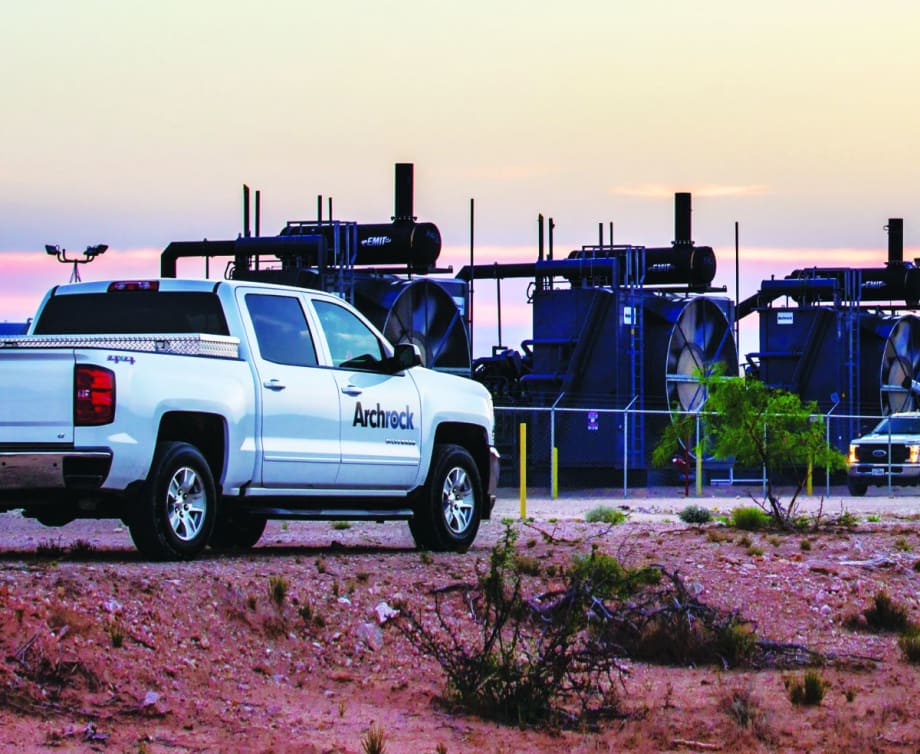
Ordering decisions at Archrock Services used to be left up to the field. Now, the fleet has created a replacement list to prioritize replacements by business unit.
Photo: Archrock
8 min to read
The decision to replace a truck is a big one. Replace it too early, and you’re dealing with unnecessary acquisition costs. But, replace it too late, and maintenance costs and downtime can soar.
Ad Loading...
All of that, of course, translates directly to a fundamental metric: total cost of ownership (TCO). How do you find the sweet spot to maximize your TCO?
Ad Loading...
Fleets and OEMs share their best-in-class replacement cycling strategies to help your fleet get it right.
Assess Age & Maintenance Costs
One of the top factors in determining truck replacement is vehicle age and related maintenance costs.
“When I started with Hawaii Gas 16 years ago, we ran the trucks pretty much until they had to be replaced. Now we are looking at replacing before it gets expensive to run,” said Glenn Yamada, fleet and facilities supervisor for Hawaii Gas. “In doing so, we’re also looking into maximizing any return that can be obtained from the vehicle being replaced to lower and control our replacement costs.”
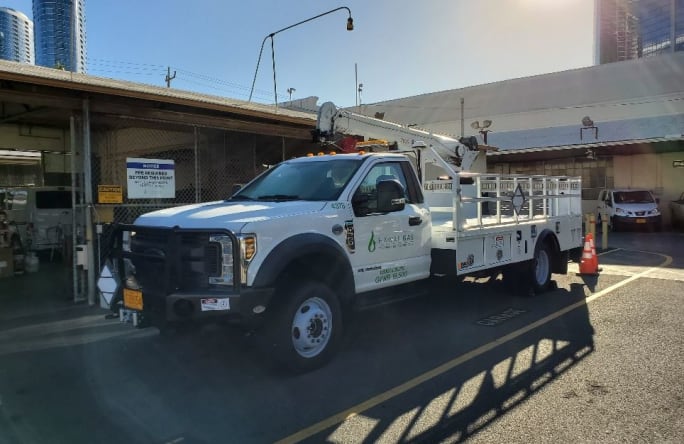
Because the fleet operates in Hawaii, replacing trucks takes additional planning and lead time.
As Yamada said, “We are on an island and can’t just drive to the next state to get a truck.”
Ad Loading...
Having a set replacement strategy has improved forecasting replacements for the fleet, allowing Hawaii Gas to get ahead of lead times before the truck being replaced has a significant repair expense while still in service.
“In the new replacement design, we’re emphasizing safety first and foremost as well as new designs for productivity improvements for the employees to make their job a little easier,” Yamada said.
Hawaii Gas is seeing benefits from the updated strategy.
“We have lowered the upward swing of the expense curve, for the most part, avoiding major repair expenses in our core business area of Honolulu. We are now in the process of carrying this over to the other island locations,” Yamada said. “As a result, we are seeing better utilization of specialized trucks, improved driver satisfaction, and are slowly lowering avoidable vehicle accidents with additions of new collision mitigation technologies.”
Rank Replacement Units Based on Weighted Factors
Archrock Services, a natural gas/compression services company, has also made a major strategy shift.
Ad Loading...
“Up until the 2020 model-year, there hasn’t been any sort of defined replacement strategy at Archrock. Vehicle budgets and ordering decisions were left up to the field operations,” said Emily Garza, vehicle fleet manager for Archrock. “This system does not effectively work; therefore, a few changes were put into place for 2020.”
To develop a new replacement cycling strategy, Archrock Services worked with its fleet management company to identify and rank replacement units based on several weighted factors, including miles, months in service, and operating expenses.
With the replacement listing in hand, Archrock factored in its proposed budget and prioritized the replacements by business unit.
“Adopting a ‘Net 1’ philosophy has helped plan for 2020,” Garza said. “Since replacement units and new units had never been linked via the fleet database in the past, we’ve adopted that process as well. This will help better manage disposals when the new units deliver.”
Linking replacement units to new vehicles have simplified the ordering process.
Ad Loading...
“I’d like to eventually get into a specified spring and fall order cycle, so vehicles are consistently being replaced throughout the year,” she said. “This would also allow us to take advantage of certain OEM production schedules and project more accurate upfit lead times.”
Following the first year of the new strategy, Garza anticipates years two and three will bring true cost savings and efficiencies.
Operating in Hawaii requirements additional planning and lead time when replacing truck models. Hawaii Gas has set a replacement strategy to get ahead of lead times.
Photo: Hawaii Gas
Replacement Cycling Strategy Mistakes & How to Avoid Them
The mistake: Doing things the way you’ve always done them.
“The ‘if it isn’t broke, why fix it?’ mentality is understandable, but the technology in these vehicles is coming quickly,” said Mark Namuth, senior manager, commercial vehicle sales for Nissan North America.
“Embracing new technology is the key to staying ahead.” The mistake: Wearing blinders.
“It’s important to be an educated fleet manager,” said Namuth. “Staying on top of trends and changes that are coming allows you to proactively manage your fleet instead of reactively responding to changes you didn’t see coming. Stay current on market trends, including keeping an eye on what technology the truck OEMs are introducing and why. Be aware of the changes that are coming. For example, are there new emissions regulations or major compliance dates on the horizon? What safety initiatives is NHTSA going to mandate?”
The mistake: Making decisions on data alone…or instinct alone.
“It’s critical to use fleet data and end-user feedback in decision making and stick to your game plan before making any drastic changes without substantial data to prove otherwise it’s not working,” said Glenn Yamada, fleet and facilities supervisor for Hawaii Gas. “Use your data and your instinct (from your experience) to plan your strategy. Sometimes it takes more than numbers to be effective.”
The mistake: Building a strategy in isolation.
“When defining a strategy, be sure to incorporate input from all stakeholders. The program has to work for all aspects of the business for it to be truly effective,” said Emily Garza, vehicle fleet manager for Archrock. “Make sure the details are thoroughly understood by the key stakeholders and ensure clear & concise communication is orchestrated to the drivers and/or field operations.”
The mistake: Not planning ahead.
“If proper and timely planning does not occur, order to delivery lead times will most certainly increase. Having a defined strategy and being able to execute when model year order banks open is key,” said Garza of Archrock. “Also, without proper planning or a defined strategy, capital expenditure budgets may be severely overextended and/or operating costs will skyrocket.”
The mistake: Making decisions for the “now” and not for the future.
“Make decisions for today, tomorrow and beyond whenever possible,” advised John Ruppert, general manager, commercial & government fleet sales of Ford Motor Company. “The experts are managing their fleets in three- to five-year windows, not just by ‘how much money do I have this year?’ ”
Match the Application
A truck’s application can also factor into a fleet’s replacement cycling strategy. Determining when to replace a truck can vary widely between applications, as can different markets and segments.
The same truck used for one type of job may have a shorter replacement cycle than the same truck doing a different job — or even doing the same job but across diverse terrain.
“When we look at a typical Class 8, on-highway application, for example, a five-year 500,000-mile trade cycle is common,” said Jim Nachtman, director, heavy duty product marketing for Navistar. “Some have shorter trade cycles for unique applications, such as team driver applications that accumulate mileage much faster. Some other customers run much longer trade cycles and may choose to run the vehicle until its end of life. While a shorter replacement cycle comes with many benefits, best-in-class comes down to that customer’s unique application and specific needs.”
Ad Loading...
Even though some applications may be better suited to longer or shorter replacement cycles, Nachtman said it can still be difficult to find the right fit.
“The challenges come in finding the correct balance between the benefits of a shorter trade cycle — such as improved fuel economy, uptime, and driver retention — with the incremental investment required to do so,” he said. “This challenge varies depending on the customer — how many vehicles they have, where they are running them, and the vehicles’ application.”
Adjust for Truck Type
Just as application can inform the right replacement cycle, so can the type of truck driven.
“The replacement strategy should remain the same based on TCO,” said Mark Namuth, senior manager, commercial vehicle sales for Nissan North America. “That said, the powertrains as one moves from light- to medium- to heavy-duty have different life expectancies, which need to be factored into the replacement models.”
Speaking specifically about medium-duty trucks, Brent Rottweiler, vice president of remarketing for Volvo Trucks North America, said they tend to run fewer miles per year, prompting customers to keep them for longer periods of time.
Ad Loading...
“The repairs and maintenance on a medium-duty truck are also usually less costly, so owners can justify a longer operation cycle, where it makes overall sense,” he said. “With medium-duty trucks, many customers in this industry classification have specialty bodies mounted on medium-duty chassis, so a planned replacement cycle should give consideration to both chassis life and body life.”
John Ruppert, general manager, commercial & government fleet sales for Ford Motor Company, said gross vehicle weight rating (GVWR) plays a factor.
“There are some differences in replacement strategies for light-, medium-, and heavy-duty vehicles,” he said. “In broad terms, the vehicles at the lower end of the GVWR scale tend to be replaced based on mileage-usage patterns, whereas the trigger points for higher GVWR vehicles tend to be based on operating hours.”
Replace Based on Your Goals
The decision to replace a truck may also come down to a fleet’s specific goals. For instance, if optimized fuel economy is at the top of the list, fleets might opt for a shorter cycle, as fuel economy typically improves with each new model-year.
“A shorter trade cycle helps provide higher average fuel economy,” said Nachtman of Navistar. “Newer vehicles typically have better uptime, further supporting a shorter trade cycle.”
Ad Loading...
If attracting and retaining drivers is your goal, replacing trucks sooner and providing newer, more desirable vehicles to drive can help.
“Fleets are in short supply of drivers, so to secure drivers, and the best drivers, fleets want modern, new equipment with safety and ergonomic features focusing on driver safety, comfort, and productivity,” said Rottweiler of Volvo.
If reducing maintenance costs is your goal, Rottweiler said the length of the warranty could prompt a replacement.
“Many customers trade trucks close to the warranty expiration and before experiencing increased maintenance costs,” he added. “Improved safety, fuel efficiency, and telematics features are encouraging customers to replace sooner, too. Companies want to be seen operating the most up-to-date, safe equipment with the least amount of environmental impact.”
Update for Technology Benefits
Although replacing units comes with a cost, newer models often come with updated technology that helps fleets operate more safely and efficiently. Those upgrades can offset some of the expense, allowing fleets to justify shorter replacement cycles.
Ad Loading...
“While budget has always been a major factor in replacement cycle planning, fleet managers today also are having to consider the implementation of connectivity and driver assist technology and how all this new technology impacts the cost of operation of the asset and overall capital expenditures,” said Ruppert of Ford. “If your old vehicles don’t have the modern technology that enables your drivers to be as efficient as possible, your productivity can decline. If you’re not taking advantage of connectivity and the insights fleet management software and telematics can provide, you could be wasting money every day and not even realize it.”
Fleets are also purchasing units sooner to take advantage of safety benefits.
“The safety technologies and in particular the active safety features that OEMs are now providing have companies rethinking their replacement strategies, particularly as the newer technology units enter the fleet, and those benefits are recognized,” added Namuth of Nissan.
And, Navistar’s Nachtman said he sees the same trend.
“Collision mitigation systems and other safety-focused technologies continue to advance, and a shorter trade cycle can ensure more of a fleet is running the latest technologies,” he said.
Ad Loading...
While updated technology may not be your primary goal, it can still be factored into the total equation.
Ruppert recommended taking a hybrid approach:
“The best replacement cycling strategies today have three parts: traditional, emissions compliance, and connectivity/driver-assist technology,” he said. “Traditional considerations are the proven benchmarks like mileage and years in service that continue to underpin most replacement cycle strategies. You also need to understand the patterns around emissions regulations, especially if the fleet is buying diesel powertrains. Couple that with aligning the strategy to support your business’s connectivity and safety programs. The most sophisticated fleets are finding ways to blend these three layers of consideration into a solid strategy.”
In a Budget Pinch? Swap Routes
If you read these approaches and think, “we just don’t have the budget for that,” you can still employ this simple strategy: swap routes.
“We see far too often that as business slows or cash flow becomes tight, companies will extend their vehicle usage,” said Namuth of Nissan. It’s an understandable thing to do, but when forced into doing this, one simple tip would be to place the newer vehicles in the high-mileage routes and the older vehicles in the low-mileage routes.”
Ad Loading...
Any Strategy Is Better Than No Strategy
While there may be many options for replacement cycling strategies, having any strategy is ultimately better than having no strategy at all. “The best replacement strategy is, in fact, ‘Having a Replacement Strategy’ and doing your best to stay on track,” added Namuth of Nissan.
Ford Pro Advantage brings manufacturer-backed inspections, warranties, roadside assistance, and service support to used Class 1-7 commercial trucks and vans.
A low-mileage truck can still be one of the fleet’s hardest-working and most worn assets. Engine hours, idle time, and duty cycle reveal what the odometer misses.
Meter readings still matter, but engine hours, idle time, maintenance trends, and utilization can help fleets spot costly vehicles before the odometer does.
REP Inspection Services, led by someone with more than 30 years of industry experience, has launched its professional inspection services for trucks, trailers, and equipment across the commercial vehicle industry.