





FLEET TIPS: Do You Know if Your Drivers Need a CDL?
Have Traffic Violations Disqualified Your CDL Truck Drivers?
A CDL holder may be disqualified, if convicted of certain violations, while operating any vehicle. It is important to remember that violations that occur in a driver’s personal vehicle could also result in the loss of a CDL.
July 1, 2008

Certain traffic violations that occur in or out of a commercial motor vehicle (CMV) and the driver’s personal vehicle may have an effect on the eligibility to drive a commercial motor vehicle.
Photo: Work Truck
4 min to read
On July 31, 2002, the Federal Motor Carrier Safety Administration (FMCSA) issued a final rule that included changes to the disqualification regulations (FMCSR 383.51) for drivers who possess a commercial driver’s license (CDL). This rule went into effect Sept. 30, 2002, and all states needed to be in "substantial compliance" no later than Sept. 30, 2005.
Understanding CDL Truck Driver Disqualifications
As fleet or safety professionals, it is important to understand that a number of requirements must be met for drivers to remain qualified to operate equipment that requires a CDL. Certain traffic violations that occur in or out of a commercial motor vehicle (CMV) and the driver’s personal vehicle may have an effect on the eligibility to drive a commercial motor vehicle.
Employers must not allow disqualified drivers operate vehicles at any time. To help employers comply with this rule, there are two regulatory safety nets in place.
The first is FMCSR 383.31, Notification of Conviction for Drivers. This regulation requires the driver to notify both the state and employer of any conviction(s).
The second is FMCSR 391.25, Annual Inquiry and Review Driving Record. This regulation requires the employer to review driver MVRs to ensure the driver is not disqualified and the employee is required to complete a certification of violations.
The driver, as well as the person responsible for reviewing MVRs, must understand the types of violations.
What Are the Major Offenses for CDL Suspension?
Being under the influence of alcohol as prescribed by state law, or refusing to undergo testing.
Being under the influence of a controlled substance.
Leaving the scene of an accident involving a commercial motor vehicle.
Using a vehicle to commit a felony.
Using a vehicle in the commission of a felony involving the manufacture, distribution, or dispensing of a controlled substance.
What are Commercial Motor Vehicle (CMV)-Only Violations?
First, what is a commercial motor vehicle?According to J.J. Keller,the definition of a commercial motor vehicle (CMV) found in CFR 49 §383.5 speaks directly to drivers and motor carriers that operate large vehicles and those who operate certain specialized types of vehicles. This definition covers both interstate and intrastate drivers and motor carriers.
Having an alcohol concentration of 0.04% or more.
Driving with a revoked, suspended, or canceled CDL, or after being disqualified.
Causing a fatality through the negligent operation of a commercial motor vehicle.
The CDL disqualification period for the first conviction is one year, three years if hauling HAZMAT. A second conviction results in disqualification for life.
If convicted of using a vehicle in the commission of a felony involving the manufacture, distribution, or dispensing of a controlled substance, a driver is disqualied for life with no eligibility for reinstatement.
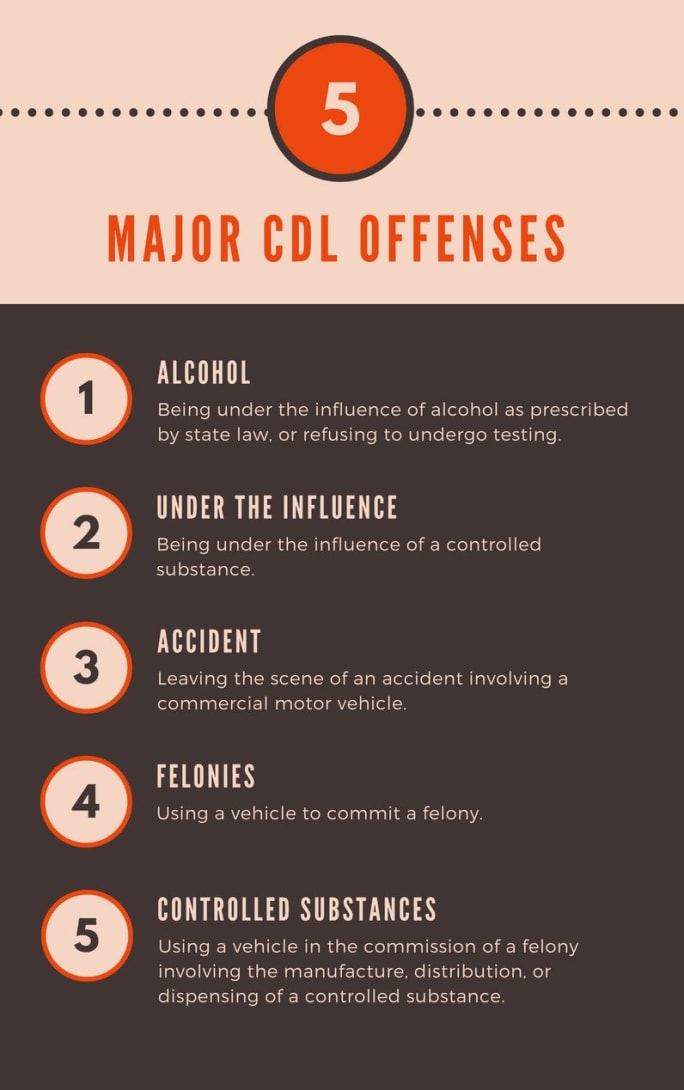
There are five major offenses that can disqualify a driver from their CDL.
Source: Work Truck Research Dept.
Serious Violations that Impact CDL Qualification
Serious violations that will result in a CDL truck driver disqualification include:
Excessive speeding — 15 mph or more above the posted speed limit.
Reckless driving.
Improper or erratic lane changes.
Following too closely.
A traffic violation arising in connection with a fatal traffic accident.
Driving a commercial motor vehicle without having obtained a CDL.
Driving a commercial motor vehicle without having a CDL in the driver’s possession.
Driving a commercial motor vehicle without the proper class of CDL and/or endorsements for the specific vehicle group operated, for passengers or cargo type.
Differences in CDL Disqualification Periods
The time a truck driver is disqualified from a CDL varies by offense and includes:
Two serious traffic violations in separate incidents during any three-year period: 60-day disqualification.
Three serious traffic violations in separate incidents during any three-year period: 120-day disqualification.
If the truck driver is convicted of two or more serious traffic violations while operating a vehicle other than a commercial motor vehicle, he or she becomes disqualified only if there is a revocation or suspension of driving privileges.
Impact of Out-of-Service Violations
If a driver is convicted of violating an out-of-service order, he or she is disqualified for:
First offense: 90 days – one year.
Second offense in a 10-year period: one to five years.
Third offense in 10 years: three to five years.
Penalties for HAZMAT drivers:
First offense:180 days – two years.
Two or more violations in a 10-year period: three to five years.
Railroad & Highway Grade Crossing Offenses
If a truck driver is convicted of operating a commercial motor vehicle in violation of federal, state, or local law pertaining to any of the six railroad-highway grade crossing requirements, per FMCSR 383.51(d), the following disqualification periods apply:
First violation: minimum 60 days.
Second violation during any three-year period: minimum 120 days.
Three or more violations within any three-year period: minimum one year.
It is important to remind drivers that violations in any type of vehicle could result in a loss of their CDL.
All information reported in this article is based on regulatory minimums. Individual companies or organizations may have more stringent requirements and may remove a driver from operating a commercial motor vehicle. Only the state has the authority to suspend or revoke an individual’s CDL.
Subscribe to Our Newsletter
More Safety
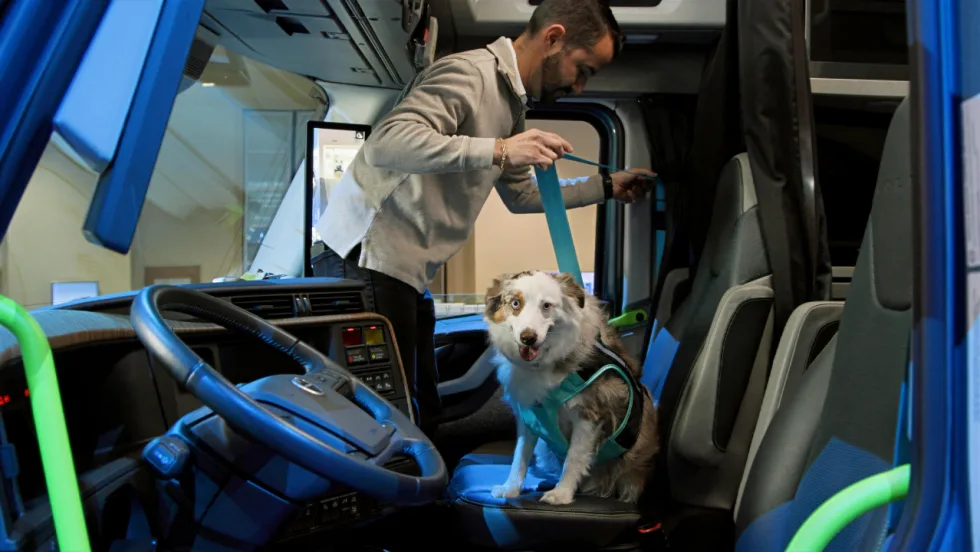
Volvo Trucks Releases New Safety Recommendations for Traveling with Pets
One of the most important recommendations for professional drivers traveling with pets is to ensure pets are properly restrained while the truck is moving. Other tips are available in the new guide from Volvo Trucks North America and Center for Pet Safety.
Read More →
API Issues Refueling Safety Guidelines
The American Petroleum Institute offers a list of safe vehicle refueling guidelines, including ways to avoid potential problems with static electricity discharges in fall, winter, and early spring.
Read More →
Winter Fleet Prep: Expert Tips to Keep Vehicles Running Smoothly
Cold weather can expose weak batteries, tires, fuel systems, and maintenance gaps fast. Use this winter fleet checklist to prepare trucks and drivers before temperatures drop.
Read More →
When a Work Truck Breaks Down, the Job Can Stop, Too
A work truck breakdown can stop more than the vehicle. Discover how payloads, jobsites, and specialty equipment change the roadside response.
Read More →
What Stronger Long-Term Fleet Service Partnerships Actually Require
Fleet service partnerships rarely fall apart all at once. Learn the three warning signs that trust is eroding and what fleets and providers can do before downtime, frustration, and lost revenue follow.
Read More →
Applause & TRUCE Software Partner to Improve Driver Safety Through AI-Powered Telematics & Employee Performance Management
Applause has integrated TRUCE driving metrics directly into its employee-first performance and safety platform that transforms mobile devices into AI-powered telematics.
Read More →
How Detroit Assurance with Active Brake Assist Works
Do you want to see what it is like to experience Detroit Assurance’s Active Brake Assist? In this video, Work Truck will put you in the cab to see how it all works and then hear more details from DTNA’s Mike Young.
Read More →
Get Left of Loss: A 5-Step Workplace Violence Prevention Framework for Fleet Operators
Violence risks do not stop at the driver’s door. Learn five practical steps fleets can take to spot threats early and protect workers before loss occurs.
Read More →
Sponsored•July 17, 2026
How Better Visibility Cut Speeding Violations by 48%
Fleet leaders don't need more data, they need clearer visibility into what the data is saying. This case study explores how one utility replaced speeding-event counts with a single metric — miles driven in violation — to strengthen safety and significantly reduce speeding violations.
Read More →
13 Safe Driving Tips for Commercial Vehicle Drivers
Make sure you are spending time on the road safely with these important tips.
Read More →