




Why Every Violation Counts During a DOT Audit
DOT audits catch more than critical violations. Learn why every infraction matters, how fines add up, and what carriers must fix to stay compliant.


A driver prepares for a DOT audit, a reminder that even small violations can add up for motor carriers.
Photo: Work Truck
Not every violationcited during a DOT audit impacts your safety rating, but all have the potential to result in a fine.
In fact, two of the top five audit violations in 2024 were neither acute nor critical (the most serious types of violations reviewed), demonstrating how the Federal Motor Carrier Safety Administration (FMCSA) puts your whole compliance program under its review.
During an audit, investigators are provided with a list of regulations deemed acute or critical. A critical regulation will only harm your safety rating if there is a pattern of violations.
Consider the following top five audit violations from 2024:
1. 392.2: Local Laws
A violation of section 392.2 occurs when you are not following the laws, ordinances, and regulations of the jurisdiction in which the commercial motor vehicle is being operated.
Auditors will look at the number of Level I, II, and III roadside inspections over the past 365 days and compare it against the number of these inspections that had a 392.2 unsafe driving violation. There are 20 violations under 392.2, unsafe driving. Each has a suffix to identify the specific violation (e.g., speeding).
Those 392.2 violations that resulted in a conviction are used to see if the carrier has a high enough pattern of violations to qualify as a “critical” violation, which could then affect the motor carrier’s safety rating.
Those violations that didn’t result in a conviction are recorded as non-critical violations. Even though a non-critical violation is considered a lesser infraction, enforcement may still require corrective action.
2. 382.701(a): Pre-Employment Queries
The second most cited violation in 2024 was failing to conduct a pre-employment query of the Drug and Alcohol Clearinghouse. Violations relating to the Clearinghouse are not currently considered acute or critical, but carriers may still be cited for them.
This specific query is required for new CDL drivers hired in safety-sensitive positions. It reveals past FMCSA Part 382 testing violations and whether the driver needs evaluations, treatment, and/or follow-up testing.
Even though the violation doesn’t impact a motor carrier’s safety rating, auditors can consider enforcement action on the citation, including fines up to $7,155.
3. 395.8(e)(1): False Logs
This critical violation occurs when there is a pattern of false records of duty status (logs).
Examples of false-log violations include:
Altered logs,
Incorrect duty statuses,
A tampered electronic logging device (ELD),
Intentional misrepresentation of information on the log, and
Intentional misuse of unassigned driving time.
Falsification is an action that FMCSA considers serious, to the point that a carrier (and driver) can be fined up to $15,846.
4. 382.701(b)(1): Failing to Conduct an Annual Query
Failing to perform annual queries is another Clearinghouse violation and is another non-rated violation that can result in enforcement action.
Motor carriers must request a query from the Clearinghouse annually on drivers in safety-sensitive positions. This helps identify drug- or alcohol-related violations occurring under another motor carrier when the driver fails to tell their current employer.
5. 396.3(b)(2) Vehicle Maintenance Due Dates
This critical violation occurs when a motor carrier lacks a way to track vehicle inspections and maintenance. Motor carriers must have a means to show when oil is changed, brakes are checked, and the like. Without this documentation, it isn’t easy to prove whether a vehicle missed a service interval.
This violation can cost a carrier up to $1,584 per day it continues, but no more than $15,846.
After an Audit
No matter the audit violation, a motor carrier must identify the root cause and implement corrective action to prevent future occurrences. Documenting your next steps is critical to regaining the FMCSA's confidence following an audit and to reducing claims of negligence in the event of litigation.
More Safety & Compliance
GeoFencing Adds to Your Truck Security Arsenal
Geofencing is a familiar fleet tool today, but its early adoption marked a major shift in vehicle tracking, route monitoring, and the debate over employee privacy.
Read More →
Recalls You Need to Know About in October 2026
In October 2026, what recalls might impact your fleet? Work Truck has the answers in this comprehensive overview of recent NHTSA recalls.
Read More →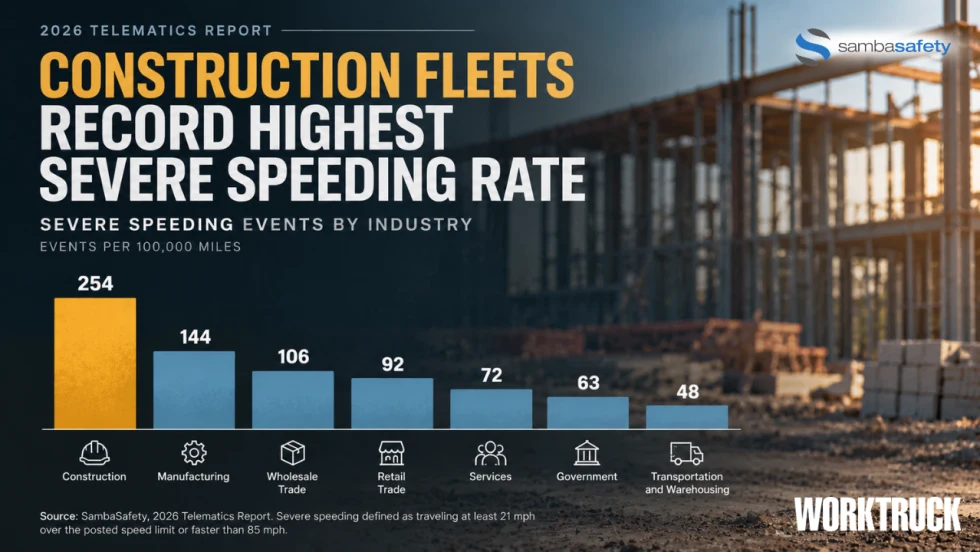
Construction Fleets Show Telematics Adoption Alone May Not Reduce Driving Risk
SambaSafety found construction fleets monitor roughly 92% of their vehicles but recorded the highest severe speeding rate among industries studied.
Read More →From Our Partners




Lytx Launches 360 Hub Kit for Expanded Fleet Camera Visibility
Lytx’s new AI-ready gateway and HD auxiliary camera ecosystem, the Lytx 360 Hub Kit, extends visibility across side, rear, cargo, and blind-zone views to help fleets see more and respond faster.
Read More →
Mack Defense Achieves Cybersecurity Maturity Model Certification Level 2
After an assessment conducted by an authorized Certified Third-Party Assessment Organization (C3PAO), Mack Defense has achieved Cybersecurity Maturity Model Certification (CMMC) Level 2.
Read More →
When Work Trucks Under 26,001 Pounds Need IRP Registration
Think trucks under 26,001 pounds are automatically in the clear when it comes to IRP? Not always. Learn where lighter vehicles can still run into trip permit, apportioned registration, and IFTA compliance requirements when crossing state or provincial lines.
Read More →
Smith System Wants Work Truck Fleets to Look Beyond the Driver Alert
Smith System’s new Driver Risk Management program is built to help mixed work truck fleets turn telematics alerts and observations into specific behaviors, coaching actions, and measurable follow-up.
Read More →
Volvo Trucks Releases New Safety Recommendations for Traveling with Pets
One of the most important recommendations for professional drivers traveling with pets is to ensure pets are properly restrained while the truck is moving. Other tips are available in the new guide from Volvo Trucks North America and Center for Pet Safety.
Read More →
Are Work Truck Drivers Warming Up to Dash Cams and GPS Tracking?
A new survey finds field-service drivers may be more comfortable with dash cams and GPS tracking than fleet managers think, especially when the technology helps protect them after a crash.
Read More →
Recalls You Need to Know About in September 2026
If you have Altec, Chrysler, Ford, Heil, General Motors, International, Mack Trucks, Paccar, Rivian, Royal Truck, Toyota, US Truck Body, or Volvo Trucks vehicles in your fleet, you should check these important recalls issued by the National Highway Safety Administration.
Read More →