




U.S. Proposes V2V Mandate to Reduce Crashes
Separately, the U.S. DOT's Federal Highway Administration will soon issue guidelines for vehicle-to-infrastructure (V2I) communications.
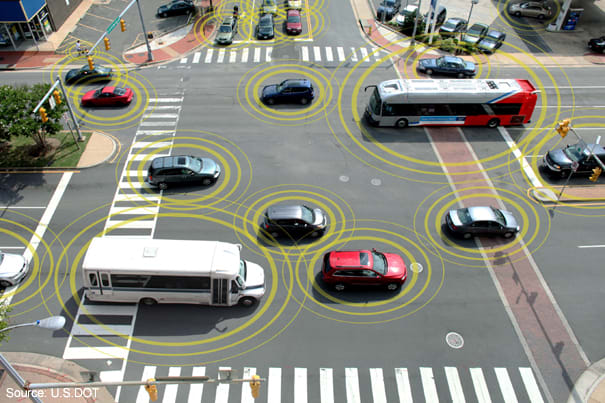
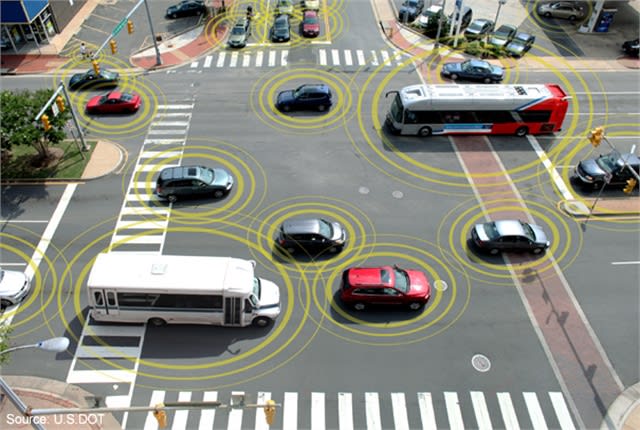
The U.S. Department of Transportation has proposed mandating vehicle-to-vehicle communication technology on all new light-duty vehicles to enable a wide range of new crash-avoidance applications.
Once fully deployed, these crash-avoidance features "could prevent hundreds of thousands of crashes every year by helping vehicles 'talk' to each other," the department said in a released statement about the proposed rule.
The action reflects the DOT's years-long efforts to accelerate development and deployment of connected vehicle communications and autonomous vehicles. The proposed rule would require vehicle-to-vehicle (V2V) communications devices to exchange information through standardized messaging developed with industry participation.
Automakers would need to fully comply with the mandate within four years after the final rule's implementation.
In a separate move, the department’s Federal Highway Administration plans to soon issue guidelines for vehicle-to-infrastructure (V2I) communications. V2I communications will help transportation planners "integrate the technologies to allow vehicles to 'talk' to roadway infrastructure such as traffic lights, stop signs and work zones to improve mobility, reduce congestion and improve safety," the DOT said.
The department's National Highway Traffic Safety Administration agency estimates that safety applications enabled by V2V and V2I could eliminate or mitigate the severity of up to 80% of crashes not involving impaired drivers. These include crashes occurring at intersections or while changing lanes.
V2V devices would use dedicated short-range communications (DSRC) to transmit data — such as location, direction, and speed — to nearby vehicles. That data would be updated and broadcast up to 10 times per second to nearby vehicles. Using that information, V2V-equipped vehicles could identify risks and provide warnings to drivers to avoid imminent crashes.
Vehicles equipped with automated driving functions — such as automatic emergency braking and adaptive cruise control — could also benefit from the use of V2V data to better avoid or reduce the consequences of crashes, according to NHTSA.
Additionally, V2V communications could provide the vehicle and driver with enhanced abilities to address additional crash situations. Examples include assisting the driver in deciding whether it’s safe to pass on a two-lane road or to make a left turn across the path of oncoming traffic. The technology can also determine whether a vehicle approaching an intersection appears to be on a collision course.
In those situations, V2V communications can detect developing threat situations hundreds of yards away — often in situations in which the driver and on-board sensors alone cannot detect the threat, NHTSA said.
Privacy is also protected in V2V safety transmissions, according to NHTSA.
"V2V technology does not involve the exchange of information linked to or, as a practical matter, linkable to an individual, and the rule would require extensive privacy and security controls in any V2V devices," the agency said.
The notice of proposed rulemaking will be open for public comment for 90 days, which carries the issue into the next administration. President-elect Donald Trump's nominee for Transportation secretary is Elaine Chao, who is expected to draw U.S. Senate confirmation without a problem.
"We are carrying the ball as far as we can to realize the potential of transportation technology to save lives," said current Transportation Secretary Anthony Foxx. "This long promised V2V rule is the next step in that progression. Once deployed, V2V will provide 360-degree situational awareness on the road and will help us enhance vehicle safety."
Back in February 2014, Foxx announced his intent to speed efforts to enable V2V communications. That's when he directed NHTSA to begin work on the rulemaking.
Originally posted on Automotive Fleet
More Safety
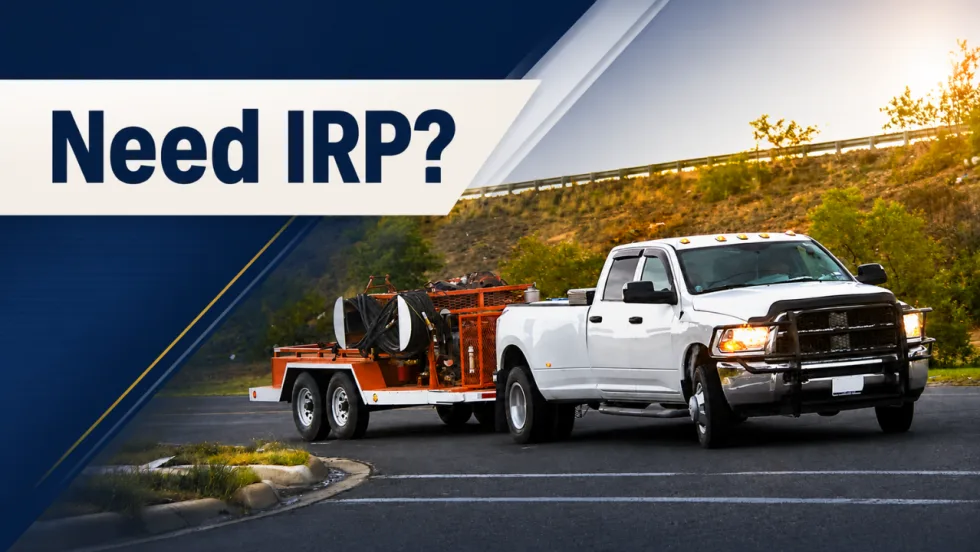
When Work Trucks Under 26,001 Pounds Need IRP Registration
Think trucks under 26,001 pounds are automatically in the clear when it comes to IRP? Not always. Learn where lighter vehicles can still run into trip permit, apportioned registration, and IFTA compliance requirements when crossing state or provincial lines.
Read More →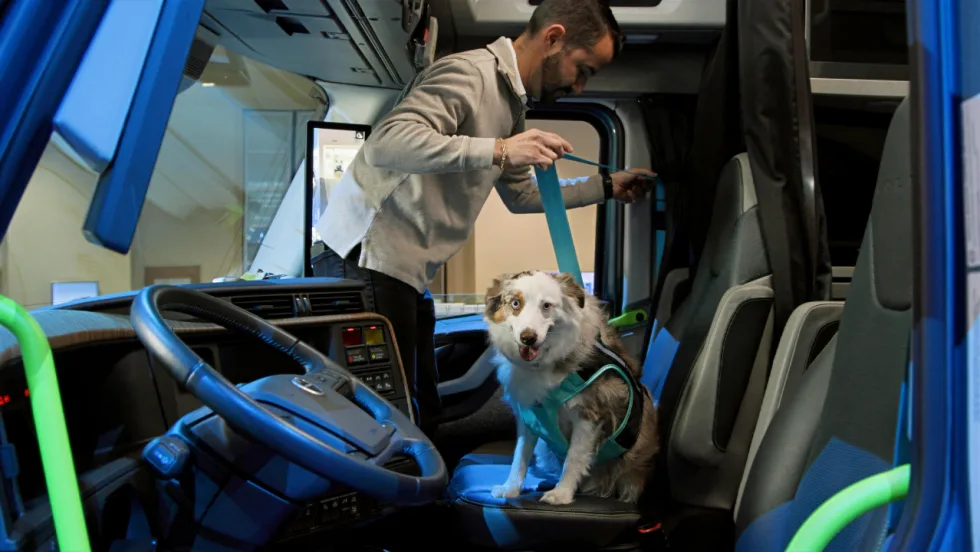
Volvo Trucks Releases New Safety Recommendations for Traveling with Pets
One of the most important recommendations for professional drivers traveling with pets is to ensure pets are properly restrained while the truck is moving. Other tips are available in the new guide from Volvo Trucks North America and Center for Pet Safety.
Read More →
API Issues Refueling Safety Guidelines
The American Petroleum Institute offers a list of safe vehicle refueling guidelines, including ways to avoid potential problems with static electricity discharges in fall, winter, and early spring.
Read More →
Winter Fleet Prep: Expert Tips to Keep Vehicles Running Smoothly
Cold weather can expose weak batteries, tires, fuel systems, and maintenance gaps fast. Use this winter fleet checklist to prepare trucks and drivers before temperatures drop.
Read More →
When a Work Truck Breaks Down, the Job Can Stop, Too
A work truck breakdown can stop more than the vehicle. Discover how payloads, jobsites, and specialty equipment change the roadside response.
Read More →
What Stronger Long-Term Fleet Service Partnerships Actually Require
Fleet service partnerships rarely fall apart all at once. Learn the three warning signs that trust is eroding and what fleets and providers can do before downtime, frustration, and lost revenue follow.
Read More →
Applause & TRUCE Software Partner to Improve Driver Safety Through AI-Powered Telematics & Employee Performance Management
Applause has integrated TRUCE driving metrics directly into its employee-first performance and safety platform that transforms mobile devices into AI-powered telematics.
Read More →
How Detroit Assurance with Active Brake Assist Works
Do you want to see what it is like to experience Detroit Assurance’s Active Brake Assist? In this video, Work Truck will put you in the cab to see how it all works and then hear more details from DTNA’s Mike Young.
Read More →
Get Left of Loss: A 5-Step Workplace Violence Prevention Framework for Fleet Operators
Violence risks do not stop at the driver’s door. Learn five practical steps fleets can take to spot threats early and protect workers before loss occurs.
Read More →
How Better Visibility Cut Speeding Violations by 48%
Fleet leaders don't need more data, they need clearer visibility into what the data is saying. This case study explores how one utility replaced speeding-event counts with a single metric — miles driven in violation — to strengthen safety and significantly reduce speeding violations.
Read More →