





AI in Fleet: Leveraging the Benefits and Understanding the Limitations
Study Shows the Fleet Industry Leaders Are Looking to AI to Improve Operations
Leaders are looking to AI to improve vehicle tracking, decision-making, expense planning, administrative work, fraud detection, and worker safety.
December 7, 2023
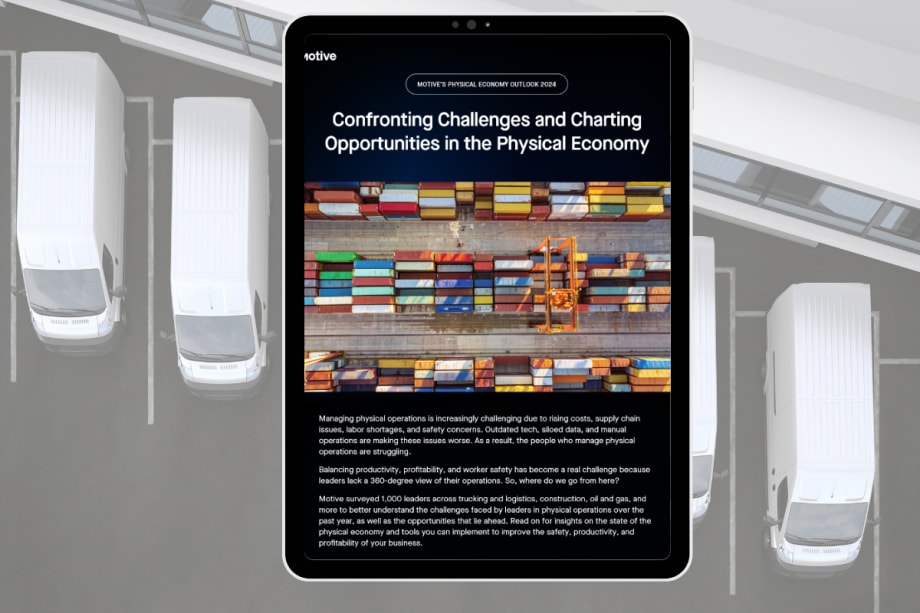
Rising costs, economic instability, and labor shortages left leaders grappling with revenue losses and an uncertain economic outlook.
Photo: Motive/Work Truck
3 min to read
Motive, an integrated operations platform for the physical economy, unveiled a recent study revealing that companies trucking, logistics, oil, and gas sectors incurred an average loss exceeding $1 million attributed to economic volatility, labor issues, and operational inefficiencies.
The Motive Physical Economy Outlook 2024 conducted by Motive, gathered insights from 1,000 leaders spanning various sectors within the physical economy, including trucking, logistics, construction, oil and gas, manufacturing, retail, and more.
This survey aimed to delve into the difficulties encountered by leaders in physical operations throughout the past year and shed light on the emerging opportunities on the horizon.
"Over the past year, leaders in the physical economy grappled with rising uncertainties, escalating costs, increasing fraud, and a scarcity of skilled labor," said Shoaib Makani, co-founder and CEO of Motive. "The need for transformation is evident, with limited visibility and data silos hampering profitability and heightening safety risks. Leaders recognize technology, particularly AI, as a game-changer for automating proactive decisions, improving visibility, and enhancing safety, effectively addressing industry challenges and presenting opportunities across this critical sector of our economy."
Motive's Physical Economy Outlook: Overcoming Losses with AI-Driven Solutions
Key findings of Motive’s Physical Economy Outlook 2024 include:
Rising costs, economic instability, and labor shortages have left leaders grappling with revenue losses and an uncertain economic outlook.
The top five challenges that threatened physical operations in 2023 include rising costs (59%), economic instability (51%), labor shortages and talent retention (45%), supply chain disruptions (42%), and operational inefficiencies (36%).
Half of leaders think that 12 months from now the economy will be better than it is today, while 18% expect it to be about the same, and 32% expect it to be worse.
Leaders lack a single, 360-degree view of their operations due to data silos and lack of integration.
Nearly half (46%) of leaders are using more than ten individual tools to manage their operations, with 30% saying it’s too many to count.
As a result, 58% say they spend most of their time dealing with reactive issues versus proactively managing their workers, fleet, spend, or assets and equipment. 44% of leaders admit to losing track of vehicles at least monthly.
Fraud is an invisible financial drain and leaders struggle to pinpoint its origin or extent.
44% of physical operations leaders say fraud has a big financial impact on their business but they aren’t sure how to find it. Among the c-suite, this jumps to 57%.
On average, leaders estimate 19% of their current fleet spending may be fraudulent with construction leaders estimating fraud to be as high as 22% of spend.
Leaders see technology as one of the only aspects of their operations that they can consistently control.
The top five opportunities for physical operations over the next 12 months include updated technology and software (33%), economic stability (31%), supply chain improvements (31%), increase in demand (30%), and operational efficiencies (29%).
80% of leaders agree that having a single, end-to-end solution to manage physical operations would make their job easier.
From addressing labor shortages to boosting visibility and road safety, AI is becoming critically important for managing physical operations.
The top five areas where leaders see AI bringing the most value include tracking assets and vehicles (43%), more accurate decision-making (40%), expense planning (39%), reducing administrative work (39%), and detecting fraud (38%).
69% of physical operations leaders think AI will have a positive impact on their jobs and nearly a third expect AI to address labor shortages.
73% of leaders agree that roads are safer with AI-enabled cameras and 64% say AI is crucial for preventing accidents and coaching drivers.
More Operations
Family Ties Inside the Fleet Families Building Careers Across Generations
Three fleet families share what it really takes to work together, learn across generations, and keep business from following them home.
Read More →
Shades of Fleet Call for Voices: Fleet's Hidden Heroes
Fleet’s hidden heroes are often the ones keeping everything moving behind the scenes. September’s Shades of Fleet is looking for dispatchers, coordinators, parts specialists, and other support pros to share their stories.
Read More →
Truck Centers, Inc. Celebrates National Truck Driver Appreciation Week with $1,000 Fuel Card Giveaways
During National Truck Driver Appreciation Week, Truck Centers, Inc. is offering customers a chance to fuel up for free. Customers at all Truck Centers locations can enter to win one of four $1,000 fuel cards from Sept. 14 - 18.
Read More →
Fleet Guides, AI Time-Savers, Truck Tariffs & Fuel Strategy Lead the News
This week’s Truck Chat Cheat Sheet covers new fleet vehicle guides, practical AI use cases, U.S.-Canada truck production, mixed-energy strategy, and more.
Read More →
What Fleet Employers Are Missing When Hiring Veterans
What if some of the strongest candidates for fleet are already out there, but their experience is written in a language our industry does not always recognize?
Read More →
Automotive Fleet Opens 2026 Personal Use Survey for Commercial Fleet Managers
Less than two weeks left! Commercial and corporate fleet managers are invited to share how their organizations handle company vehicle personal-use policies, charges, and driver eligibility.
Read More →
What Resilient Fleets Do Differently When Conditions Change
Fleet resilience is about more than reacting to disruption. Lauren Fletcher talks with AP Fleet’s Alex Coveney about flexibility, planning, scaling, and what helps fleets adapt when business conditions shift.
Read More →
If We Want the Next Generation in Automotive, We Have to Give Them a Reason to Care
The automotive industry talks constantly about its workforce shortage. But before we can recruit the next generation, we may need to do a better job giving kids a reason to care about automotive in the first place.
Read More →
Ram ProMaster City Under $40K, Truck Tariffs, and AI Maintenance Lead the News
A sub-$40K commercial van, tariff questions, AI-powered maintenance, and a new EV production strategy headline this week’s Truck Chat Cheat Sheet.
Read More →
Bob Adamsky Shares the Fleet Lessons You Usually Learn the Hard Way
After more than 30 years in fleet, Arrow International’s Bob Adamsky has learned that the job is about far more than vehicles. He shares the lessons he wishes every fleet manager could learn a little earlier.
Read More →