




NHTSA Promotes Two Connected-Car Technologies to Prevent Crashes
The agency released a report assessing such connected-car applications as left turn assist and intersection movement assist, which could save as many as 1,083 lives annually, according to estimates.
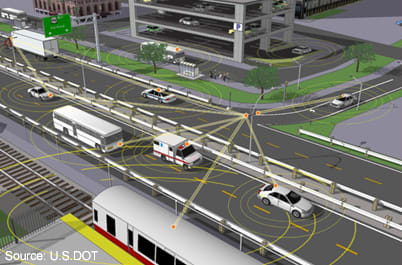
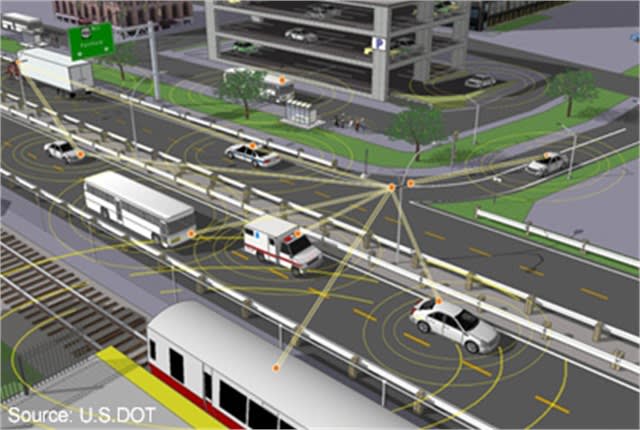
As part of its quest to mandate vehicle-to-vehicle (V2V) communications capability in light-duty vehicles, the National Highway Traffic Safety Administration has released a research report analyzing the technology’s feasibility, safety benefits, potential costs and legal issues.
The report's authors project that just two of many possible V2V communications applications — left turn assist and intersection movement assist — could save as many as 1,083 lives and prevent up to 592,000 crashes annually.
Left turn assist warns drivers not to turn left in front of another vehicle traveling in the opposite direction, and intersection movement assist warns them if it’s not safe to enter an intersection because of the likelihood of a collision. Additional applications could also help drivers avoid imminent danger through forward collision, blind spot, “do not pass,” and stop light/stop sign warnings.
V2V systems transmit basic safety information between vehicles via short-range radio communication devices.
NHTSA estimates that the V2V equipment and supporting functions would cost about $341 to $350 per vehicle in 2020. That cost might dip to approximately $209 to $227 by 2058, after manufacturers gain experience producing the equipment, according to the report.
NHTSA is seeking public and industry feedback on the report's findings. This input will aid in development of a new federal standard requiring V2V communication capability in new passenger cars and light-duty trucks.
"V2V begins to provide safety benefits only if a significant number of vehicles in the fleet are equipped with it and if there is a means to ensure secure and reliable communication between vehicles," according to the report. "NHTSA believes that no single manufacturer would have the incentive to build vehicles able to 'talk' to other vehicles, if there are no other vehicles to talk to — leading to likely market failure without the creation of a mandate to induce collective action."
V2V technology can combine with existing vehicle safety features and serve as a building block for development of driverless vehicles, supporters of the technology predict.
Vehicles equipped with V2V technology could also enable the development of a wide range of mobility and environmental benefits based on vehicle-to-infrastructure applications and other V2V applications that can enhance traffic flow in many ways, according to NHTSA.
The agency also stressed that V2V communications don't represent a threat to individual driver privacy.
"V2V technology does not involve collecting or exchanging personal information or tracking drivers or their vehicles," according to NHTSA. "The information sent between vehicles does not identify those vehicles, but merely contains basic safety data. In fact, the system as contemplated contains several layers of security and privacy protection to ensure that vehicles can rely on messages sent from other vehicles."
In responding to NHTSA's actions, two automaker associations — the Association of Global Automakers and the Alliance of Automobile Manufacturers — urged the federal government to reserve and protect the 5.9 GHz frequency band for eventual V2V communications. The Federal Communications Commission is exploring whether the spectrum should be shared to create more spectrum for Wi-Fi service.
"As we begin to move from the research lab to the actual deployment of vehicle-to-vehicle and vehicle-to-infrastructure communications technology, it remains critically important that the FCC preserve the ability to use the radio spectrum reserved for it," the Alliance of Automobile Manufacturers said in astatement.
The Association of Global Automakers echoed those concerns.
“There is no better use of this spectrum than to save lives," said John Bozzella, president and CEO of Global Automakers. "Communication delays of even thousandths of a single second matter when dealing with auto and highway safety."
Read "Vehicle-to-Vehicle Communications: Readiness of V2V Technology for Application" research report
The ANPRM will be available at the Regulations.gov docket (NHTSA-2014-0022) and members of the public will have the opportunity to comment for 60 days
Go to NHTSA's V2V Communications site for more information
To learn more about the lingering debate over the 5.9 GHz frequency band, click here or on the photo below.
Originally posted on Automotive Fleet
More Safety
When Work Trucks Under 26,001 Pounds Need IRP Registration
Think trucks under 26,001 pounds are automatically in the clear when it comes to IRP? Not always. Learn where lighter vehicles can still run into trip permit, apportioned registration, and IFTA compliance requirements when crossing state or provincial lines.
Read More →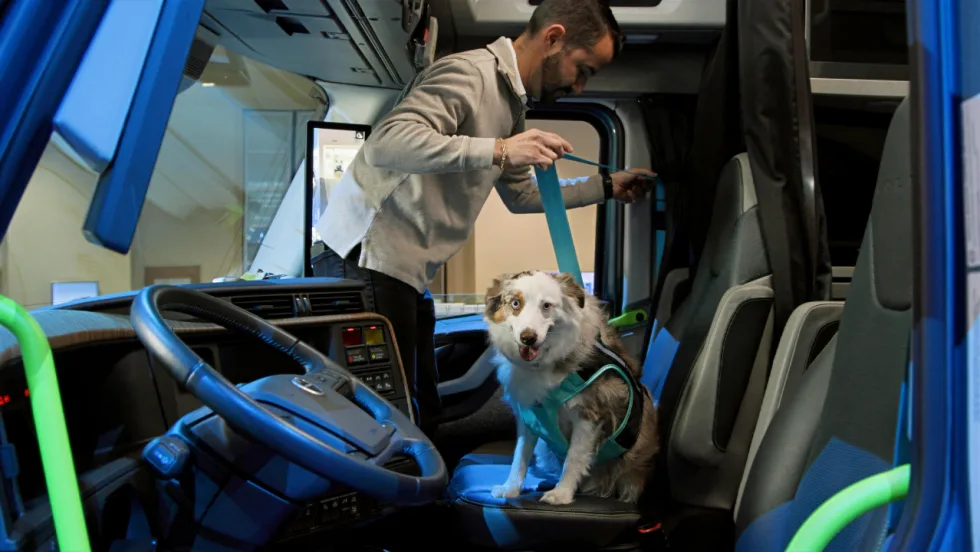
Volvo Trucks Releases New Safety Recommendations for Traveling with Pets
One of the most important recommendations for professional drivers traveling with pets is to ensure pets are properly restrained while the truck is moving. Other tips are available in the new guide from Volvo Trucks North America and Center for Pet Safety.
Read More →
API Issues Refueling Safety Guidelines
The American Petroleum Institute offers a list of safe vehicle refueling guidelines, including ways to avoid potential problems with static electricity discharges in fall, winter, and early spring.
Read More →
Winter Fleet Prep: Expert Tips to Keep Vehicles Running Smoothly
Cold weather can expose weak batteries, tires, fuel systems, and maintenance gaps fast. Use this winter fleet checklist to prepare trucks and drivers before temperatures drop.
Read More →
When a Work Truck Breaks Down, the Job Can Stop, Too
A work truck breakdown can stop more than the vehicle. Discover how payloads, jobsites, and specialty equipment change the roadside response.
Read More →
What Stronger Long-Term Fleet Service Partnerships Actually Require
Fleet service partnerships rarely fall apart all at once. Learn the three warning signs that trust is eroding and what fleets and providers can do before downtime, frustration, and lost revenue follow.
Read More →
Applause & TRUCE Software Partner to Improve Driver Safety Through AI-Powered Telematics & Employee Performance Management
Applause has integrated TRUCE driving metrics directly into its employee-first performance and safety platform that transforms mobile devices into AI-powered telematics.
Read More →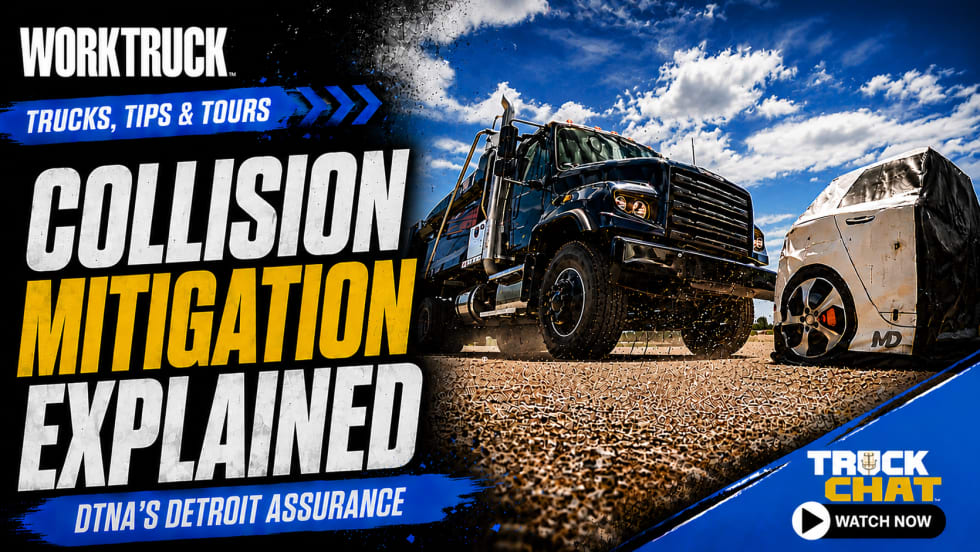
How Detroit Assurance with Active Brake Assist Works
Do you want to see what it is like to experience Detroit Assurance’s Active Brake Assist? In this video, Work Truck will put you in the cab to see how it all works and then hear more details from DTNA’s Mike Young.
Read More →
Get Left of Loss: A 5-Step Workplace Violence Prevention Framework for Fleet Operators
Violence risks do not stop at the driver’s door. Learn five practical steps fleets can take to spot threats early and protect workers before loss occurs.
Read More →
How Better Visibility Cut Speeding Violations by 48%
Fleet leaders don't need more data, they need clearer visibility into what the data is saying. This case study explores how one utility replaced speeding-event counts with a single metric — miles driven in violation — to strengthen safety and significantly reduce speeding violations.
Read More →