





Learn More: North America Fleet Collisions Drop 38.7% as Risk Narrows to a Small Group of Drivers
Cargo Theft Gets Smarter as Fleets Face Rising Risk, Driver Strain, and a Growing Tech Gap
Cargo theft is getting smarter and costlier. See how cyber tactics, driver strain, and security gaps are putting fleets at greater risk.
March 19, 2026

Geotab outlines a layered defense strategy combining physical security, GPS tracking, video monitoring, and identity verification to combat increasingly digital cargo theft threats.
Credit: Geotab | Work Truck
4 min to read
A new Geotab report suggests cargo theft is no longer just a security problem. It is becoming an operations problem, a driver-retention problem, and, increasingly, a technology problem.
A few numbers jump out right away:
38% of fleet professionals are more concerned about cargo theft than they were 12 months ago.
47% say theft-related stress and safety risks are contributing to driver burnout and turnover.
30% of consumers believe they ultimately pay for cargo theft through higher prices.
58% agree that an effective defense requires layered technology, yet nearly one-quarter of fleets still rely on “a strong lock and a vigilant driver.”
That disconnect sits at the center of Geotab’s latest report, Securing the Supply Chain: A 2026 Blueprint for Countering Smarter Theft, which argues the cargo theft landscape has shifted well beyond traditional break-ins and smash-and-grab incidents.
Cargo Theft is Evolving Past the Padlock
Estimates show that cargo theft losses in North America reached $6.6 billion in 2025, as criminal activity became both more valuable and more sophisticated. The report points to a growing wave of cyber-enabled and deception-based theft, including GPS spoofing, stolen credentials, AI-powered phishing, fraudulent pickups, and identity-based schemes designed to remove freight without force.
For fleets, that means old assumptions about what theft looks like are no longer holding up.
“This isn’t the same cargo theft problem the industry was dealing with even two years ago,” said Emily Williams, AVP of transportation business development at Geotab. “We’re seeing a convergence of physical and cyber threats.”
That convergence matters for the work truck market because many operations still depend on a mix of physical security, driver awareness, and disconnected systems. As theft tactics become more strategic, those gaps become easier to exploit.
Concern is Rising Because the Threat is Getting Harder to Spot
According to Geotab’s survey of 575 U.S. fleet operators, 34% said they had experienced a theft incident in the previous 12 months. At the same time, nearly a quarter of fleet professionals identified strategic theft, including fraud, identity theft, and falsified paperwork, as the biggest threat they face.
That is a notable shift for fleet managers accustomed to thinking about theft in more physical terms, such as unsecured parking, trailer tampering, or stolen equipment. In this newer model, the cargo may be handed over through what appears to be a legitimate transaction, only for the load to disappear into a much larger fraud network.
For the work truck audience, that makes this less about a single weak point and more about systemwide visibility. A lock can still matter, but it cannot verify who is authorized to pick up a load or flag a spoofed route in real time.
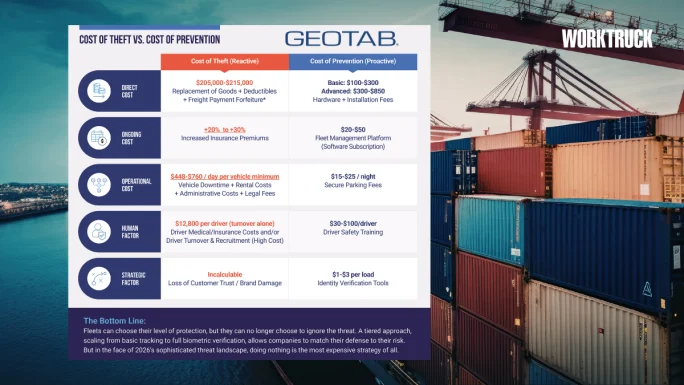
A Geotab infographic breaks down the true cost of cargo theft compared to prevention, showing how losses, downtime, and driver turnover quickly outweigh basic security investments.
Credit: Geotab | Work Truck
The Human Cost is Becoming Harder to Ignore
One of the stronger takeaways from the report is that cargo theft is not only hitting balance sheets. It is also hitting the people behind the wheel.
Geotab found that 47% of respondents believe the stress and personal safety risks tied to cargo theft are contributing to driver burnout and turnover. That finding lands in an industry already dealing with workforce pressure, recruiting challenges, and the very real limits of asking drivers to do more with less.
For fleets in the work truck space, that point may resonate as much as the theft totals themselves. Security strategies that rely too heavily on driver vigilance can add pressure without necessarily improving outcomes, especially when the threat involves falsified credentials or coordinated fraud that no driver could reasonably detect on their own.
Technology Adoption Still Isn’t Where Fleets Say it Should Be
Even with concern running high, the report shows many fleets are still somewhere between knowing what they need and actually deploying it.
While 58% of respondents said a layered strategy is the right approach, Geotab found that adoption remains uneven. Some fleets are leaning into GPS tracking, video telematics, smart locks, geofencing, and connected data systems. Others are still relying on more basic measures that were never designed for digitally coordinated theft.
That matters because modern cargo crime increasingly rewards speed, deception, and blind spots. If a fleet’s security tools do not work together, response time slows down, and verification gets harder. For bad actors, that is the opening.
Consumers are Starting to Connect Theft with Higher Costs
The report also suggests cargo theft is no longer invisible outside the fleet yard.
Geotab found that 30% of consumers believe they ultimately shoulder the financial burden through higher prices. That turns cargo theft into more than an internal operational issue. It becomes a customer-trust issue, too, especially as late, missing, or disrupted shipments gain more visibility across the supply chain.
For fleets and service providers, that raises the stakes. Lost freight is one problem, but lost confidence is another.
Fleets that want a deeper look at the numbers, threat trends, and technology recommendations can find more in Geotab’s full report, Securing the Supply Chain: A 2026 Blueprint for Countering Smarter Theft.
More Safety
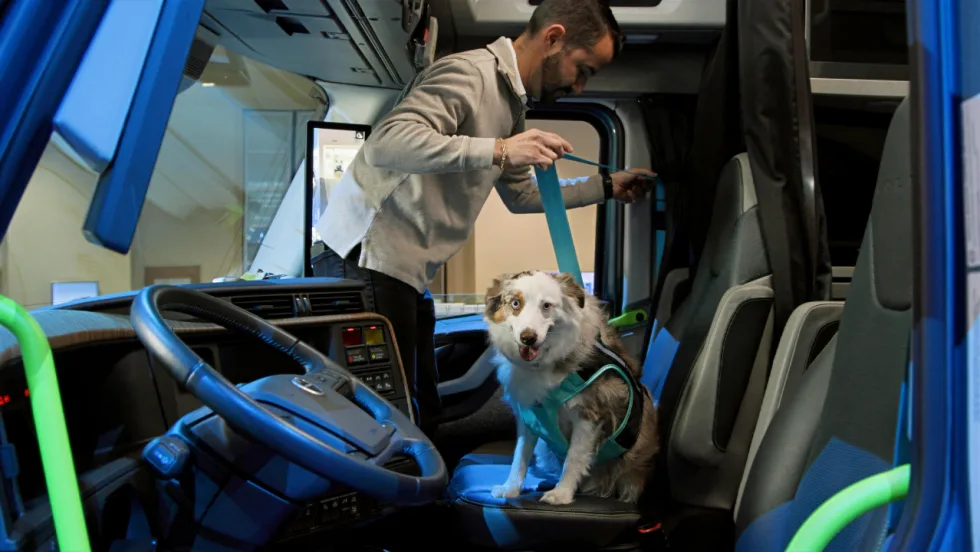
Volvo Trucks Releases New Safety Recommendations for Traveling with Pets
One of the most important recommendations for professional drivers traveling with pets is to ensure pets are properly restrained while the truck is moving. Other tips are available in the new guide from Volvo Trucks North America and Center for Pet Safety.
Read More →
API Issues Refueling Safety Guidelines
The American Petroleum Institute offers a list of safe vehicle refueling guidelines, including ways to avoid potential problems with static electricity discharges in fall, winter, and early spring.
Read More →
Winter Fleet Prep: Expert Tips to Keep Vehicles Running Smoothly
Cold weather can expose weak batteries, tires, fuel systems, and maintenance gaps fast. Use this winter fleet checklist to prepare trucks and drivers before temperatures drop.
Read More →
When a Work Truck Breaks Down, the Job Can Stop, Too
A work truck breakdown can stop more than the vehicle. Discover how payloads, jobsites, and specialty equipment change the roadside response.
Read More →
What Stronger Long-Term Fleet Service Partnerships Actually Require
Fleet service partnerships rarely fall apart all at once. Learn the three warning signs that trust is eroding and what fleets and providers can do before downtime, frustration, and lost revenue follow.
Read More →
Applause & TRUCE Software Partner to Improve Driver Safety Through AI-Powered Telematics & Employee Performance Management
Applause has integrated TRUCE driving metrics directly into its employee-first performance and safety platform that transforms mobile devices into AI-powered telematics.
Read More →
How Detroit Assurance with Active Brake Assist Works
Do you want to see what it is like to experience Detroit Assurance’s Active Brake Assist? In this video, Work Truck will put you in the cab to see how it all works and then hear more details from DTNA’s Mike Young.
Read More →
Get Left of Loss: A 5-Step Workplace Violence Prevention Framework for Fleet Operators
Violence risks do not stop at the driver’s door. Learn five practical steps fleets can take to spot threats early and protect workers before loss occurs.
Read More →
Sponsored•July 17, 2026
How Better Visibility Cut Speeding Violations by 48%
Fleet leaders don't need more data, they need clearer visibility into what the data is saying. This case study explores how one utility replaced speeding-event counts with a single metric — miles driven in violation — to strengthen safety and significantly reduce speeding violations.
Read More →
13 Safe Driving Tips for Commercial Vehicle Drivers
Make sure you are spending time on the road safely with these important tips.
Read More →