Getting the Most Out of Your ePTO Today and Tomorrow
The electronic power take-off (ePTO) is crucial for work truck electrification, as it reduces fuel consumption and emissions, but not all ePTOs are the same.
by Jonah Leason of Parker Hannifin
May 13, 2024
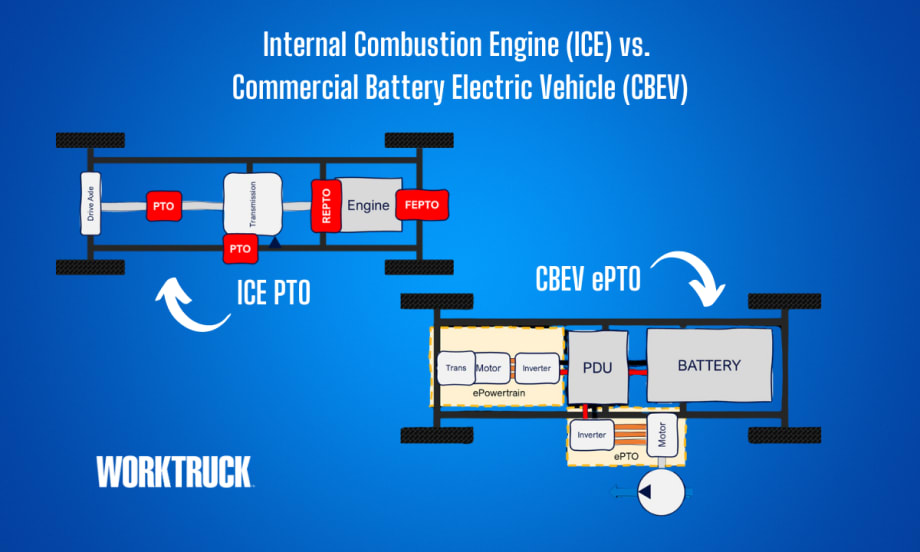
With existing internal combustion engine (ICE) PTOs, you are constrained as to where you can put the PTO as it needs to be located where things rotate. More than 70% of PTOs on the market today are powered from the transmission. That’s a major constraint to have to take off power to rotational energy.
Source: Parker Hannifin | Work Truck
7 min to read
Whether in the media, in the legislature, or on the manufacturing floor, everyone seems to be focused on the promise of zero-emission vehicles (ZEVs). Largely as a result of the Advanced Clean Transportation Act and the Advanced Clean Fleet Act, an aggressive schedule is in place to electrify many different types of equipment.
Ad Loading...
Despite many in the industry's hopes to the contrary, it does not appear that this time schedule will be relaxed. If anything, these well-financed legislative agencies will be emboldened to adopt even stricter regulations and implement fast-paced schedules to affect air quality and further reduce carbon emissions.
Ad Loading...
And it's not just about California. As the fifth largest economy in the world, California is undoubtedly a contributor to the green movement, but it's not the entire cause. Today, zero-emissions technology is being adopted in all states. But that doesn't mean 100% of commercial vehicle components will be electrified in the short term.
To be classified as a ZEV, the vehicle must have an electric powertrain. Commercial vehicle electrification in the next few years will heavily affect straight trucks and the work functions they host. In all probability, it won't be until roughly 2030 that we see intentional ZEV designs with electric work bodies.
Specifying the Right ePTO for Your Application
At the heart of work truck electrification is the electronic power take-off (ePTO), which reduces fuel consumption, emissions on ICE powertrains, and noise levels by limiting engine idling. However, not all ePTOs are the same. They don't consume the same power or require the same energy storage on board. It depends on the work required of the vehicle.
Consider three examples: a dump truck, a concrete truck, and a street sweeper. All utilizing the same chassis.
The dump truck might only make a few trips to a quarry to dump a few times per day, which means the ePTO consumes less energy because it only needs power to make the dump. Conversely, the concrete truck consumes a lot of energy because the ePTO works much of the day spinning the drum. So, electric versions of the latter require a larger battery that powers it to drive to the site, mix, and pour the concrete. It's the same situation as with a street sweeper. These vehicles are continual consumers of energy.
Ad Loading...
A significant challenge when specifying the right ePTO is that many people don't know how to value efficiency in big battery systems. Everyone thinks efficiency is the most important criterion. However, with ePTOs, you must consider functionality to ensure the system is fit for purpose.
When discussing power, we're referring to current (power = current x voltage), which is classified as peak or continuous. We evaluate the ePTO application power electronics need based on continuous and intermittent current draw. Most of the time, we care about continuous current, but some applications require intermittent current (power) peaks for start-up inertia or to overcome some rotational resistance.
Energy is computed as a combination of power and time. For example,10-kiloWatt hours (kWh) can provide 10 kW of power for one hour (at a c-rate of 1) or 1kW of power for 10 hours (at a c-rate of 0.1). So, energy storage is calculated by how much power can be consumed from the energy storage system (battery), and the battery management system sets the rate (c-rate) at which the energy can be used.
When evaluating energy needs or sizing an energy storage system, you must consider how long you will need, how much power, and at what rate it will be consumed in relation to the total available energy. Power units are kilowatts or horsepower. A kWh is an energy storage unit, and the c-rate is the rate at which batteries can be charged or discharged.
More Flexible Design Options
With existing internal combustion engine (ICE) PTOs, you are constrained as to where you can put the PTO, as it needs to be located where things rotate. More than 70% of PTOs on the market today are powered from the transmission. That's a major constraint to have to take off power to rotational energy.
Ad Loading...
In comparison, ePTOs have fewer constraints. With ZEVs, you can take power from the power distribution unit and send it anywhere on the chassis via cables or wires to have ePTO power anywhere on the vehicle. This increases efficiency by putting hydraulic or rotational power very close to where it is needed.
When sourcing your ePTO, it's also important to consider your connections. A lot of people overlook the importance of considering the connectors and what you're plugging in to. There are lots of different kinds of power connections, including quick connect and glanded lugged connections.
Glanded lugged connections are very cost effective but require particular attention to detail for proper initial assembly and reassembly. Quick connect fittings offer greater mistake-proofing and speed up initial assembly and reassembly during a service event.
So Many Choices
With more OEMs entering the electrification space today, there are more ePTO system options than ever before. Specifically, there are three main types of electric power take-offs:
AC-powered ePTO: This option takes in DC power from a battery and outputs AC at either 120 or 240. It is an ideal option if you need to power a welder or refrigeration.
Mechanical (mPTO): This is ideal for applications where you can use the rotational energy of an electric motor to power something like a fan or winch directly.
Hydraulic (hPTO): With this option, you can use electric motors to power hydraulic pumps, enabling the use of hydraulic actuators.
Ad Loading...
Both mPTOs and hPTOs can be sourced as individual components, typically a motor and inverter for mPTOs with an added hydraulic pump to make an hPTO.
Today, there are several suppliers offering modular and integrated ePTO systems.
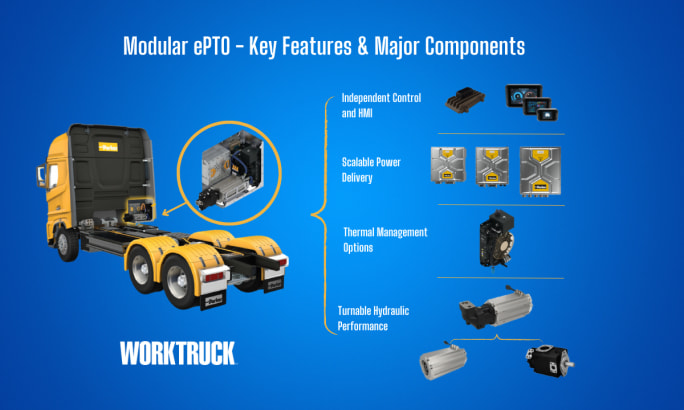
Modular ePTO systems: These combine the electric motor-pump system with the necessary cabling, cooling, and fluid conveyance required into a complete mechanical package that can be mounted behind the cab or on the frame rail, allowing the user to only run the hydraulic work from the battery when needed, eliminating engine idle (if there is an engine at all).
Integrated ePTOs: These designs allow us to simplify and increase system efficiency. Electric motors run most efficiently at 6000 RPMs and up, but there is not much on an ICE powertrain that runs at that high of speed. When you connect the motor to a pump, the motor might run most efficiently at 6000 rpms, but the pump can't run that fast. An integrated ePTO can solve this problem. Some integrated ePTOs, like Parker's e970, also contain internal coolant systems to prevent subcomponents from overheating. These can be configured with external coolers for higher and continuous power applications.
Modular ePTO systems combine the electric motor-pump system with the necessary cabling, cooling, and fluid conveyance required into a complete mechanical package that can be mounted behind the cab or on the frame rail, allowing the user to only run the hydraulic work from the battery when needed, eliminating engine idle (if there is an engine at all).
Source: Parker Hannifin | Work Truck
Looking at Future Options
Additional cooling options are a focus for future research with the ultimate goal of thermal management via ambient cooling. Current predictions indicate that by 2035 or 2040, many companies will strive for ambient cooling over the water ethylene glycol (WEG) powertrain cooling and auxiliary cooling options that exist today.
State-of-the-art integrated ePTO concepts are being developed by leading manufacturers like Parker to reduce today's integration complexities. Integrated systems reduce package size while decreasing installation time and cabling complexity.
Ad Loading...
Safety will continue to be a priority, especially for high-voltage systems, and that's why pre-charge circuits need to be a point of discussion with body OEMs and body builders implementing ePTOs.
Electronic devices have capacitors that want to satisfy their charge immediately when given energy, which means a lot of current is running to these capacitors. A pre-charge circuit, however, resists and/or paces the flow of electrons to improve system safety. Often, a pre-charged circuit is within the battery system itself. If you want to run a relay and turn off/on an ePTO, you must consider a pre-charge circuit.
ePTOs should also tie into the vehicle's high-voltage interlock loop (HVIL) so that disconnecting the ePTO system shuts down the battery power quickly to reduce the risk of high-voltage exposure to any operator or technician. When an HVIL's continuity is broken, this should cause the battery contactors to open and instigate an active discharge of the HV bus where the energy stored in the capacitors is actively discharged by resistor/s in the system.
One last point of interest when talking about the future of ePTOs is distributed work functions. Today, we see a lot of large centralized systems similar to ICE PTOs. These oversized systems use large motors, inverters, and pumps. The challenge, beyond those related to size, is that it's difficult to ensure you have the right amount of power where the work needs to happen. That's where distributed work functions offer an advantage, creating the possibility for more compact system components and delivering sufficient power to perform work functions exactly where they are needed.
About the Author: Jonah Leason is Electrification Product Manager for Parker Hannifin’s Electronic Motion & Controls Division. This article was authored and edited according to WT editorial standards and style. Opinions expressed may not reflect that of WT.
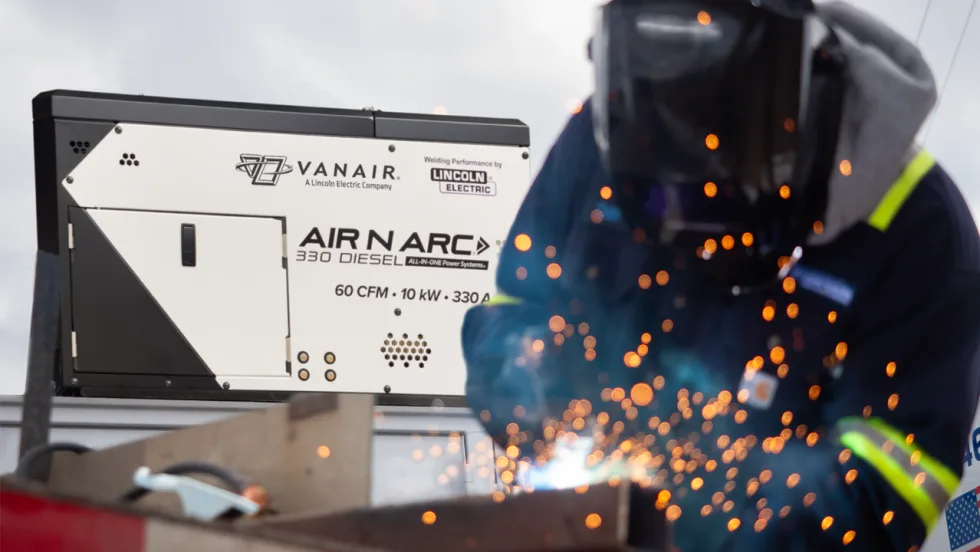
The Air N Arc 330 Diesel 60 CFM from Vanair consolidates a welder, generator, rotary screw air compressor, battery booster, battery charger, and EV charger into a single 750-pound enclosure driven by one 24.8-horsepower Kubota diesel engine.
Buyers Products has been awarded a Sourcewell contract for a wide range of winter maintenance equipment and accessories, including snowplows, municipal plow systems, wing plows, spreaders, and more.
Hilltip’s new SnowStriker SFT Flex expandable box plow features hydraulically extendable sections that allow operators to adapt the clearing width to changing conditions and applications on the go.
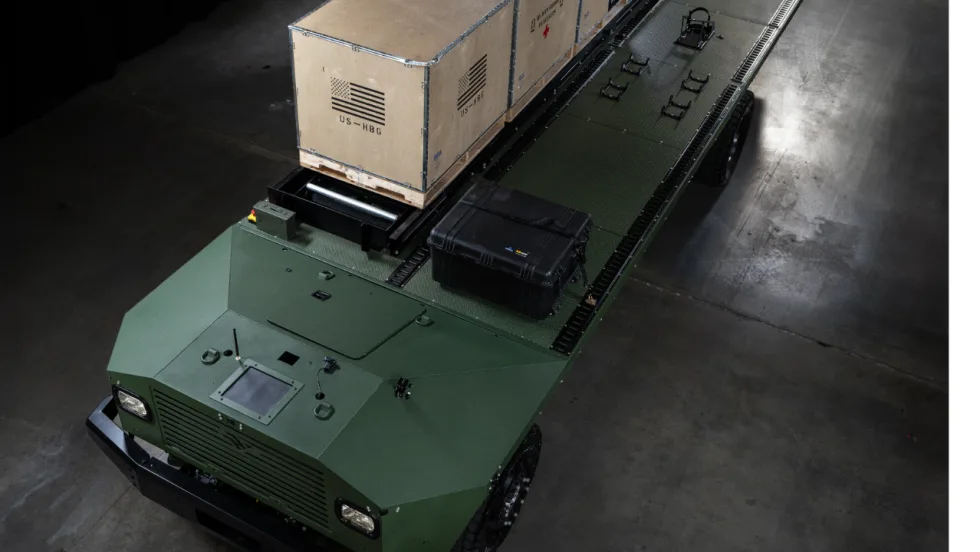
American Rheinmetall received an 18-month U.S. Army contract to deliver autonomous, hybrid-powered uncrewed ground vehicles. Harbinger is providing the truck platform for those vehicles.
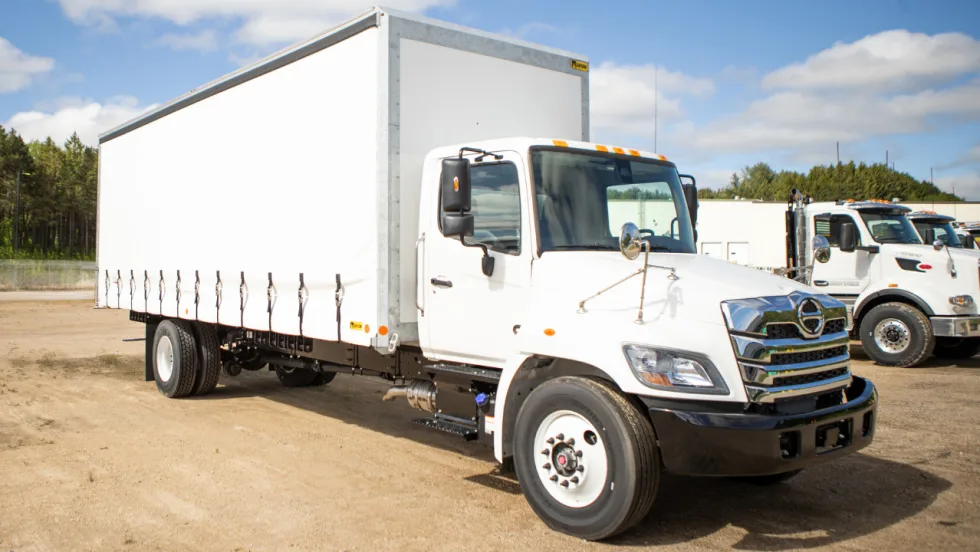
Choosing the right truck body can have a major impact on loading efficiency, cargo protection, downtime, and long-term operating costs. Here’s how dry vans, platforms, and curtainsiders compare, plus what fleets should consider before spec’ing their next truck.
Think your upfit deserves industry recognition? Enter the 2027 Work Truck Upfit Package of the Year Awards before the Sept. 30 deadline. There is less than a month left to get your submissions in!
Reading Truck Equipment and Masterack have integrated operations to create one of North America's largest and most comprehensive commercial vehicle upfit organizations.
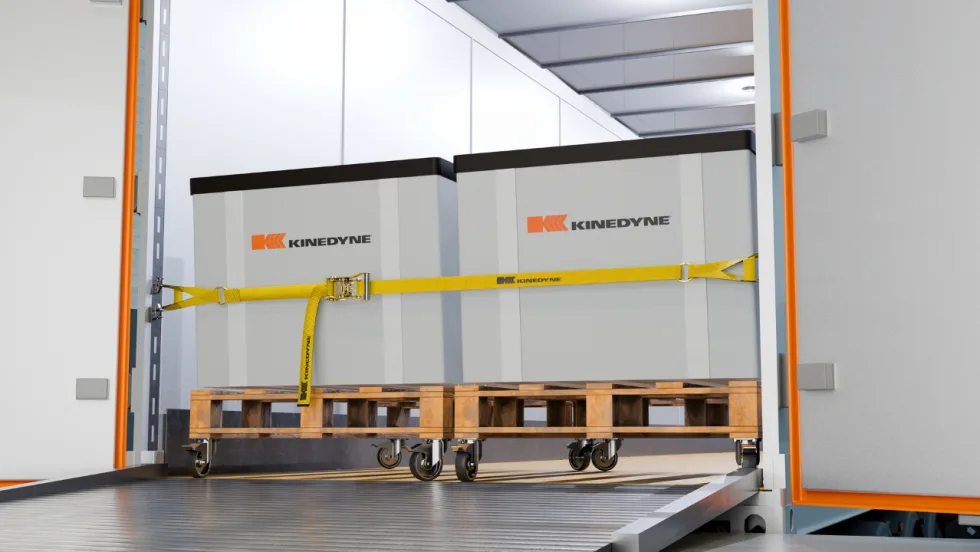
Kinedyne’s new Heavy Duty Logistic Shoring Strap features a patent-pending four-point design to deliver greater cargo stability, increased strength, and easier handling for rolling and shifting freight.
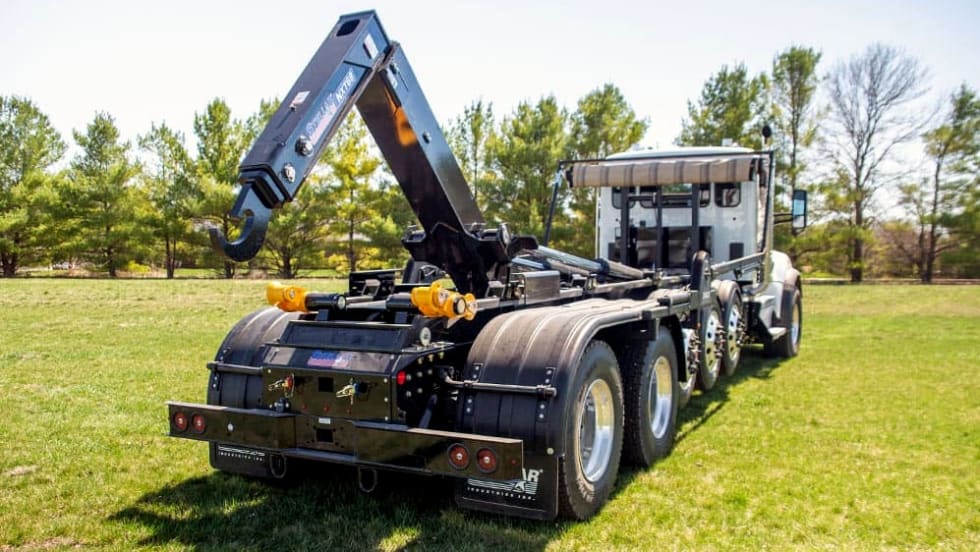
Stellar Industries’ new bumper for the NZT Series Hooklifts come in two capacity options: the 20K, designed for Class 3 – 6 chassis with a 20,000-pound pull capacity, and the 90K, built for Class 7 and 8 chassis with a 90,000-pound pull capacity.
Maxon Lift, a liftgate manufacturer since 1957, received the Wabash Platinum Award for supply chain performance in 2025. Each year, Wabash presents awards to top suppliers for excellence in supply chain performance.