Costs. Maintenance. Engine life. Performance. Which powertrain has the advantage? Gasoline, or diesel? Which one is right for your fleet? Likely, it depends.
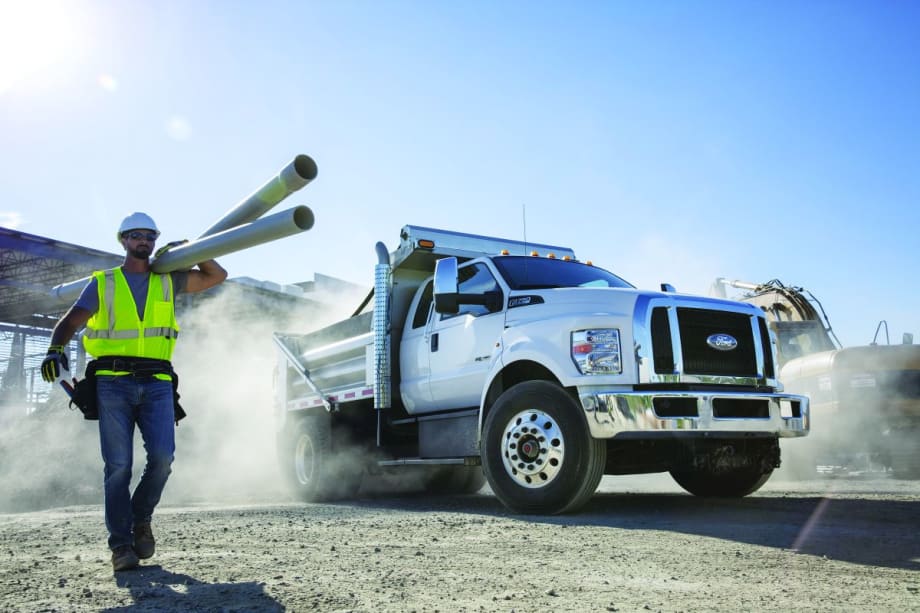
When looking at whether gasoline or diesel is the best option for your fleet, Ford noted that maintenance for diesel models can be more costly, specialized, and complex.
Photo: Ford Motor Co.
9 min to read
Gasoline versus diesel. It’s an age-old engine debate — and one that keeps popping up as technology and fleet needs continually evolve. Where does it stand for today’s light- and medium-duty trucking fleets? OEM experts weigh in.
Ad Loading...
Acquisition and Fuel Costs
Let’s start at the beginning: up-front costs.
Ad Loading...
Nathan Oscarson, brand manager for Ford commercial trucks, said diesel trucks cost around $10,000 more upfront than similarly spec’ed gasoline trucks. But, there is a reason.
“Diesel engines, such as our third-generation 6.7L Power Stroke, are built for the worst-case scenario. This engineering and testing, along with the cost and maintenance of emissions equipment, can increase the initial investment and long-term maintenance costs of a diesel engine,” he said. “Ford gasoline trucks have become very popular with fleet managers because they are significantly more affordable and require less maintenance.”
If you’re looking at up-front costs alone, gasoline gets the advantage. Gasoline-powered trucks also win on the cost per gallon of fuel. But again, there’s a caveat.
“Diesel is generally more expensive,” said Dave Sowers, head of Ram Commercial Marketing. “At the same time, diesel fuel has a higher density than gasoline, meaning it needs less fuel to generate the same power as a gasoline-powered engine. So, diesel engines can provide superior fuel economy to gasoline engines.”
For instance, Sowers explained that the 2020 Ram 1500 EcoDiesel features a highway rating of 29 mpg for 4x4 models, compared to a 21 mpg for a typical gasoline engine truck. So, while the cost of diesel averages $0.50 more per gallon, the vehicle has improved fuel economy.
Ad Loading...
Greg Baker, product director for Mitsubishi Fuso Truck of America, said this improved fuel economy could make up for the higher sticker price, especially for high-mileage fleets.
“If the customer has high mileage, a diesel truck may make more sense because of the improved fuel economy. The improved fuel economy may help offset the higher initial investment cost of the diesel truck,” he said. “However, most light- and medium-duty truck applications are not high-mileage-type vehicles, which can make gasoline trucks more economical.”
Maintenance Differences
When it comes to maintenance, each engine type has its unique demands — and those can make a meaningful difference.
For instance, diesel engine components require service for fuel filters and diesel exhaust fluid (DEF). Gasoline engines, on the other hand, have shorter oil change intervals and require periodic maintenance on spark plugs that don’t exist on diesel engines.
“While maintenance of a diesel engine costs more per occurrence, intervals can be extended compared to a gasoline engine,” said Sowers of Ram Commercial. “For example, Ram Heavy Duty pickups equipped with a Cummins Diesel engine can extend oil change intervals to 15,000 miles.”
Ad Loading...
Although both engine types have unique requirements, Oscarson of Ford said maintenance for diesel-powered engines tends to be more costly and difficult.
“A fleet manager must have a plan in place for diesel maintenance, as it is more complex and specialized then gasoline engine maintenance and repair,” he explained. “Maintenance for diesel trucks can be more expensive because it requires specialized training. And, there are not as many diesel service facilities as gasoline engine repair facilities.”
Then there’s the DEF factor, which doesn’t pertain to gasoline-powered engines.
“More maintenance is required on a diesel with the DEF fluid that needs to be added to the truck about every 2,000 to 3,000 miles,” said Brian Tabel, executive director of marketing for Isuzu Commercial Truck of America. “The diesel particulate filter (DPF) also needs to be serviced and cleaned at every 100,000 miles, which is an additional maintenance cost.”
Putting it all together, Baker of Mitsubishi Fuso said gasoline gets the advantage when it comes to maintenance.
Ad Loading...
“Diesel trucks have significantly greater overall maintenance costs even with the longer intervals between service dates,” he said. “The reason for this is that gasoline engines have a more simplistic emissions system compared to the more complex diesel emissions system. The diesel truck also requires additional consumables such as DEF fluid.”
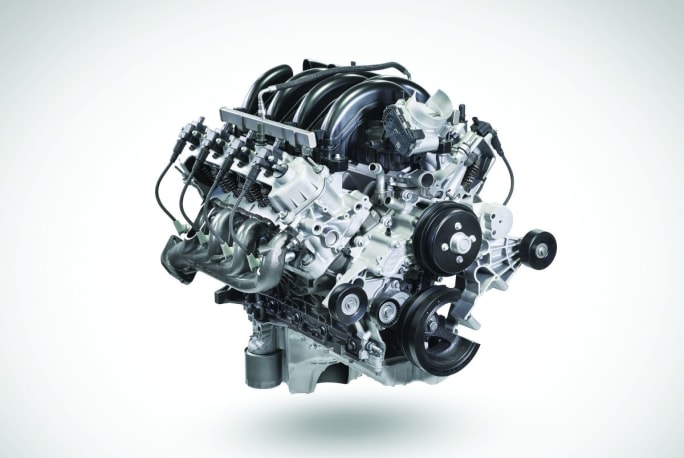
The 7.3L V-8 features an overhead valve architecture that helps get heavier loads moving sooner due to power low in rev range.
Photo: Ford Motor Co.
Factors in Choosing Between Gasoline & Diesel
Application/vocation.
Duty cycle.
Number of miles driven per year.
Total hours driven.
Available capital and operating budget.
Experience/training of drivers.
Maintenance facility capabilities.
Fuel availability in the area of operation.
Differences in Engine Life
You’ve purchased your truck and plan to maintain it properly. Now, let’s talk about engine life. Which lasts longer, gasoline or diesel?
“The B-10 rating on a diesel engine is always longer,” said Tabel of Isuzu. “The B-10 for the Isuzu 4HK is 375,000 miles. The B-10 rating means 10 diesel engines run, and one engine failed at 375,000 miles, but the other nine are still running.”
The reason diesel engines tend to last longer, according to Sowers of Ram Commercial, is that diesel engines require more robust parts than gasoline counterparts. These parts include block and cylinder heads and pistons, due to high-compression ratios and cylinder pressure. Diesel fuel is also less corrosive, enabling the diesel exhaust system to have a longer shelf life.
Ad Loading...
Even though diesel engines tend to last longer, Ford’s Oscarson said it doesn’t mean every fleet should take the diesel path.
“In very general terms, a diesel is likely to last longer than a gasoline engine, but depending on your duty-cycle, spec’ing a diesel may be overkill,” he said. “First and foremost, a fleet manager needs to consider the application.”
Performance & Towing Capacity
If towing capacity matters to your fleet, diesel is the winner here. That’s because of their higher torque rating, providing more power to haul loads.
“Diesel typically offers more power and towing capability and is preferred for higher-mileage applications,” said Oscarson of Ford.
Since diesel engines generate more torque and offer increased fuel economy, the result can be more time on the road.
Ad Loading...
“It’s about picking the right tool for the job, but the torque advantage that comes along with a diesel engine is important if you find yourself towing often,” said Sowers of Ram Commercial. “Diesel engines provide robust torque at lower speeds and are better suited for towing heavy loads up a steep grade as well.”
Although diesel may appear to have the advantage due to greater torque and the resulting higher towing capacity, Oscarson said performance needs differ based on how and where the truck is used.
“Ford gasoline trucks are preferred by fleet managers with applications that have lighter-duty cycles and lower torque requirements. These vehicles are often used for food distribution, moving and storage, and in many municipal applications,” he said. “Diesel engines exist for brute force and long-term durability. In applications where a fleet manager has high-capacity power take-off (PTO) requirements or needs to tow fully laden trailers over long distances, diesel is the preferred option.”
Emissions Systems
A critical difference between a medium-duty gasoline truck and a diesel truck is the emissions systems for each truck — and this time, gasoline gets the advantage.
“From an operational standpoint, the gasoline emission system is much easier to operate compared with today’s diesel engine and eliminates the need for DEF,” said Baker of Mitsubishi Fuso.
Ad Loading...
“The emissions systems of diesel engines are more complex and, therefore, require more attention when operating compared to a gasoline-powered truck. Gasoline trucks also eliminate the need for the aftertreatment system (ATS), tank to hold the DEF, and the plumbing of all the components such as electrical and fluids.”
In the case of diesel, drivers must check DEF levels and refill the fluid every few thousand miles, which can pull them away from their core job duties.
“Since the majority of light- and medium-duty truck operators aren’t professional drivers and are instead using these trucks to support their business needs (e.g., landscaping), the simplistic nature of the gasoline emission system provides the business owner greater peace of mind,” Baker added.
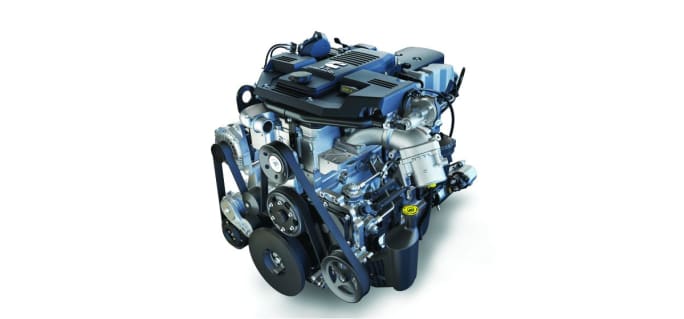
The 2020 Ram Cummins 6.7L Turbodiesel I-6 acheives 400 hp and broke the 1,000 lb.-ft. torque barrier.
Photo: Ram Trucks
unknown node
At-a-Glance:
Diesel vs. Gasoline
ADVANTAGE
Acquisition Cost
Gasoline
Fuel Economy
Diesel
Price per Gallon
Gasoline
Towing Capacity
Diesel
Maintenance
Gasoline
Engine Life
Diesel
Emissions Equipment
Gasoline
Upfitting
Gasoline
Resale Value
Diesel
WINNER:
Depends on the application: Gas for low mileage, light-haul applications, diesel for heavy towing, high-mileage applications.
Upfitting Impact
Speaking of DEF, diesel emissions systems can also make upfitting more challenging. But Tabel of Isuzu said it’s not a deal-breaker.
“The gasoline chassis has a cleaner chassis without the DPF,” he said. “It’s easier for upfitters to work on a gasoline chassis versus diesel, but it’s still easy to upfit on diesel.”
Ad Loading...
To be adequately upfitted, some of the DEF lines or the tank on some diesel models may have to be relocated. Sowers said this is no longer an issue for Ram trucks.
“Ram has made sure to keep DEF system components out of the ‘upfit zone’ so no intervention should be needed,” he said.
Ford is tackling this issue, too, aiming to decrease the work a dealer, fleet, or upfitter must do when considering gasoline vs. diesel trucks.
“In the past, we expanded features like mobile PTO mode that traditionally were found only on diesel vehicles into our gasoline truck offerings,” Ford’s Oscarson said. “In diesel trucks, we’ve made PTO standard in our Class 3-5 Chassis Cabs for the new model year, and we continue to push daily to open doors for our builders.”
Baker of Mitsubishi Fuso said another major difference between diesel and gasoline is the location of the fuel tank.
Ad Loading...
“Depending on the body application, this could play a role when determining which type of fuel to use,” he said.
Resale Value
When it’s time to remarket your light- or medium-duty truck, diesel gets the advantage for resale value.
“Diesel typically has a better resale value but also depends on what your local area demand is for trucks,” said Tabel of Isuzu.
Ram Commercial’s Sowers said the reason diesel trucks tend to have higher resale values has to do with engine life.
“If you look at a diesel engine with 150,000 miles, the market dictates that there’s more usable life remaining when compared to a gasoline engine, so diesels tend to hold higher values longer term,” he said.
Ad Loading...
While diesel may have a higher resale value, Baker of Mitsubishi Fuso noted not to forget the up-front cost.
“Diesel resale value is often higher; yet, so is its initial acquisition cost. But as more second and third users of vehicles look to purchasing gasoline trucks, resale value for these trucks is increasing within the market — namely on the simplicity of the maintenance needs offered by gasoline trucks,” he said.
How to Choose
While gasoline is the clear winner in some categories and diesel in others, ultimately, the question of which to choose comes down to the application.
“Look at what type of routes the truck needs to drive and what it needs to carry, then buy the right truck for the right route,” Isuzu’s Tabel recommended. “If the truck doesn’t have to carry that much and doesn’t drive a lot of miles, gasoline would be the best option. If the truck needs to haul more and has longer to drive, diesel would be the best option.”
Sowers of Ram Commercial agreed, adding that after application, costs are the next consideration.
Ad Loading...
“Fleet managers should consider the duty cycle, or mission, of the truck, then look at acquisition and fuel costs when looking to acquire another truck,” he said. “What daily work is demanded of the truck? Buy the powertrain that gets the job done.”
Mixed-energy fleets aren’t about picking a winning fuel. Sarah Booth of WEX explains how vehicle data, duty cycles, charging strategy, and real-world costs can help fleets choose the right energy source for each job.
New research suggests neglected diesel aftertreatment systems could waste up to $30 in fuel per vehicle each day. Here's why vocational fleets should pay attention.
This week’s product launch with Standard Fleet’s connected vehicle platform reflects WEX Venture Capital's strategy of turning startup innovation into customer solutions. Standard Fleet is now available to WEX fleet customers.
The new Energy Hub combines fuel transactions, EV charging data, vehicle range, and energy costs in one dashboard for fleets operating multiple vehicle and energy types.
The DriverDash mobile payment app, by WEX, has been integrated into the CITGO merchant network, which means WEX has expanded its U.S. station footprint with the addition of approximately 4,000 CITGO locations.
Mixed energy fleets are becoming the new normal. Learn how fleet managers are balancing EVs, gas and diesel vehicles while controlling costs and planning for the future.
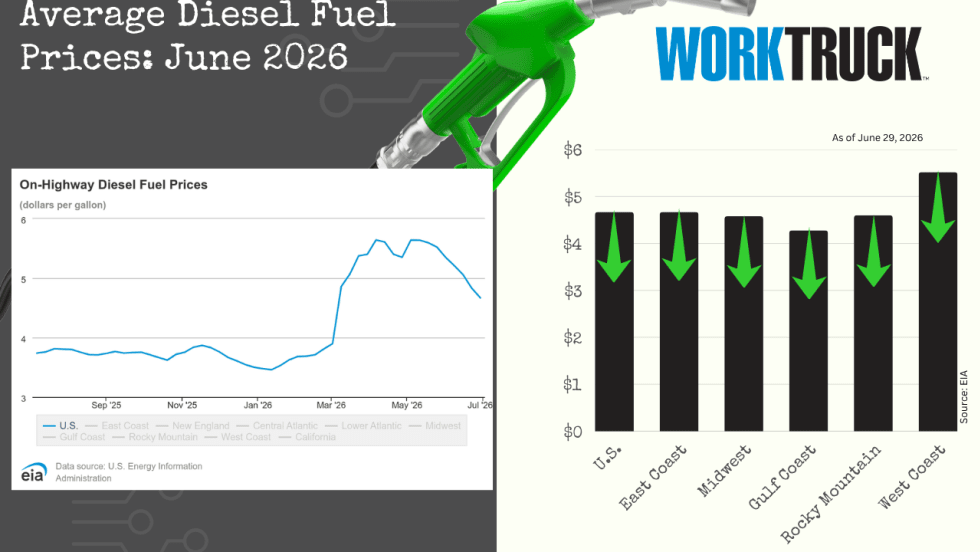
The national average price of a gallon of diesel has dropped again, this week by more than 16 cents. All five regions reported lower average prices, ranging from almost 13 cents to more than 28 cents cheaper than a week ago.
RoadFlex Direct connects fuel cards, controls, and data to the telematics and fleet management systems fleets already run, from Geotab and Samsara to Fleetio and RTA, with no separate dashboard or double data entry.