





This article appeared in the 2022 Connected Fleet Guide, which offers resources to turn connected car data into actionable insights to foster safer and more efficient fleets.
Electric & Connected: Fleet Managers Face New Responsibilities
Electric vehicles are computers on wheels. Here’s how their operation adds to fleet managers’ — and drivers’ — roles. It starts with managed EV charging and extends to managing data from both the vehicles and drivers.
December 27, 2022
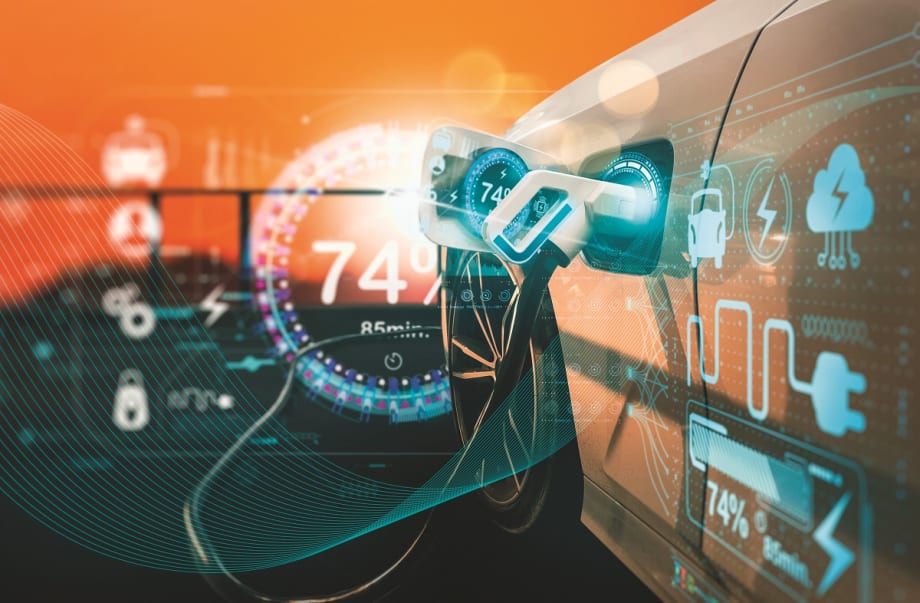
Managing EV charging, as well as data, is imperative for the modern fleet manager. Combining the data from multiple systems, though, can be tricky,
Photo: Getty Images/greenbutterfly
6 min to read
It’s always been about the data. It’s just that back in the day, we didn’t have the resources at our fingertips to extract it — and thus there was less of an expectation to do anything. Those days are over. If you’re not on a continual quest as a fleet manager to use data to hone your processes, create efficiencies, and conserve your fleet budget, you’re not doing your job.
The changes were incremental: Analyzing data from fuel card reporting helped mitigate fraud and lessened fuel spend. Then came the rise of the fleet management information systems (FMIS) that track and automate everything from fuel, maintenance, technicians, driver logs, and timecards, to tax, title, and licensing. You eventually got into telematics to monitor driver location and performance, routing, and vehicle diagnostics. You may have integrated dashboard from your fleet management company to monitor data and many of these processes.
You figured out how to manage well enough through automated rules and exception reporting. But there was always the promise that these systems could talk to each other and that the information would flow through a single pane of glass, though that never quite happened. And that was okay, because the benefits those individual systems delivered are more than enough to offset the extra management hassle.
Now, the electric vehicles cometh. EVs are more than just an internal combustion engine (ICE) swapped for a battery. They’re computers on wheels — and they bring new and heightened requirements around connectivity, software management, and data mining along with them.
Here’s how their operation adds to fleet managers’ (and drivers’) roles, particularly as it relates to data, though this isn’t a complete picture. It starts with managed EV charging and extends to managing data from both the vehicles and drivers.
Monitoring EV Charging
Unlike fueling an ICE engine, EVs take eight hours or more to reach 80% capacity on a Level 2 charger. This dictates remote monitoring of home or depot chargers, often after work hours, to make sure they are in fact plugged in and receiving juice. An EV that fails to charge will really screw up your next day.
Understanding Battery State-of-Charge
With EVs’ limited ranges and the lack of public infrastructure, fleet managers need to know how much juice their EVs have left to strategize on how not to get stranded.
Managing Electricity Rate Fluctuation
As much as we abhor unpredictable gas prices, electricity demand and rates fluctuate by the hour and peak load times. To avoid expensive demand charges, fleets must remotely activate chargers Again, this task is often performed after hours. With many virtual tasks, the goal is to automate them by establishing rules and exception alerts based on how soon the vehicle is needed, rate curve, and present state of charge.
Accessing Public EV Charging
While most charging should be done at home or the depot, public charging should be worked into the plan as a backup when necessary. Public chargers are run on multiple networks. You’ll need to subscribe to a network with the best coverage for you. Each network comes with a proprietary app to locate its charge points. You’ll then need to monitor costs by kWh, dwell time, and type of charging (Level 2 or more expensive Level 3 DC fast charging). To expand charger accessibility, you’d want to subscribe to multiple networks — but that requires another set of apps for both you and your drivers.
Reimbursing for Home EV Charging
Another aspect of home charge management for fleets involves separating utility bills by personal and work expense for fleet vehicle charging, and then reimbursing the employee accurately.
Managing EVSE
The chargers themselves (also known as EVSE, or electric vehicle supply equipment), whether at employees’ home or the depot, need to be maintained to minimize the potential for maintenance issues. Again, an EV that fails to charge because of faulty equipment will really screw up your next day.
Managing Vehicle, Driver Data
Managing vehicle and driver data are still important in the ICE world but take on even greater importance with EVs. These data sets are needed to understand battery efficiency (the costliest component of an EV by far) and how range is affected by factors such as driving style and payload, stops, road grade, and external temperature.
Ways to Integrate EV Data
A major issue today is that there are no communications standards or protocols regarding how data from EVs is communicated, which creates difficulties in gathering data across makes and models. As a result, there isn’t one set way to access and analyze all this data. (Protocols on the charging side have been developing, however.)
Entities that can access data include aftermarket-installed telematics, new data services platforms, fleet card providers, EV charging network provider apps, and automakers’ EV management systems. Each of these systems takes on specific roles in the EV ecosphere, and many provide multiple solutions, but none do them all.
That leaves fleets to integrate EV data from multiple sources. This is only a sample of the hypotheticals:
Automakers’ EV management systems connect their fleet customers with their electric vehicles. Those systems are essential to monitor EVs’ status in the charging queue, identify battery state of charge, precondition cabins, locate chargers, measure energy consumption, and offer other metrics on vehicle performance. A select few of these systems have robust functionality, while some electric OEMs don’t have any system or app at all. If you’re running EVs from multiple OEMs, you’re again faced with juggling multiple apps, like finding chargers. If you acquire new electric models, are you prepared to manage a new system and have your drivers download and learn a new app?
Some proprietary OEM systems are marketing the fact that they integrate with other electric makes and models. This is worth vetting — but normalizing data from other OEMs isn’t just a digital handshake. But we’re still at the infancy of cross-brand compatibility and making data flow back and forth in easily digestible formats.
Your existing telematics system is inherently cross-brand compatible for measuring driver and vehicle performance data. Though as EVs don’t have OBD-II ports, data is instead pulled from the vehicle’s onboard computer. This brings up other data normalization issues that aren’t insurmountable, but the solutions aren’t off the shelf. Further, telematics may handle other functions that the OEM systems offer around EV batteries, chargers, and expense management.
Growing EV Resources
For EV fleet integrations of any size and of different makes and models, integration of multiple systems is essential. There is no one set answer on which combination is best, as each situation is different. How do you minimize the number of applications to manage, making sure those applications connect and deliver the right data reliably? That depends on the functionality offered by your providers and your fleet situation.
The good news is that there is an industry coalescing around holistic solutions to get your fleet on the right path. Those stakeholders include fleet management companies, telematics providers, utilities, third-party consultancies, and the manufacturers themselves. For a fee, they’ll manage a lot of the hard stuff for you.
In the Valhalla of EV fleets, vehicles receive over-the-air repairs and updates; they automatically charge an account when they’re plugged in, and they have myriad charging options on an app within close range. As well, other parts of their support system run on a standardized open platform, like Android, for third parties to invent new solutions. (Some already do and are growing their networks.)
The industry will overcome these challenges incrementally. If you’re about to embark on your EV pilot, it’s better to be prepared for them before you start.
Topics:Connected VehiclesConnected CarsElectric VehiclesEV ChargingData ManagementTechnologyGreen FleetSmall Fleet
Originally posted on Automotive Fleet
Subscribe to Our Newsletter
More Green Fleet

Fleet Forward Conference Introduces One-Day Passes for 2026
New one-day registration gives fleet professionals the flexibility to attend Tuesday, Wednesday, or Thursday, with passes available for $199 through Sept. 18.
Read More →
CALSTART Rebrands as Catalyst Mobility, Will Combine with Forth in 2027
CALSTART has rebranded as Catalyst Mobility and will combine with Forth at the start of 2027. The new organization said it is poised to become one of the world's largest, strongest, and most impactful clean transportation nonprofits.
Read More →
Electric Truck and Charging Programs to Boost Sustainability at NY & NJ Ports
Together, the Port Authority of New York and New Jersey and CALSTART will electrify drayage and terminal operations serving the East Coast’s busiest container port. A pair of incentive programs totaling $45 million has launched to accelerate adoption of zero-emission drayage trucks and terminal tractors.
Read More →
Xos Hub Surpasses One Gigawatt-Hour of Energy Delivered in the Field
A single Xos Hub has surpassed one gigawatt-hour of energy across more than 33,600 charging sessions in the field, demonstrating performance that supports Xos' expansion across new products and markets.
Read More →
Carrier Transicold Launches All-Electric Vector 8200 TRU for Diesel-Free On-Site Cold Storage
Carrier Transicold’s first engineless multi-temperature TRU helps fresh- and frozen-food fleets add supplemental cold storage capacity during seasonal peaks.
Read More →
Narro Trucks Introduces Electric Utility Vehicle
Narro Trucks officially launched its operations on Aug. 20 and hosted a ride and drive to showcase its electric truck, which will be produced in Virginia.
Read More →
Samsung SDI Takes Full Control of GM Battery JV as Indiana Plant Pivots to Energy Storage
Samsung SDI is taking full control of its Indiana battery plant with GM, marking a major shift from the EV-focused joint venture Charged Fleet first covered in 2023.
Read More →
NWSA Taps CALSTART to Administer Zero-Emission Drayage Assistance Program
CALSTART will provide free technical assistance services to drayage fleets serving the Ports of Seattle and Tacoma and looking to transition to cleaner technologies and help decarbonize freight hubs.
Read More →
EV Fleet Reality Check: What Operators Wish They Knew Before Electrifying Their Work Vans
Electric work truck upfits bring new compatibility questions. Learn how parts availability, OEM guidance, power demands, and route planning can affect fleet performance.
Read More →
Peterbilt Expands Sourcewell Partnership with Electric Vehicle Lineup
Peterbilt Motors Company’s cooperative purchasing agreement with Sourcewell and its Canadian partner, Canoe Procurement Group, now includes including Peterbilt's battery-electric vehicle lineup.
Read More →