




Could Your Next Work Truck Be a Hybrid?
In addition to the environmental benefits, medium- and heavy-duty hybrid truck tests show promise in stop-and-go situations and those that require auxiliary power generation in urban environments. But will costs come down to make them feasible for general use?
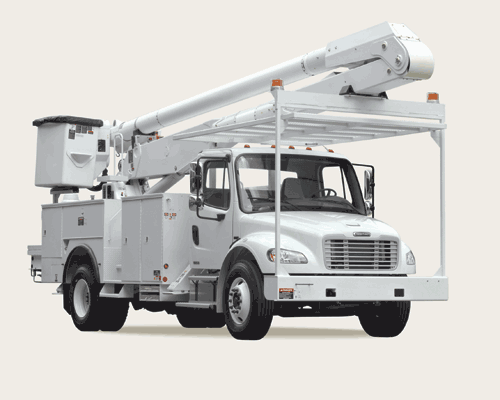
The Freightliner hybrid prototype integrates the Hybrid Electric Vehicle (HEV) system with hydraulics for electric power takeoff (ePTO) operation.
Photo: Freightliner
While hybrid passenger vehicles have garnered the lion's share of media attention and sales, many major truck manufacturers are developing diesel-electric hybrid trucks for the same reasons they did cars: fuel cost savings and a desire to reduce emissions, especially in congested urban environments.
No medium- or heavy-duty hybrids are for sale in America at this time. However, national fleets such as the U.S. Postal Service, United Parcel Service, Federal Express, Verizon and Coca-Cola are testing hybrid trucks and vans, as is the Department of Defense.
General Motors
On the light duty side, General Motors, along with corporate partners DaimlerChrysler and the BMW Group, have teamed up to co-develop a dual-mode hybrid system.
GM's version of the system will be launched this year in GM's 2008 Chevrolet Tahoe and GMC Yukon. The system uses two electrically continuously variable transmission (ECVT) modes to optimize power and torque for various conditions. Those modes are then combined with four fixed gear ratios for better efficiency and power handling applications.
When combined with Active Fuel Management, GM's cylinder deactivation technology, the dual mode hybrid system is hoped to give large SUVs a composite fuel economy improvement of 25 percent.
Work-truck pickup users take note: GM says it will implement the same system in its huge-selling full-size Silverado and Sierra pickups, though a release date has not been announced.
Breaking Down the Benefits
There are basically two types of hybrid systems: series hybrids, which use an internal combustion engine to generate electricity for the electric motor that drives the vehicle, and parallel hybrids, which use both internal combustion engines and electric motors for propulsion, yet switch back and forth as the situation demands.
One unique feature of a hybrid system is that brake energy can be recuperated with a large enough energy storage system. This can make a significant impact on fuel economy, especially in city driving.
"The more stop-and-go driving you do, the better the efficiencies," says Leif Johansson, president and CEO of truck-maker Volvo Group AB. "There's also higher starting torque than a normal diesel engine." "The diesel engine can be 35 percent smaller with a hybrid drivetrain. Also, you'll see more savings with complete electrification of the air conditioning, power steering and power take-off," explains Sten-Ake Aronsson, senior vice-president at Volvo Powertrain North America in Hagerstown, Md.
A full-hybrid system can also generate power for auxiliary units such as dump beds, wreckers and farm equipment. Since full-hybrid vehicles run solely on electric power up to about 25 miles per hour, a hybrid truck would be much quieter on average than a conventional diesel.
Diesel engine life may increase, as its load is supplemented by an electric motor. Because charging the batteries retards the motion of the truck, brake wear is reduced as well.
The Battery Debate
Today's hybrid systems used in passenger cars employ a nickel-metal hydride battery. Manufacturers such as Isuzu are pioneering a lightweight, energy-dense, high-voltage lithium-ion battery that reportedly lasts three times longer than comparable nickel-metal hydride cells.
In lieu of batteries, some hybrid truck systems store electric energy in ultracapacitors. Ultracapacitors have several advantages over batteries: very high rates of charge and discharge, little degradation over hundreds of thousands of cycles, low toxicity of materials used and high cycle efficiency (95 percent or more).
However, the amount of energy stored per unit weight is considerably lower than that of an electrochemical battery, and to effectively store and recover energy requires sophisticated electronic control and switching equipment.
Thomas Grothous, dean at the College of Technologies, University of Northwestern Ohio, believes that "ultracapacitors are something that will work for medium-duty work trucks because of all the city stop-and-go driving, with regenerative braking getting in on the action. Without regenerative braking, the capacitors are only storing what has been charged up by a generator-and that takes fuel.
The generator sets that are being used to keep a cab warm or cool will be obsolete." Now add hydraulic hybrid systems to the mix. This technology stores energy in pressurized tanks rather than batteries.
The conventional drivetrain is replaced with a hydraulic one, which eliminates the need for a mechanical transmission and driveline. The hydraulic system offers great advantages for vehicles operating in stop-and-go conditions because, like ultracapacitors, the system can capture large amounts of energy from regenerative braking.
Technical challenges with hydraulic hybrids include noise and packaging issues. Eaton Corporation and the Environmental Protection Agency are testing hydraulic hybrid prototype trucks with UPS.
Your Mileage May Vary
Fuel economy improvements in hybrid truck tests vary widely due to application and type of truck. WestStart-CALSTART, a research and development firm involved with hybrid truck technology, has conducted chassis dynamometer and in-field tests of hybrid utility trucks through its Hybrid Truck Users Forum (HTUF) pilot program.
The tests showed a decrease in fuel consumption of 40 to 60 percent measured against their non-hybrid counterparts in similar conditions.
Hino
Hino markets the 165 hybrid in Japan. In the States, two model 165 hybrid trucks have been undergoing tests with an unspecified package delivery company. It is rated at 16,000 GVW and powered by a 5-liter, 4-cylinder diesel engine.
Hino uses a proprietary flywheel generator/starter that stores electrical power from regenerative braking in a nickel-metal hydride battery array.
In SAE (Society of Automotive Engineers) fuel tests, the Hino system improved fuel economy by 14 to 17 percent, with the largest gains coming in pickup and delivery operations, according to Kenichi Kobayashi, assistant chief engineer for Hino's North American Truck Product Planning Division.
Grothous estimates a hybrid parcel delivery or refuse collection truck "can get anywhere from a 20- to 30-percent fuel reduction" relative to a conventional engine. In its hybrid truck test fleet, FedEx reports that independent lab tests showed a 57-percent reduction in fuel costs over a baseline model.
Trucks making fewer stops don't fare as well: Grothous says a Class 8 truck, on a cross-country run in high gear, can achieve a five-percent reduction in fuel cost if the driver is operating the rig in high gear 80 percent of the time. Individual manufacturer's real-world tests show substantially less fuel savings (see insets).
In its hybrid truck test fleet, FedEx reports that independent lab tests showed a 57-percent reduction in fuel costs over a baseline model.
From Prototype to Production
Though manufacturers such as Isuzu and Hino are producing hybrid models in Japan, medium- and heavy-duty hybrid trucks are still in the test stages in America.
Isuzu
"We [Isuzu] have an easy-to-implement solution, based on what is running in the Japanese market," says Ed Crawford, director of Diesel Engine Sales and Marketing for Isuzu Commercial Truck of America, Inc.
Isuzu's Elf diesel hybrid, currently sold only in Japan, employs a parallel hybrid system based on the 4HL1 diesel engine. Not only does an electric motor assist the engine, the "E-automatic shift system" allows high-efficiency regenerative braking energy storage, along with automatic shifting in fuel-saving ranges.
A Lithium-ion battery is used for energy storage. Isuzu says it provides three times longer life than a nickel-metal hydride battery.
Despite the estimated $10,000 cost difference between a conventional diesel truck and a hybrid diesel-electric, Crawford says that when Isuzu asked its dealer network about exporting its Japan-only hybrid truck to the States, the response was overwhelmingly positive.
Isuzu reports a 10 to 15 percent increase in fuel efficiency compared to their conventional diesel trucks.
These trucks are also certified as four-star, ultra low-particulate matter diesels that meet the tough new diesel standards in the United States, Isuzu says.
Therefore it's very difficult to put a price tag on implementation, manufacturers say. Some sources speculate that the government may eventually offer tax credits on medium- and heavy-duty hybrid trucks, similar to those offered on new hybrid passenger cars, though nothing is imminent.
"We don't know yet what the cost [per unit] will be," says Paul Vikner, president and CEO of Mack Trucks. "It's very volume-dependent. If we had to depend on [government] incentives, 20 years from now, we aren't doing our job." Ultimately, it becomes a matter of waiting for the economies of scale to kick in, admits Vikner. "Somewhere in the next decade we'll see the supply and demand curves for hybrid trucks crossing," says Johansson.
Sten-Ake Aronsson is confident the technology can be harnessed cost-effectively. He compares the cost of diesel-electric hybrid trucks today with catalytic converters that needed platinum in their construction. "Once, catalytic converters were very expensive," says Aronsson. "And today, they're a commodity."
Peterbilt
Peterbilt's Model 335 hybrid debuted at the Hybrid Truck Users Forum National Meeting in San Diego last November. The Class 7 truck is powered by the new PACCAR PX-6 diesel engine and uses a parallel hybrid developed by Eaton Corporation.
"We expect the hybrid Model 335 will result in 30- to 40-percent reduction in fuel use, through the combined improvement of on-road fuel economy and stationary job site operation," says Peterbilt Chief Engineer Landon Sproull.
More Small Fleet

Developing Budget-Friendly Driver Safety Programs
From driver training and safety meetings to one-on-one coaching and incentive programs, several small fleets share how they have developed a safety culture with their drivers using low- to no-cost resources.
Read More →
Boosting Last-Mile Fleet Uptime, Safety, and Value with AI Vehicle Inspections
AI-powered inspections are transforming last-mile fleets by replacing manual checks with highly accurate automated scans that detect defects in seconds. By giving fleet operations visibility into the daily condition of their vehicles, you can identify trends over the vehicle’s lifecycle that enable improved procurement decisions, route management, driver training and accountability.
Read More →
Five Ways Seat Belts Help Prevent Injuries
There are five ways seat belts protect occupants from injuries, according to the Tennessee Department of Safety and Homeland Security.
Read More →
It’s here: The 2026 Fleet Technology Trends Report
What does AI mean for fleets? Get the answer — and learn other top tech trends.
Read More →
Small Fleets, Big Impact: How Independent Drivers Power Wreaths Across America
Check out how small fleets and independent drivers power Wreaths Across America each December and why their impact matters more than ever.
Read More →
VMS Survey Finds 65% of Small Fleet Managers Run Operations Alone
A new VMS survey shows small fleet managers are stretched thin, with most handling operations solo and eager to adopt digital tools for relief.
Read More →
Tips for Driving Safely on Halloween Night
This video features a reminder from the Connecticut Department of Transportation (DOT) and the Connecticut Police Chiefs Association, urging drivers to prioritize safety this Halloween.
Read More →
AI, Access, and Uptime: VMS’s Next Chapter with David Prusinski
VMS’s new Co-CEO, David Prusinski, shares how an AI-first approach will give small fleets and repair shops the tools to compete like big players.
Read More →
Fleet Managers Share Winter Prep Tips: It's Never Too Early!
Three fleets share best practices to prep vehicles for winter and prevent downtime when the cold sets in.
Read More →