




Chevrolet Malibu Voted 2010-MY Fleet Car of the Year
Chevrolet wins Fleet Car of the Year five years running, with the Malibu capturing the honor for the second straight year. Fleets commend the 2010 Malibu for distinctive styling, outstanding fuel efficiency, and exemplary quality.

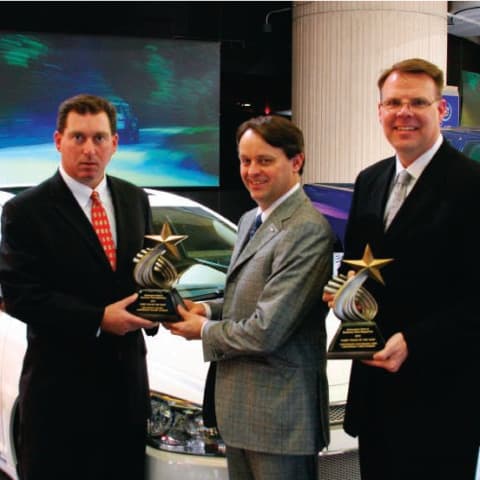
Brent Dewar (center), VP, Chevrolet Global Brand, and Jim Campbell (right), general manager, GM Fleet & Commercial Operations, accept 2010 Fleet Car and Truck of the Year trophies from Bob Brown, Automotive Fleet associate publisher.
Once again, Chevrolet has captured the Fleet Car of the Year award with the 2010-model Malibu taking top honors. For the fifth year in a row, Chevrolet has won Fleet Car of the Year. Last year, the Malibu also took the top prize, while previously, the Impala won three years running.
Fleet professionals voted on the top 2010 model-year fleet vehicles in the annual online award program sponsored by Automotive Fleet and Business Fleet magazines.
Qualified fleet buyers voted on 75 2010 model-year cars. Fleet managers could vote for one vehicle in both car and truck categories and were encouraged to select the car and/or truck that best fit their company fleet needs, considering features, function, styling, maintenance, remarketing value, OEM service, and driver feedback. Votes were cast on www.automotive-fleet.com.
Inaugurated in 2003, the Fleet Car and Truck of the Year awards continue Automotive Fleet magazine's efforts to promote excellence in the fleet industry. In addition to spotlighting outstanding fleet professionals with its Fleet Manager of the Year Award, the magazine extended that recognition to the products and tools that allow fleet professionals to do their jobs at the highest possible level, including vehicles they select to perform their companies' missions.
"We're honored and proud of this accomplishment," said Brent Dewar, vice president of the Chevrolet Global Brand. "Knowing that fleet managers vote for their favorites and have chosen the Chevrolet Malibu once again gives us validation that our customer focus is on the right track."
[PAGEBREAK]
Malibu the 'Surprise of the Automotive World'
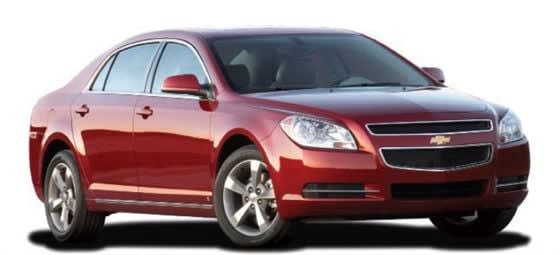
Labeled the "surprise of the automotive world" by US News & World Report and considered by many one of the best values in the mid-size sedan market, Malibu's sporty personality is established by its long wheelbase, short overhangs, and tight wheel-to-body relationship. Vehicle control is further enhanced by the standard four-wheel disc brakes with ABS and StabiliTrak.
For 2010, the Malibu's trim levels (the LS, LT, 2LT, and LTZ) remain largely unchanged. LS and LT have a 169-hp 2.4L four-cylinder engine, now capable of running on E-85 ethanol-blended fuel. LS versions have a 4-speed automatic transmission, while the LT and LTZ use a 6-speed automatic. LT and LTZ offer an optional 252-hp 3.6L V-6 that teams with the 6-speed automatic.
Available safety features on all Malibu models include ABS, traction control, antiskid system, curtain side air bags, and front-side air bags. A wireless cell phone link, leather upholstery, and heated front seats are available.
Gasoline-Sipping Malibu Leads Segment in Fuel Economy
In addition, according to Dewar, the fuel economy of the Malibu now leads its respective segments.
Malibu's standard 169 hp Ecotec 2.4L dual overhead cam (DOHC) four-cylinder engine employs fuel-saving technology, such as variable valve timing (VVT). When combined with the 6-speed automatic transmission on 2LT and LTZ models, VVT enables Malibu to earn 5.9L highway fuel consumption ratings. This translates into a highway driving range of up to 642.5 miles.
Safety-wise, the 2010 Malibu is engineered for maximum safety, starting with advanced driver control technology and comprehensive occupant protection features. These safety features include six standard air bags: dual-stage frontal air bags with a Front-Passenger Sensing System, front seat-mounted thorax side-impact air bags, and front-to-rear head curtain side-impact air bags, helping Malibu earn the highest U.S. government frontal and side-impact crash ratings - five stars.
[PAGEBREAK]
Malibu Brand Continues Evolution
After undergoing a complete redesign in 2008 and minimal changes in 2009, the 2010 Malibu model integrated a few new elements, including:
17-inch Chrome-Tech aluminum wheels on 2LT.
2.4L Ecotec engine (includes E-85 flex-fuel capability, a blend of 85-percent ethanol and 15-percent gasoline for fleet only).
"At Chevrolet, we believe one of our strengths is demonstrating continuous development throughout a product's lifecycle," Dewar said. "The Malibu, since winning the 2008 North American Car of the Year, has seen significant enhancements, including a 6-speed transmission mated to the four-cylinder engine for further fuel economy and performance improvements, along with creature comforts like adding power lumbar adjustment for the driver and USB connectivity."
The bottom line for the Malibu is to continue setting high standards in class, quality, confidence, and control for the mid-size segment. Maintaining expressive styling, exciting powertrain combinations, and technology advancements keep this model at the top of the list for fleet selectors.
Dewar concludes the Malibu's success comes from Chevrolet remaining in touch with fleet managers and understanding their needs.
"This plays a huge role in knowing the right vehicle to deliver to our customers," he said. "A combination of value, capability, and reliability are attributes that succeed in the marketplace, and we feel that the Malibu delivers these."
Originally posted on Automotive Fleet
More Small Fleet


Developing Budget-Friendly Driver Safety Programs
From driver training and safety meetings to one-on-one coaching and incentive programs, several small fleets share how they have developed a safety culture with their drivers using low- to no-cost resources.
Read More →
Boosting Last-Mile Fleet Uptime, Safety, and Value with AI Vehicle Inspections
AI-powered inspections are transforming last-mile fleets by replacing manual checks with highly accurate automated scans that detect defects in seconds. By giving fleet operations visibility into the daily condition of their vehicles, you can identify trends over the vehicle’s lifecycle that enable improved procurement decisions, route management, driver training and accountability.
Read More →
Five Ways Seat Belts Help Prevent Injuries
There are five ways seat belts protect occupants from injuries, according to the Tennessee Department of Safety and Homeland Security.
Read More →
It’s here: The 2026 Fleet Technology Trends Report
What does AI mean for fleets? Get the answer — and learn other top tech trends.
Read More →
Small Fleets, Big Impact: How Independent Drivers Power Wreaths Across America
Check out how small fleets and independent drivers power Wreaths Across America each December and why their impact matters more than ever.
Read More →
VMS Survey Finds 65% of Small Fleet Managers Run Operations Alone
A new VMS survey shows small fleet managers are stretched thin, with most handling operations solo and eager to adopt digital tools for relief.
Read More →
Tips for Driving Safely on Halloween Night
This video features a reminder from the Connecticut Department of Transportation (DOT) and the Connecticut Police Chiefs Association, urging drivers to prioritize safety this Halloween.
Read More →
AI, Access, and Uptime: VMS’s Next Chapter with David Prusinski
VMS’s new Co-CEO, David Prusinski, shares how an AI-first approach will give small fleets and repair shops the tools to compete like big players.
Read More →
Fleet Managers Share Winter Prep Tips: It's Never Too Early!
Three fleets share best practices to prep vehicles for winter and prevent downtime when the cold sets in.
Read More →