




Related: American Natural Gas Acquires Questar Fueling Company
Cow Power by the Numbers
Cow power, also known as dairy renewable natural gas, is natural gas produced from the manure from feedlots and dairy farms.
by Trey Teall
August 29, 2019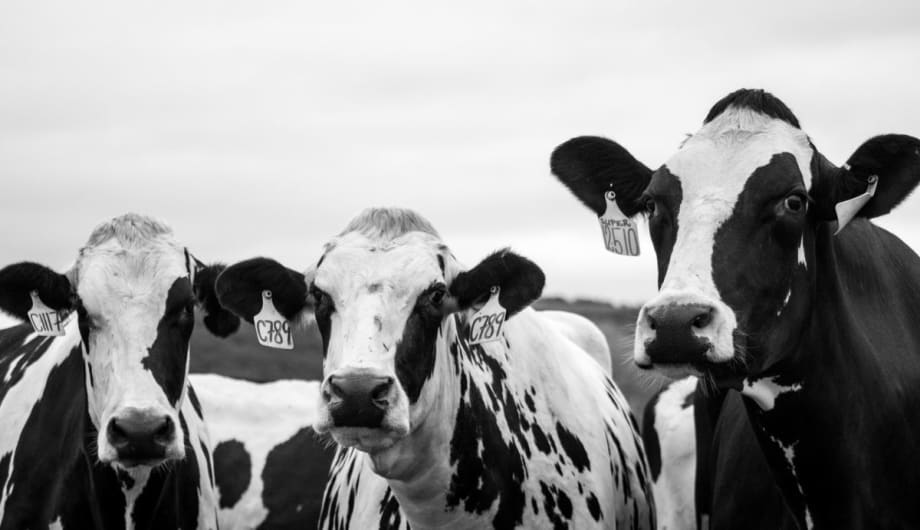
The energy production potential in the U.S is 148 trillion Btu from beef cows and 31 trillion Btu from dairy cows, which gives a total of 179 trillion Btu per year of available cow power.
Photo: Pexels
4 min to read
Cow power, also known as dairy renewable natural gas, is natural gas produced from the manure from feedlots and dairy farms.
Cow power is the cleanest of all possible energy sources, including solar, wind, diesel, biodiesel, gasoline, and ethanol. Cow power also has the potential to supplant a considerable amount of our energy needs. There is an enormous potential for cow power to reduce greenhouse gas levels in the U.S. when you combine these factors.
How Cow Gas is Made
Traditionally, the manure from cows is used in land spreading or plumbed into human-made, open-air lagoons. As the manure is organically broken down, it releases methane, a potential greenhouse gas that is roughly 30 times as potent as carbon dioxide, into the atmosphere.
The manure is took to an anaerobic digestion system, a closed bioreactor starved of oxygen in which a series of microbes work to break down the manure into biogas rich in methane. This biogas is then cleaned to produce a renewable natural gas that is transported to natural gas fueling stations like those at American Natrual Gas (ANG).
Beef cows weigh an average of 1,000 pounds each, and dairy cows weigh an average of 1,200 pounds each. Beef cows produce an average of 5 pounds of manure per day by volatile solids weight, and dairy cows produce an average of 7.7 pounds. Volatile solids are the dry weight that volatilizes below 550 °C, and that can decompose into methane.
The amount of energy that is produced by anaerobic digestion of the manure of beef and dairy cattle is 22.7 and 31 cubic meters per day per cow, respectively. After the amount needed to heat the digesters to 95 °F from an average ambient temperature of 68 °F is accounted for, the surplus energy per head of cattle is 520 Btu per hour for beef cows and 380 Btu for dairy cows. Annually then, the energy production is 4.56 million Btu per beef cow and 3.33 million Btu per dairy cow.
There are currently 32.4 million beef cows and 9.3 million dairy cows in the U.S. The energy production potential in the U.S is 148 trillion Btu from beef cows and 31 trillion Btu from dairy cows, which gives a total of 179 trillion Btu per year of available cow power. In 2018, there were 873 trillion Btu of natural gas used in the transportation sector. There are many sources of renewable natural gas, including landfill waste, wastewater treatment plants, and other types of manure waste such as poultry and swine. Cow power alone has the potential to make up 20.5% of all current use of natural gas in transportation.
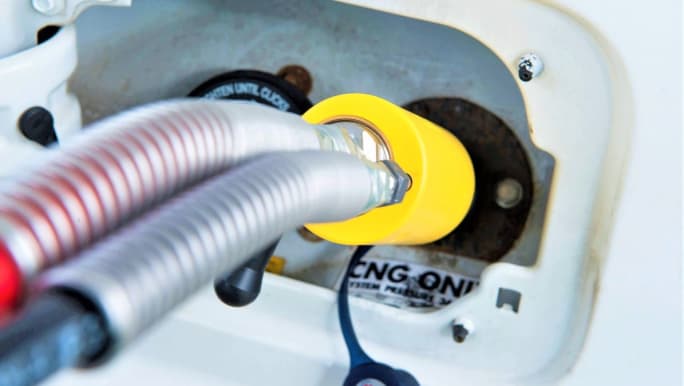
The biogas from cow manure is cleaned to produce a renewable natural gas that is transported to natural gas fueling stations like those at American Natrual Gas (ANG).
Photo: American Natural Gas
Measuring & Comparing
The most well-developed methodology for measuring and comparing greenhouse emissions from various fuel types is the Low Carbon Fuel Standard used in California. The standard utilizes a measurement called the carbon intensity. The carbon intensity is given in terms of grams of carbon dioxide equivalent emissions per megajoule of energy (gCO2e/MJ) over the entire lifecycle of a fuel’s production and use.
Often called cradle to grave, the lifecycle includes emissions from the collection of the resources needed to make the fuel, the transportation of the resources to the production facility, the materials and energy used in the conversion and refining of the resources into the fuel itself, the distribution of the fuel to its sales points, and the combustion of the fuel to power its end-use vehicles.
Of all the currently used types of fuel, renewable natural gas from dairy waste–cow power–has the lowest carbon intensity score. Since emissions are mitigated by harnessing the methane that would otherwise be released into the environment, the lowest carbon intensity allocated to any cow power source is -254.94 gCO2e/MJ. In other words, for every megajoule of cow power used, roughly 255 grams less carbon dioxide equivalent emissions are released.
By comparison, at its lowest, electric vehicles are neutral for emissions and diesel fuel, on average, emits roughly 98 grams of carbon dioxide equivalent emissions per megajoule. This calculates to 473,930 metric tons of carbon dioxide equivalents being mitigated from release into the atmosphere per trillion Btu of cow power. Imagine if we were to harness all the potential cow power in the U.S.: With technology being used right now, we could prevent the release of more than 84.3 million metric tons of carbon dioxide equivalents annually. This prevention would be done all while providing more than 20% of the current natural gas used nationally.
About the Author: Trey Teall has more than 15 years of experience in the renewable energy industry working on commercial and grant-funded renewable energy R&D and production. He has experience working with renewable natural gas, anaerobic digestion, biodiesel, and gasification for projects with the private, public, academic, and military sectors. In addition to working with ANG, Trey also serves as the Chief Technology Officer for Biodico.
Subscribe to Our Newsletter
More Sustainability
City Harvest Begins Using Volvo VNR Electric Trucks to Rescue Food Across New York City
Volvo Trucks North America and the Bronx Is Breathing project team handed over three new Volvo VNR Electric trucks to City Harvest, which will use the trucks to rescue and deliver food throughout the Bronx and across all five boroughs of New York.
Read More →
Volvo Trucks Wins International Truck of the Year 2027 for its Global Electric Range
Volvo Trucks' global heavy-duty electric range has been named International Truck of the Year 2027. Since 2019, more than 7,000 electric Volvo trucks have driven more than 310 million miles worldwide.
Read More →
Fleet Forward Conference Introduces One-Day Passes for 2026
New one-day registration gives fleet professionals the flexibility to attend Tuesday, Wednesday, or Thursday, with passes available for $199 through Sept. 18.
Read More →


CALSTART Rebrands as Catalyst Mobility, Will Combine with Forth in 2027
CALSTART has rebranded as Catalyst Mobility and will combine with Forth at the start of 2027. The new organization said it is poised to become one of the world's largest, strongest, and most impactful clean transportation nonprofits.
Read More →
Electric Truck and Charging Programs to Boost Sustainability at NY & NJ Ports
Together, the Port Authority of New York and New Jersey and CALSTART will electrify drayage and terminal operations serving the East Coast’s busiest container port. A pair of incentive programs totaling $45 million has launched to accelerate adoption of zero-emission drayage trucks and terminal tractors.
Read More →
The Smart Way to Build a Mixed-Energy Fleet Isn’t About Picking a Side
Mixed-energy fleets aren’t about picking a winning fuel. Sarah Booth of WEX explains how vehicle data, duty cycles, charging strategy, and real-world costs can help fleets choose the right energy source for each job.
Read More →
Xos Hub Surpasses One Gigawatt-Hour of Energy Delivered in the Field
A single Xos Hub has surpassed one gigawatt-hour of energy across more than 33,600 charging sessions in the field, demonstrating performance that supports Xos' expansion across new products and markets.
Read More →
Carrier Transicold Launches All-Electric Vector 8200 TRU for Diesel-Free On-Site Cold Storage
Carrier Transicold’s first engineless multi-temperature TRU helps fresh- and frozen-food fleets add supplemental cold storage capacity during seasonal peaks.
Read More →
Narro Trucks Introduces Electric Utility Vehicle
Narro Trucks officially launched its operations on Aug. 20 and hosted a ride and drive to showcase its electric truck, which will be produced in Virginia.
Read More →
Samsung SDI Takes Full Control of GM Battery JV as Indiana Plant Pivots to Energy Storage
Samsung SDI is taking full control of its Indiana battery plant with GM, marking a major shift from the EV-focused joint venture Charged Fleet first covered in 2023.
Read More →