





Three Ways to Reimburse Employees for EV Home Charging: The Good, the Bad, and the Ugly
2026 IRS Business Standard Mileage Rate Rises to 72.5 Cents Per Mile
IRS boosts the 2026 business mileage rate to 72.5 cents per mile, up 2.5 cents. Here’s what it means for fleets and reimbursements.
January 6, 2026
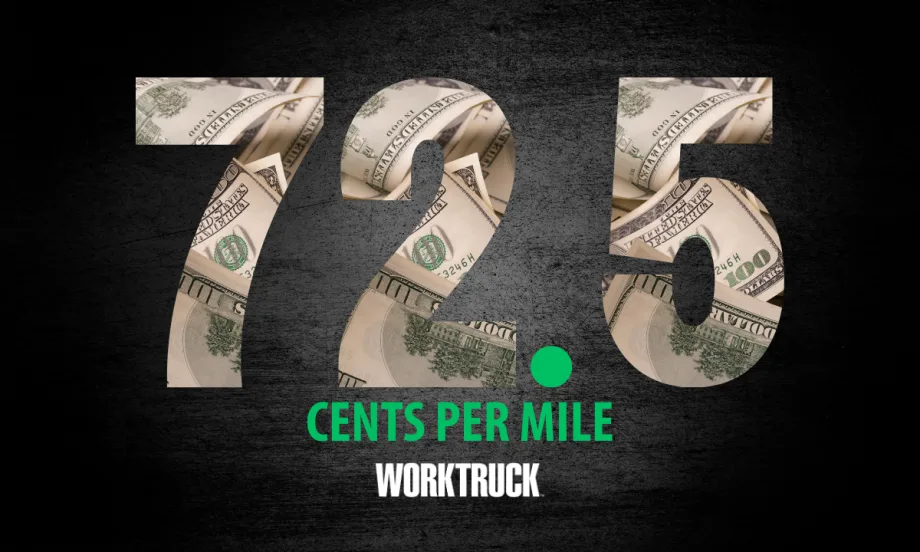
The IRS set the 2026 standard mileage rate for business use at 72.5 cents per mile, effective Jan. 1, 2026, reflecting updated vehicle operating cost data.
Credit: Work Truck
3 min to read
The Internal Revenue Service has released the updated optional standard mileage rates for 2026, increasing the business rate to 72.5 cents per mile. The new rate goes into effect Jan. 1, 2026, and applies to the use of cars, vans, pickups, and panel trucks, including fully electric and hybrid vehicles, as well as gas and diesel-powered models.
What are the 2026 Standard Mileage Rates?
Beginning Jan. 1, 2026, the IRS mileage rates are:
72.5 cents per mile driven for business use (up 2.5 cents from 2025)
20.5 cents per mile driven for medical purposes (down 0.5 cents from 2025)
20.5 cents per mile driven for moving purposes for certain active-duty military members and certain members of the intelligence community (down 0.5 cents from 2025)
14 cents per mile driven in service of charitable organizations (unchanged)
The IRS notes the business mileage rate is based on an annual study of fixed and variable costs, while the medical and moving rates are based on variable costs only. The charitable rate is set by statute.
Why the Mileage Rate Matters for Fleets and Employers
For companies reimbursing drivers who use personal vehicles for work, the IRS mileage rate is often used as a benchmark because it helps define the tax-free reimbursement ceiling for mileage-based plans. Employees and eligible taxpayers may also use it to calculate deductible vehicle costs, depending on their situation.
To put the change into perspective, a driver logging 10,000 business miles per year would see reimbursement rise by about $250 versus 2025, if reimbursed at the standard rate.
Motus, a vehicle reimbursement provider, said the increase reflects rising ownership costs even as fuel prices cooled in 2025. According to Motus, factors such as vehicle prices, insurance, maintenance, and depreciation continue to drive the cost of operating a vehicle for work.
Standard Rate vs. Actual Expenses
The IRS reminds taxpayers that the standard mileage rate is optional. Taxpayers may instead choose to calculate the actual costs of using their vehicle.
However, taxpayers using the standard mileage rate for a vehicle they own and use for business must choose to use the rate in the first year the automobile is available for business use. In later years, they can choose to use the standard mileage rate or actual expenses.
For a leased vehicle, taxpayers using the standard mileage rate must employ that method for the entire lease period, including renewals.
A Few Other Details Fleets May Want to Note
Notice 2026-10 also includes updates relevant to reimbursement and employer-provided vehicle programs. The IRS set the depreciation portion of the business mileage rate at 35 cents per mile for 2026, used when calculating basis reductions under the standard mileage method.
The notice also sets a $61,700 cap on the vehicle value used for certain reimbursement and valuation rules, including FAVR plans and employer-provided vehicle valuation methods such as the cents-per-mile rule and fleet-average valuation rule.
More details are included in Notice 2026-10, which also outlines maximum automobile cost and employer-provided vehicle valuation rules for 2026.
More Operations

Family Ties Inside the Fleet Families Building Careers Across Generations
Three fleet families share what it really takes to work together, learn across generations, and keep business from following them home.
Read More →
Shades of Fleet Call for Voices: Fleet's Hidden Heroes
Fleet’s hidden heroes are often the ones keeping everything moving behind the scenes. September’s Shades of Fleet is looking for dispatchers, coordinators, parts specialists, and other support pros to share their stories.
Read More →
Truck Centers, Inc. Celebrates National Truck Driver Appreciation Week with $1,000 Fuel Card Giveaways
During National Truck Driver Appreciation Week, Truck Centers, Inc. is offering customers a chance to fuel up for free. Customers at all Truck Centers locations can enter to win one of four $1,000 fuel cards from Sept. 14 - 18.
Read More →
Fleet Guides, AI Time-Savers, Truck Tariffs & Fuel Strategy Lead the News
This week’s Truck Chat Cheat Sheet covers new fleet vehicle guides, practical AI use cases, U.S.-Canada truck production, mixed-energy strategy, and more.
Read More →
What Fleet Employers Are Missing When Hiring Veterans
What if some of the strongest candidates for fleet are already out there, but their experience is written in a language our industry does not always recognize?
Read More →
Automotive Fleet Opens 2026 Personal Use Survey for Commercial Fleet Managers
Less than two weeks left! Commercial and corporate fleet managers are invited to share how their organizations handle company vehicle personal-use policies, charges, and driver eligibility.
Read More →
What Resilient Fleets Do Differently When Conditions Change
Fleet resilience is about more than reacting to disruption. Lauren Fletcher talks with AP Fleet’s Alex Coveney about flexibility, planning, scaling, and what helps fleets adapt when business conditions shift.
Read More →
If We Want the Next Generation in Automotive, We Have to Give Them a Reason to Care
The automotive industry talks constantly about its workforce shortage. But before we can recruit the next generation, we may need to do a better job giving kids a reason to care about automotive in the first place.
Read More →
Ram ProMaster City Under $40K, Truck Tariffs, and AI Maintenance Lead the News
A sub-$40K commercial van, tariff questions, AI-powered maintenance, and a new EV production strategy headline this week’s Truck Chat Cheat Sheet.
Read More →
Bob Adamsky Shares the Fleet Lessons You Usually Learn the Hard Way
After more than 30 years in fleet, Arrow International’s Bob Adamsky has learned that the job is about far more than vehicles. He shares the lessons he wishes every fleet manager could learn a little earlier.
Read More →