





Read More: State of the Fuel Industry 2024
Relay Payments: Managing Payments & Mitigating Fraud
Less than six years ago, Ryan Droege and Spencer Barkoff found a way to automate lumper payments. From those initial successes, their company, Relay Payments, has grown to be a major player in fuel payment solutions. Hear from the co-founders about their primary focus heading into the end of 2024.
October 2, 2024

Ryan Droege and Spencer Barkoff co-founded Relay Payments in 2019 to automate payments in the transportation sector.
Photo: Relay Payments/WT Illustration
7 min to read
When Ryan Droege and Spencer Barkoff co-founded Relay Payments in 2019, they were simply looking for a way to ease the pain points the trucking industry faced with lumper payments. But in just a little over five years, the company has expanded to automate various transportation-sector payments and has taken a bite out of fuel fraud.
Fuel payments are now a key focus for the company, which is still headquartered in metro Atlanta, Georgia. But how did they grow from a company focused on a very small niche in the transportation industry to one that is now a major player in fuel payment management?
Work Truck visited with co-founders Droege and Barkoff to learn more about Relay Payments' rapid growth, successes, and expansion of service.
Making Lumper Payments Easier 24/7
When they started Relay Payments, Barkoff and Droege researched what was needed by spending thousands of hours talking to carriers, brokers, shippers, unloaders, and truck drivers at truck stops, warehouses, and other places. They learned that lumper payments, the payment made to a crew that unloads a truck, did not often go smoothly or easily, so they hatched a plan that was the company's original line of business.
“Some of these lumper payments would take 45 minutes to an hour for them to go through in a world where drivers only have 14 hours they can be on duty. If they're waiting for an hour or two hours to authorize a payment, it goes directly against their hours of service, and they're not able to make money during that time,” explained Barkoff, president of Relay Payments.
What if a driver needed a payment authorization at 3 a.m. and a broker did not answer the phone at that time. That was yet another dilemma. Should a driver wait, or leave and come back once the payment was authorized? Neither was a good option.
Payments often required paper receipts, which could be lost, and when that happens, a driver is on the hook for the lumper expense.
The solution was simple.
“How do we make payments when in our everyday lives?” Barkoff said.
While most of the consumer world now revolved around digital payments, Barkoff and Droege thought it was time for lumper payments to do the same. So, they created a way to do that through Relay Payments.
“We started in the in the lumper market because we heard that was the most painful payment they had to make,” explained Barkoff. That was in 2019, and then COVID-19 hit.
Relay Payments was in the right place at the right time. During the pandemic, in many cases, drivers were not allowed to come inside warehouses.
“We quickly built technology that let them pay directly from their cab, and that allowed us to grow our network. We were accepted basically at every distribution center in the United States that charged the lumper fee,” he added.
Moving forward, Relay Payments now works with 10 of the top 30 for-hire carriers, nine of the top 10 less-than-truckload (LTL) carriers, and about 100,000 mid-sized fleets.
Then it was time to tackle the next big challenge, one that impacted not just freight movers but commercial fleets of all types and sizes.
Fighting Fuel Fraud & Managing Expenses
As the duo continued to grow the company’s success with digital payments for lumper fees, they heard from large truck stops that fuel fraud was becoming rampant because many fuel cards did not contain chips, and a swipe of a card was still needed to make a fuel transaction.
“Organized crime rings were installing card skimmers at the pump to lift the information off of the mag stripe,” Barkoff said.
“It's not like when you and I experience fraud in our everyday life. When we do, we log into American Express, or VISA, and click ‘dispute,’ and we move on with our lives,” Barkoff said. “When the trucking companies experience fraud, they're on the hook, and it becomes a conversation between them, the truck stop, and their payment provider on who's going to cover that fraud,”
Relay Payments created a solution.
“We’re digital and fraud-free. We guarantee it,” Barkoff added.
The successes of managing lumper fees and fuel purchases grew into new business areas for Relay Payments, including managing:
Scales fees
Cash advances
Repair fees
Anything a driver pays for while on the road
The company moved into handling settlement payments from the brokerages to the carriers with a product called Relay Direct. Many of those customers had used Relay Payments for lumper payments. Likewise, some came to Relay Direct because they had used the company for fuel purchasing and had seen the successes.
“Those are validating milestones when your customers are coming to you asking for more help because you solved one of their problems,” Droege, Relay Payments CEO, explained.
How Relay Prevents Fuel Fraud
Fleets working with Relay Payments can set parameters for their drivers that establish things like what days a driver works, the route or area where he likely will fuel, the amount of fuel that is typically purchased, and more.
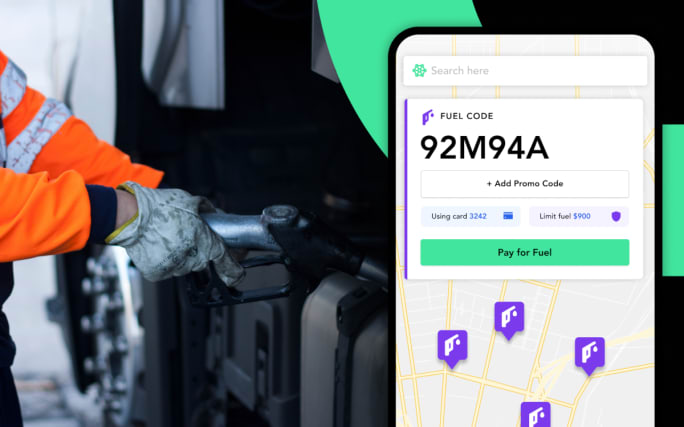
Drivers access the Relay Payments app for a fuel code that is specific to that driver, location, and time.
Photo: Relay Payments
When a driver needs to fuel, he or she pulls into an authorized pump and launches Relay’s app. All fueling is authorized through that Relay Payments app without the need for a card at all. Behind the scenes, Relay Payments’ technology is hard at work to make sure the fuel transaction will be a valid purchase.
“We do a lot of checks to make sure they're within policy. We use the geolocation from the phone to make sure that they are at the right location, that they're where the vehicle is, and then the driver's given what's called a Relay code. This is a one-time 12-digit number that they key into the pump, and then the pump is unlocked and authorized,” Droege explained.
“So, we've been able to eliminate fraud with that. And we guarantee that we stand behind that and guarantee the fraud-free aspect of our business,” he added.
Still Focusing Growth Around Fuel
Managing fuel payments is what Droege calls the “main driver” of Relay Payments’ focus currently.
The company handles fuel payments at about 1,000 fueling locations, but he said that will be closer to 2,000 by the end of the year.
He said there are about 6,000 stops in the US that sell high-flow diesel, but within that about 2,500 provide the majority of the fueling and the market is heavily consolidated. So, if Relay can reach 2,000 of those 2,500 key locations, it will be a huge milestone for the still relatively young fintech company.
“We believe by the end of this calendar year, we can cover 80% of the diesel that is sold in America, given the locations we have in the consolidation,” Droege explained.
To put the company’s success and growth in perspective, Relay Payments just entered the fuel transaction business last year.
The Scope of the Transportation Sector
To explain the market opportunities, Droege said there is about $800 billion that exchanges hands between parties in the transportation market.
About $200 billion of that is in the form of broker-to-carrier settlements, which is where Relay Direct can help automate the payments.
Another $200 billion flows as fuel transactions, and then the lumper and unloading portion is only about $1.5 billion.
So, Relay Payments started in the smallest segment, and quickly moved upstream to the larger opportunities.
On-Site Fueling Accounting
For some fleets, such as work truck, municipal, last-mile, or regional delivery fleets, drivers may fuel their trucks at a terminal or company facility rather than at diesel retailers or truck stops. Relay Payments can also help manage and track those fuel fills, even if there is no payment to an outside entity.
The fleets need an accounting method to track how many gallons are pumping, what drivers are fueling, how many trucks come through, and more. There is still the possibility of fuel theft, such as a driver fueling a personal vehicle, and Relay Payments can help fight that type of fraud at on-site fueling locations the same as they do elsewhere.
“They can use our mobile application with any of their on-site fuel pumps as well. In order to automate the dispensers, turn them on, we still do all the same reconciliation and reporting on the backend, and still provide the same security that we have from the office management side, making sure nobody inside the company is authorizing unnecessary fuel payments,” Droege explained.
Subscribe to Our Newsletter
More Operations
Family Ties Inside the Fleet Families Building Careers Across Generations
Three fleet families share what it really takes to work together, learn across generations, and keep business from following them home.
Read More →
Shades of Fleet Call for Voices: Fleet's Hidden Heroes
Fleet’s hidden heroes are often the ones keeping everything moving behind the scenes. September’s Shades of Fleet is looking for dispatchers, coordinators, parts specialists, and other support pros to share their stories.
Read More →
Truck Centers, Inc. Celebrates National Truck Driver Appreciation Week with $1,000 Fuel Card Giveaways
During National Truck Driver Appreciation Week, Truck Centers, Inc. is offering customers a chance to fuel up for free. Customers at all Truck Centers locations can enter to win one of four $1,000 fuel cards from Sept. 14 - 18.
Read More →
Fleet Guides, AI Time-Savers, Truck Tariffs & Fuel Strategy Lead the News
This week’s Truck Chat Cheat Sheet covers new fleet vehicle guides, practical AI use cases, U.S.-Canada truck production, mixed-energy strategy, and more.
Read More →
What Fleet Employers Are Missing When Hiring Veterans
What if some of the strongest candidates for fleet are already out there, but their experience is written in a language our industry does not always recognize?
Read More →
Automotive Fleet Opens 2026 Personal Use Survey for Commercial Fleet Managers
Less than two weeks left! Commercial and corporate fleet managers are invited to share how their organizations handle company vehicle personal-use policies, charges, and driver eligibility.
Read More →
What Resilient Fleets Do Differently When Conditions Change
Fleet resilience is about more than reacting to disruption. Lauren Fletcher talks with AP Fleet’s Alex Coveney about flexibility, planning, scaling, and what helps fleets adapt when business conditions shift.
Read More →
If We Want the Next Generation in Automotive, We Have to Give Them a Reason to Care
The automotive industry talks constantly about its workforce shortage. But before we can recruit the next generation, we may need to do a better job giving kids a reason to care about automotive in the first place.
Read More →
Ram ProMaster City Under $40K, Truck Tariffs, and AI Maintenance Lead the News
A sub-$40K commercial van, tariff questions, AI-powered maintenance, and a new EV production strategy headline this week’s Truck Chat Cheat Sheet.
Read More →
Bob Adamsky Shares the Fleet Lessons You Usually Learn the Hard Way
After more than 30 years in fleet, Arrow International’s Bob Adamsky has learned that the job is about far more than vehicles. He shares the lessons he wishes every fleet manager could learn a little earlier.
Read More →