





Learn more: Economics of Vans vs. Pickups
Which Truck Models Last Over 200k Miles?
A comprehensive data analysis of passenger cars and pickup trucks from iSeeCars found that heavy-duty pickup models last twice as long as light-duty models — yet two truck-based SUVs last longer. Which models took the top of the list?
March 4, 2021
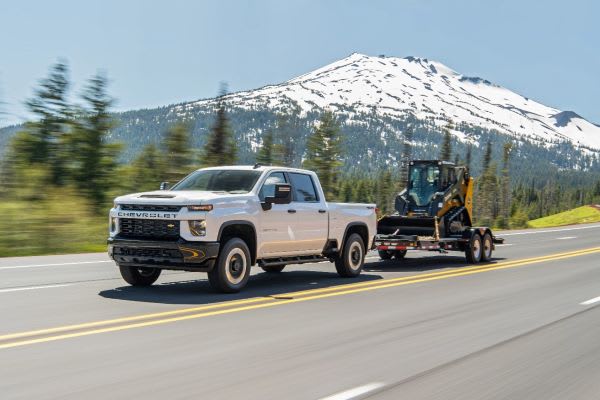
At 6.3%, the Chevrolet Silverado 2500HD took second as the truck model most likely to exceed 200,000 miles. What model took first?
Photo courtesy of General Motors.
2 min to read
Editor's note: We thought 200,000 miles was a long time to drive a pickup truck, but we have an updated study on trucks that made it 250,000 miles and more. Check it out!
Of any truck model in production in 2021, the Ram 3500 pickup is most likely to reach 200,000 miles or more, according to a new study by automotive research firm and car search engine iSeeCars.com. The study found that 8.4% of Ram 3500 pickups are expected to be on the road after 200,000 miles. The Chevrolet Silverado 2500HD (6.3%) and Ford F-350 Super Duty (5.8%) are second and third on the list.
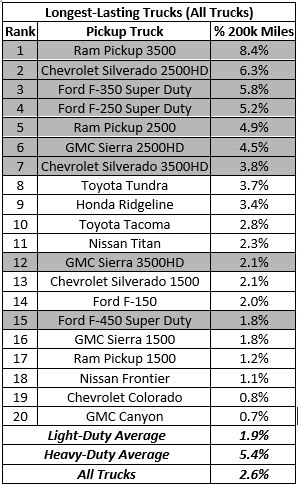
Heavy-duty pickups are more likely than any other vehicle group to be on the road after 200,000 miles.
Data courtesy of iSeeCars.
iSeeCars.com analyzed over 11.8 million pre-owned cars sold in 2020. For each model, the percentage of the number of vehicles with at least 200,000 miles was mathematically modeled.
"The data confirms what most would expect — the bigger they are the harder they drive. Trucks, in general, are some of the longest-lasting vehicles in the U.S. fleet,” said Karl Brauer, executive analyst for iSeeCars. “And heavy-duty trucks last up to twice as long as light-duty versions, confirming the aggressive use cases many of these HD models are subjected to. Of course, they cost more than light-duty models, but with this kind of lifespan HD models are arguably a better investment, especially considering their increased capabilities throughout that lifespan."
When compared to all passenger cars and trucks, however, two truck-based SUVs take the overall prize for longevity: the Toyota Land Cruiser (16.3%) and Toyota Sequioa (11.2%). These truck-based SUVs occupy the top spots by a wide margin, with the Sequoia twice as likely to reach 200,000 miles as the next ranked car on the list.
When analyzing which light-duty pickup trucks are most likely to reach 200,000 miles, six pickups rate above the 1.9% average for the vehicle class. Three additional longest-lasting pickups join the top-ranked Toyota Tundra, the second-ranked Honda Ridgeline, and the third-ranked Toyota Tacoma.
“On average, pickup trucks are almost twice as likely to reach 200,000 miles with a 1.9% average for the segment, which is nearly double the average for all vehicles,” said Brauer. “Pickup trucks are commonly used as work vehicles and are likely to accrue more miles than a typical passenger car while often benefitting from more consistent preventative maintenance and necessary repairs.”
Analyzing passenger cars only, the top 16 models identified each have over 2.5% of their vehicles (more than two-and-a-half times the overall average) reach 200,000 miles, and include a mix of vehicle types with 10 SUVs (including a hybrid), three pickup trucks, one sedan, one minivan, and one hybrid hatchback.
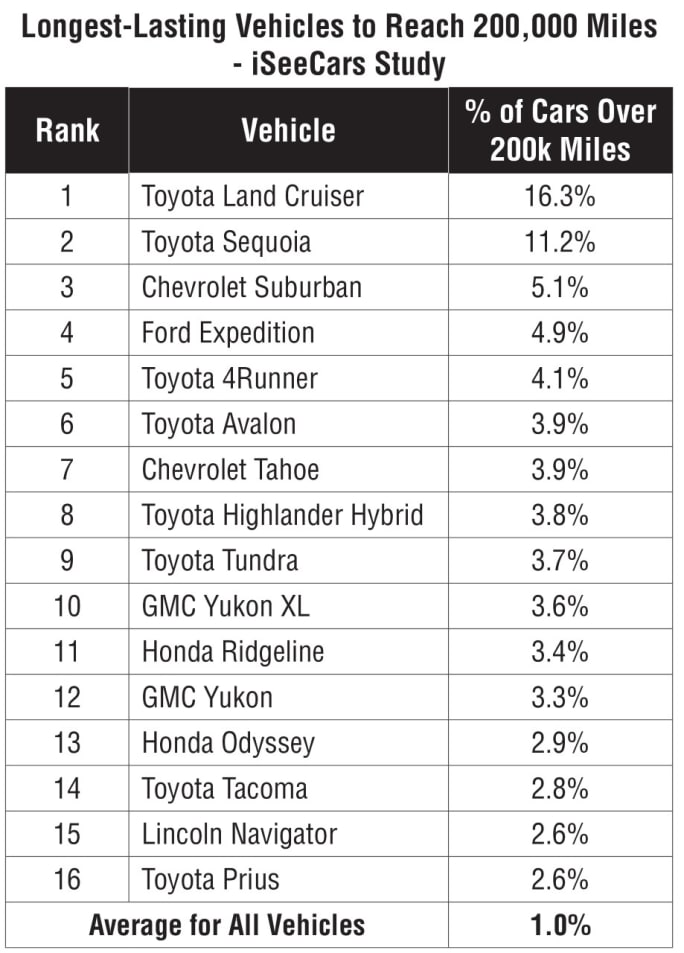
Two truck-based SUVs from Toyota took the top spots by a wide margin of all vehicles studied.
Data courtesy of iSeeCars.
More Small Fleet


Developing Budget-Friendly Driver Safety Programs
From driver training and safety meetings to one-on-one coaching and incentive programs, several small fleets share how they have developed a safety culture with their drivers using low- to no-cost resources.
Read More →
Sponsored•March 9, 2026
Boosting Last-Mile Fleet Uptime, Safety, and Value with AI Vehicle Inspections
AI-powered inspections are transforming last-mile fleets by replacing manual checks with highly accurate automated scans that detect defects in seconds. By giving fleet operations visibility into the daily condition of their vehicles, you can identify trends over the vehicle’s lifecycle that enable improved procurement decisions, route management, driver training and accountability.
Read More →
Five Ways Seat Belts Help Prevent Injuries
There are five ways seat belts protect occupants from injuries, according to the Tennessee Department of Safety and Homeland Security.
Read More →
Sponsored•January 14, 2026
It’s here: The 2026 Fleet Technology Trends Report
What does AI mean for fleets? Get the answer — and learn other top tech trends.
Read More →
Small Fleets, Big Impact: How Independent Drivers Power Wreaths Across America
Check out how small fleets and independent drivers power Wreaths Across America each December and why their impact matters more than ever.
Read More →
VMS Survey Finds 65% of Small Fleet Managers Run Operations Alone
A new VMS survey shows small fleet managers are stretched thin, with most handling operations solo and eager to adopt digital tools for relief.
Read More →
Tips for Driving Safely on Halloween Night
This video features a reminder from the Connecticut Department of Transportation (DOT) and the Connecticut Police Chiefs Association, urging drivers to prioritize safety this Halloween.
Read More →
AI, Access, and Uptime: VMS’s Next Chapter with David Prusinski
VMS’s new Co-CEO, David Prusinski, shares how an AI-first approach will give small fleets and repair shops the tools to compete like big players.
Read More →
Fleet Managers Share Winter Prep Tips: It's Never Too Early!
Three fleets share best practices to prep vehicles for winter and prevent downtime when the cold sets in.
Read More →