




Volvo Unveils Cyclist Detection Safety Feature with Auto Brake
A cyclist in the same lane swerving out in front of the car is one incident type that is addressed by Pedestrian and Cyclist Detection with full auto brake, which will be available in the Volvo V40, S60, V60, XC60, V70, XC70 and S80 models from mid-May this year.
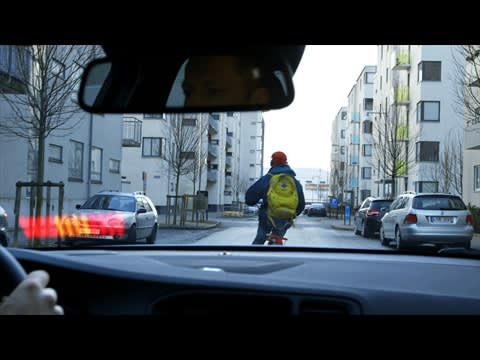
Volvo's new safety feature automatically detects and brakes for cyclists. Photo courtesy Volvo.
Volvo Car Group has introduced a new safety feature that detects and automatically brakes for cyclists swerving out in front of the car. The new function is an enhancement of the company’s present detection and auto brake technology, and the package will be called Pedestrian and Cyclist Detection with full auto brake.
All Volvo cars equipped with pedestrian detection will also incorporate cyclist detection.
Doug Speck, senior vice president of marketing, sales and customer service at Volvo Car Group, literally rolled out the new collision avoidance feature during a press conference at the 2013 Geneva Motor Show on Tuesday, March 5. He entered the stage on a bicycle.
New advanced software, including more rapid vision processing, has made it possible to extend the present detection and auto brake technology to also cover certain cyclist situations.
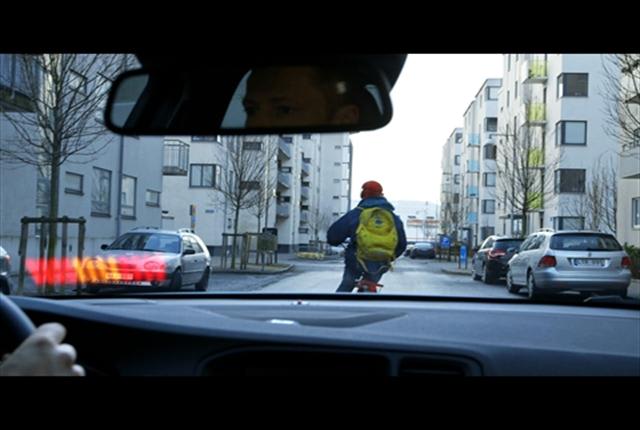
Volvo's new safety feature automatically detects and brakes for cyclists. Photo courtesy Volvo.
“By covering more and more objects and situations, we reinforce our world-leading position within automotive safety,” Speck said. “We keep moving towards our long-term vision to design cars that do not crash."
A cyclist in the same lane swerving out in front of the car is one incident type that is addressed by Pedestrian and Cyclist Detection with full auto brake, which will be available in the Volvo V40, S60, V60, XC60, V70, XC70 and S80 models from mid-May in 2013.
The advanced sensor system scans the area ahead. If a cyclist heading in the same direction as the car suddenly swerves out in front of the car as it approaches from behind and a collision is imminent, there is an instant warning and full braking power is applied.
The car's speed has considerable importance for the outcome of an accident. A lower speed of impact means that the risk of serious injury is significantly reduced.
Pedestrian and Cyclist Detection with full auto brake consists of a radar unit integrated into the car's grille, a camera fitted in front of the interior rear-view mirror and a central control unit. The radar's task is to detect objects in front of the car and to determine the distance to them. The camera determines the type of the objects. Thanks to the dual-mode radar's wide field of vision, pedestrians and cyclists can be detected early on.
The high-resolution camera makes it possible to spot the moving pattern of pedestrians and cyclists. The central control unit continuously monitors and evaluates the traffic situation.
The auto brake system requires both the radar and the camera to confirm the object. With the advanced sensor technology, it is then possible to apply full braking power immediately when necessary. The technology also covers vehicles driving in the same lane.
At the company's press conference in Geneva, Volvo Cars also presented the new model range, which includes new versions of the Volvo S60, V60, XC60, V70, XC70, S80 and the Volvo V60 Plug-in Hybrid.
Originally posted on Automotive Fleet
More Small Fleet


Developing Budget-Friendly Driver Safety Programs
From driver training and safety meetings to one-on-one coaching and incentive programs, several small fleets share how they have developed a safety culture with their drivers using low- to no-cost resources.
Read More →
Boosting Last-Mile Fleet Uptime, Safety, and Value with AI Vehicle Inspections
AI-powered inspections are transforming last-mile fleets by replacing manual checks with highly accurate automated scans that detect defects in seconds. By giving fleet operations visibility into the daily condition of their vehicles, you can identify trends over the vehicle’s lifecycle that enable improved procurement decisions, route management, driver training and accountability.
Read More →
Five Ways Seat Belts Help Prevent Injuries
There are five ways seat belts protect occupants from injuries, according to the Tennessee Department of Safety and Homeland Security.
Read More →
It’s here: The 2026 Fleet Technology Trends Report
What does AI mean for fleets? Get the answer — and learn other top tech trends.
Read More →
Small Fleets, Big Impact: How Independent Drivers Power Wreaths Across America
Check out how small fleets and independent drivers power Wreaths Across America each December and why their impact matters more than ever.
Read More →
VMS Survey Finds 65% of Small Fleet Managers Run Operations Alone
A new VMS survey shows small fleet managers are stretched thin, with most handling operations solo and eager to adopt digital tools for relief.
Read More →
Tips for Driving Safely on Halloween Night
This video features a reminder from the Connecticut Department of Transportation (DOT) and the Connecticut Police Chiefs Association, urging drivers to prioritize safety this Halloween.
Read More →
AI, Access, and Uptime: VMS’s Next Chapter with David Prusinski
VMS’s new Co-CEO, David Prusinski, shares how an AI-first approach will give small fleets and repair shops the tools to compete like big players.
Read More →
Fleet Managers Share Winter Prep Tips: It's Never Too Early!
Three fleets share best practices to prep vehicles for winter and prevent downtime when the cold sets in.
Read More →