




Video: 2015 Hyundai Genesis Earns Top IIHS Safety Award
The redesigned luxury car performs well in crash tests and also draws a 'superior' rating for front crash prevention.

Photo of 2015 Hyundai Genesis courtesy of Hyundai.
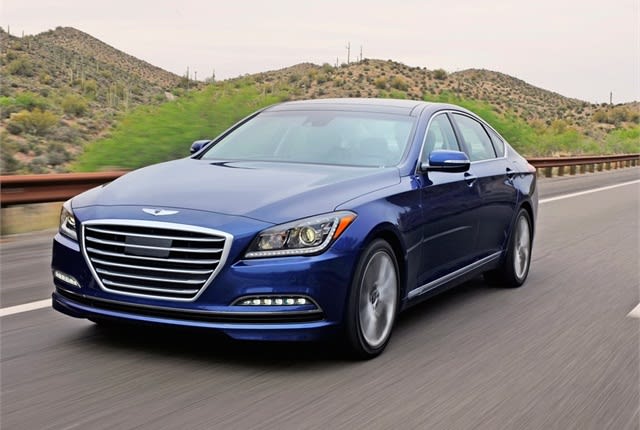
Photo of 2015 Hyundai Genesis courtesy of Hyundai.
The redesigned Hyundai Genesis, a large luxury car, has earned the 2014 Top Safety Pick+ award from the Insurance Institute for Highway Safety (IIHS) -- thanks to a “good” rating in the challenging small overlap front crash test and a “superior” rating for front crash prevention.
The 2015 Genesis also drew “good” ratings in the moderate overlap front, side, roof strength and head restraint evaluations.
In the small overlap test, the driver's space was maintained well, and injury measures recorded on the driver dummy indicated low risk of any significant injuries in a crash of this severity, IIHS said. The dummy's head made good contact with the front airbag, which stayed in position during the crash, and the side curtain airbag deployed to protect the head from contact with side structures.
IIHS added the small overlap evaluation to its testing lineup in 2012. In the crash, 25 percent of a vehicle's front end on the driver side strikes a 5-foot-tall rigid barrier at 40 mph. It replicates what happens when the front corner of a vehicle strikes another vehicle or an object like a tree or a utility pole.
The Genesis’ optional front crash prevention system, which is being offered for the first time on the 2015 model, earned a “superior” rating because of its automatic braking capabilities. In track tests, the car stopped completely before hitting the target in tests at 12 mph and 25 mph, IIHS said.
The Genesis is one of only three large luxury cars to have earned the institute’s highest award for 2014. To qualify for Top Safety Pick+, a vehicle must earn a “good” or “acceptable” rating for small overlap protection, a “good” rating in the other four IIHS tests, and a “basic,” “advanced” or “superior” rating for front crash prevention.
“The Top Safety Pick+ designation recognizes state-of-the-art safety,” said Adrian Lund, IIHS president. “The new Genesis is not only engineered to protect people when crashes happen, but with its optional automatic emergency braking system rated superior in our tests, this car can help drivers avoid some of the most common kinds of collisions altogether.”
The 2015 Genesis uses new Sensory Surround Safety technology including a Hyundai first -- Automatic Emergency Braking (AEB) -- utilizing sensor fusion technology to help avoid a potential collision or reduce its impact. With this system, Genesis employs automatic braking whenever it detects another vehicle at an unsafe closing rate of speed. This system uses the front radar from the Smart Cruise Control system and the forward camera from the Lane Departure Warning (LDW) to provide this extra margin of safety.
In addition, Genesis combines available LDW with all-new Lane Keep Assist (LKA) to provide a driver-adjustable level of steering assist. This helps prevent inadvertent lane departure when a vehicle approaches the edge of a lane and also provides steering wheel haptic vibration feedback.
Genesis is equipped with a number of new, advanced technologies, many of them Hyundai firsts. A new driver-selectable Intelligent Drive Mode allows drivers to select from four drive modes, depending on conditions and driving preferences. A new Blind-Spot Detection system (BSD) helps monitor traffic around the car. For Genesis vehicles equipped with the Heads-Up Display (HUD), the BSD system indicators also project onto the windshield, nearer the driver’s view of the road.
Lane Change Assist (LCA) helps detect vehicles approaching toward its rear side at high speeds, especially during higher-speed driving, while Rear Cross-traffic Alert (RCTA) scans areas to each side of the car when drivers are backing out of parking spaces.
Genesis also benefits from technology in its CO2 sensor control system. Hyundai engineers discovered that occupants start to get drowsy when CO2 levels reached more than 2,000 parts per million, so the new ventilation system helps ensure the cabin maintains a CO2 concentration well below that level at all times using freshly-ventilated ambient air.
Originally posted on Automotive Fleet
More Small Fleet


Developing Budget-Friendly Driver Safety Programs
From driver training and safety meetings to one-on-one coaching and incentive programs, several small fleets share how they have developed a safety culture with their drivers using low- to no-cost resources.
Read More →
Boosting Last-Mile Fleet Uptime, Safety, and Value with AI Vehicle Inspections
AI-powered inspections are transforming last-mile fleets by replacing manual checks with highly accurate automated scans that detect defects in seconds. By giving fleet operations visibility into the daily condition of their vehicles, you can identify trends over the vehicle’s lifecycle that enable improved procurement decisions, route management, driver training and accountability.
Read More →
Five Ways Seat Belts Help Prevent Injuries
There are five ways seat belts protect occupants from injuries, according to the Tennessee Department of Safety and Homeland Security.
Read More →
It’s here: The 2026 Fleet Technology Trends Report
What does AI mean for fleets? Get the answer — and learn other top tech trends.
Read More →
Small Fleets, Big Impact: How Independent Drivers Power Wreaths Across America
Check out how small fleets and independent drivers power Wreaths Across America each December and why their impact matters more than ever.
Read More →
VMS Survey Finds 65% of Small Fleet Managers Run Operations Alone
A new VMS survey shows small fleet managers are stretched thin, with most handling operations solo and eager to adopt digital tools for relief.
Read More →
Tips for Driving Safely on Halloween Night
This video features a reminder from the Connecticut Department of Transportation (DOT) and the Connecticut Police Chiefs Association, urging drivers to prioritize safety this Halloween.
Read More →
AI, Access, and Uptime: VMS’s Next Chapter with David Prusinski
VMS’s new Co-CEO, David Prusinski, shares how an AI-first approach will give small fleets and repair shops the tools to compete like big players.
Read More →
Fleet Managers Share Winter Prep Tips: It's Never Too Early!
Three fleets share best practices to prep vehicles for winter and prevent downtime when the cold sets in.
Read More →