




Twenty Pedestrians Died Daily On U.S. Roads in 2022
Experts note that deadly trends like an increase in speeding and impaired driving point to continued heightened risks for people walking on or nearby roads.

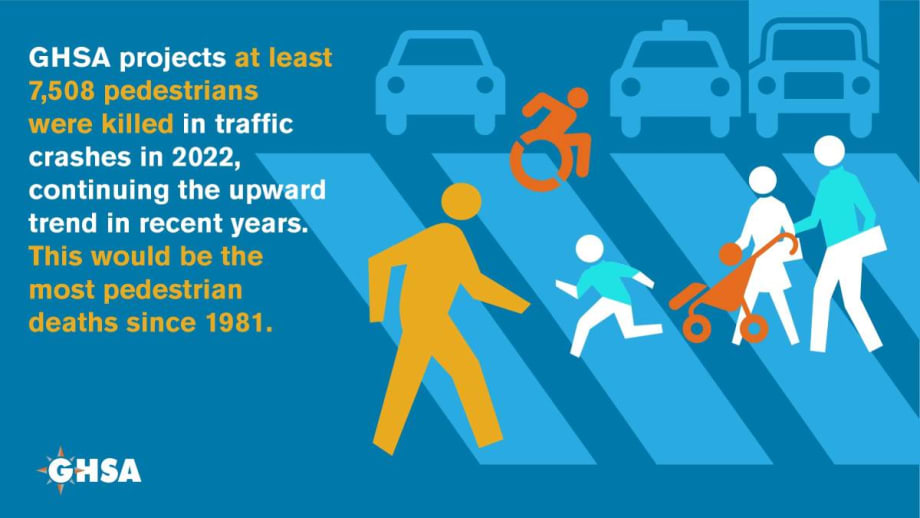
A new report from the Governor’s Highway Safety Association explores the troubling upward trend in pedestrian traffic fatalities based on data from 49 states and the District of Columbia.
Photo: Courtesy of GHSA
In the United States, some 7,508 people on foot were stuck and killed by motor vehicles in 2022 — a 1% increase over the 7,443 pedestrian deaths in 2021.
Alarmingly, the 2022 number is the highest since 1981 and translates to an average of 20 pedestrian deaths every day, according to a new report from the Governor’s Highway Safety Association (GHSA).
A total of 49 states and D.C. provided pedestrian fatality data for the report, but due to a technical issue, Oklahoma did not participate.
The report estimates that in 2022 pedestrian fatalities increased in 22 states, remained unchanged in one (Rhode Island), and decreased in 26 states and the District of Columbia.
The fact that more states saw decreases in pedestrian traffic fatalities is somewhat promising. However, the experts note that deadly trends like an increase in speeding and impaired driving point to continued heightened risks for people walking on or nearby roads.
In terms of raw numbers, Arizona, Virginia, and Oregon are the three states that saw the largest increases in lost lives among people on foot.
There were 47 additional pedestrian deaths in Arizona in 2022 as compared to 2021, 44 additional in Virginia, and 41 additional in Oregon.
On the upside, New Jersey, South Carolina, and California all experienced 20 fewer pedestrian fatalities in 2022 as compared with 2021.
The GHSA report also includes an analysis of 2021 data from the National Highway Traffic Safety Administration’s Fatality Analysis Reporting System.
This analysis uncovered a shocking safety disparity for people walking: Pedestrian deaths rose a troubling 77% between 2010 and 2021, compared to a 25% rise in all other traffic fatalities.
Other insights and trends gleaned from the FARS data include the fact that most pedestrian fatalities occur at night. Since 2010, nighttime fatal crashes have increased by 86%, compared with a 31% rise in daytime pedestrian deaths.
Lack of sidewalks is another dangerous factor. In 2021, some 69% of pedestrian fatalities occurred in locations where there was no sidewalk — up from 59% in 2017 and continuing a steady upward climb in recent years.
As to where pedestrian traffic fatalities occur, the FARS data clearly indicates that non-freeway arterial roads, which typically carry large volumes of traffic at high speeds, are the most dangerous for people on foot, accounting for 60% of all fatalities in 2021.
That same year, an estimated 18% of pedestrian deaths, some 1,300, occurred on freeways. The data also explores the type of vehicles most likely to strike a pedestrian.
Drivers of passenger cars have consistently accounted for the greatest number of fatal pedestrian crashes. But in the last 10 years, sport utility vehicles (SUVs) have been responsible for an increasing number of pedestrian deaths due to their greater weight and larger profile.
Finally, the FARS data shows the percentage of pedestrian deaths involving speeding was 8.1% in 2021, a slight decrease from the year before but higher than before the pandemic, when about 6-7% of pedestrian fatalities involved a speeding driver. The average risk of death for pedestrians increases exponentially the faster a vehicle is traveling, from 10% at 23 mph to 90% at 58 mph.
Originally posted on Automotive Fleet
More Small Fleet


Developing Budget-Friendly Driver Safety Programs
From driver training and safety meetings to one-on-one coaching and incentive programs, several small fleets share how they have developed a safety culture with their drivers using low- to no-cost resources.
Read More →
Boosting Last-Mile Fleet Uptime, Safety, and Value with AI Vehicle Inspections
AI-powered inspections are transforming last-mile fleets by replacing manual checks with highly accurate automated scans that detect defects in seconds. By giving fleet operations visibility into the daily condition of their vehicles, you can identify trends over the vehicle’s lifecycle that enable improved procurement decisions, route management, driver training and accountability.
Read More →
Five Ways Seat Belts Help Prevent Injuries
There are five ways seat belts protect occupants from injuries, according to the Tennessee Department of Safety and Homeland Security.
Read More →
It’s here: The 2026 Fleet Technology Trends Report
What does AI mean for fleets? Get the answer — and learn other top tech trends.
Read More →
Small Fleets, Big Impact: How Independent Drivers Power Wreaths Across America
Check out how small fleets and independent drivers power Wreaths Across America each December and why their impact matters more than ever.
Read More →
VMS Survey Finds 65% of Small Fleet Managers Run Operations Alone
A new VMS survey shows small fleet managers are stretched thin, with most handling operations solo and eager to adopt digital tools for relief.
Read More →
Tips for Driving Safely on Halloween Night
This video features a reminder from the Connecticut Department of Transportation (DOT) and the Connecticut Police Chiefs Association, urging drivers to prioritize safety this Halloween.
Read More →
AI, Access, and Uptime: VMS’s Next Chapter with David Prusinski
VMS’s new Co-CEO, David Prusinski, shares how an AI-first approach will give small fleets and repair shops the tools to compete like big players.
Read More →
Fleet Managers Share Winter Prep Tips: It's Never Too Early!
Three fleets share best practices to prep vehicles for winter and prevent downtime when the cold sets in.
Read More →