




Roush Adds E-Series Vans to Propane Vehicle Lineup
The ROUSH propane-fueled Ford E-Series vans will achieve Super Ultra Low Emissions Vehicle (SULEV) II emission standards. Additionally, ROUSH delivers its first propane-fueled Ford F-350 with an under-bed tank.
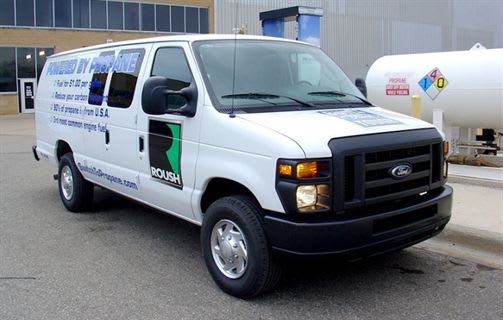
Based on the tremendous reception for the propane-fueled pickups offered by ROUSH Performance, the company is launching into the next phase of their liquid propane injected vehicle offerings with a line of E-Series vans.
"The response from the fleets to our line of F-150, F-250 and F-350 propane pickups and conversion kits has been outstanding, and their feedback inspired us to develop the complete line of E-Series vans. Many of the fleet managers we have spoken with utilize a tremendous number of vans in the course of their daily business and were looking for the type of cost and environmental advantages that propane offers as a motor fuel. Their desire is what motivated ROUSH to continue to add to our line of propane vehicles," said Jack Roush.
The order banks are now open for the propane-fueled E-150, E-250 and E-350 and production is anticipated to begin in the first quarter of 2010. ROUSH will offer fuel conversion solutions for both passenger and cargo van applications. The E-Series was selected because Ford has long held a leadership role in the van segment for more than 30 years and fleet managers are familiar with the ordering process, cost of ownership, and maintenance schedules.
From an emissions reduction standpoint, the ROUSH propane-fueled E-Series vans will achieve Super Ultra Low Emission Vehicle (SULEV) II emission standards; on average a SULEV vehicle is 90 percent cleaner in emissions than the average new model year car or truck. The ROUSH conversion system works on the Ford 5.4L, V-8 engine found in 2009 and newer vans, including the gaseous prep engine offered by the Ford Motor Company.
As with all the ROUSH propane-fueled vehicles, the E-Series vans will be covered by a 3-year/36,000 mile warranty. Dealers are able to order the conversion on a ship-through basis to help reduce transportation costs, or conversion systems can be ordered and installed through any authorized Ford dealership for vehicles already in operation.
While propane fueling stations are already quite prevalent, such as at each of the more than 1200 U-Haul locations nationwide, many of the fleets prefer to have a refueling station on-site at their location of business. ROUSH can assist with this by working with propane distributors such as Ferrellgas, AmeriGas or Heritage Propane to install a propane fueling station at little to no cost to the fleet.
ROUSH is currently working on developing a propane kit for the Ford 6.8L, V-10 engine used on the E-450 Cutaway vehicle. This is scheduled to be available in late 2010.
Additionally, in an attempt to run their business 100 percent on propane, Competitive Lawn Service (CLS) accepted the keys to the first production ROUSH propane-fueled F-350 with an under-bed tank.
Further, CLS' Eric Hansen plans to convert his other trucks in his Downers Grove, Ill.-based fleet to ROUSH propane F-350s, and says this will result in a considerable savings for his business by using propane, a predominantly domestically-produced fuel.
"A down-and-dirty number would be a savings of around $800 per truck each month," Hansen explained. "With all the lawn care equipment added in we could be saving $2500 per month per truck. I'm looking forward to proving that out over the next several months."
More Small Fleet


Developing Budget-Friendly Driver Safety Programs
From driver training and safety meetings to one-on-one coaching and incentive programs, several small fleets share how they have developed a safety culture with their drivers using low- to no-cost resources.
Read More →
Boosting Last-Mile Fleet Uptime, Safety, and Value with AI Vehicle Inspections
AI-powered inspections are transforming last-mile fleets by replacing manual checks with highly accurate automated scans that detect defects in seconds. By giving fleet operations visibility into the daily condition of their vehicles, you can identify trends over the vehicle’s lifecycle that enable improved procurement decisions, route management, driver training and accountability.
Read More →
Five Ways Seat Belts Help Prevent Injuries
There are five ways seat belts protect occupants from injuries, according to the Tennessee Department of Safety and Homeland Security.
Read More →
It’s here: The 2026 Fleet Technology Trends Report
What does AI mean for fleets? Get the answer — and learn other top tech trends.
Read More →
Small Fleets, Big Impact: How Independent Drivers Power Wreaths Across America
Check out how small fleets and independent drivers power Wreaths Across America each December and why their impact matters more than ever.
Read More →
VMS Survey Finds 65% of Small Fleet Managers Run Operations Alone
A new VMS survey shows small fleet managers are stretched thin, with most handling operations solo and eager to adopt digital tools for relief.
Read More →
Tips for Driving Safely on Halloween Night
This video features a reminder from the Connecticut Department of Transportation (DOT) and the Connecticut Police Chiefs Association, urging drivers to prioritize safety this Halloween.
Read More →
AI, Access, and Uptime: VMS’s Next Chapter with David Prusinski
VMS’s new Co-CEO, David Prusinski, shares how an AI-first approach will give small fleets and repair shops the tools to compete like big players.
Read More →
Fleet Managers Share Winter Prep Tips: It's Never Too Early!
Three fleets share best practices to prep vehicles for winter and prevent downtime when the cold sets in.
Read More →