




Oregon Adopts Clean-Trucks Rules; Other States May Follow
Oregon's new rules will speed the transition to electric and lower-emissions trucks, buses, and vans, and likely will inspire other states to also adopt the emissions regulations.

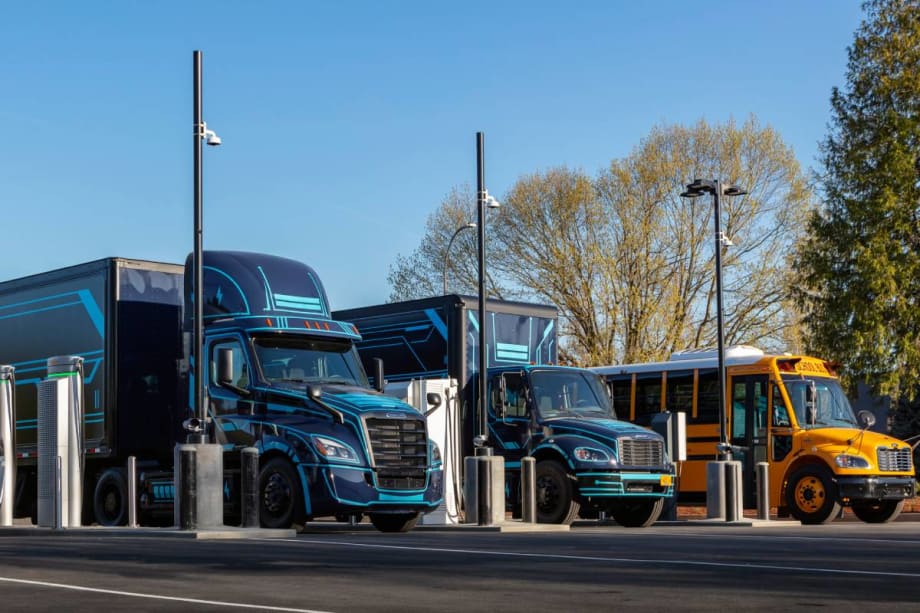
“Electric Island” at Daimler Trucks in Portland, Oregon.
Photo: Daimler Trucks North America
New rules in Oregon will accelerate the electrification of school buses, package delivery vans, waste haulers, and commercial tractors. The Oregon Environmental Commission on Nov. 17 adopted the Advanced Clean Truck Rule and the Heavy-Duty Omnibus (Low-NOx) Rule as presented by staff at the Department of Environmental Quality.
Both of the rules are the same as California's and apply to sales of new medium- and heavy-duty (MHD) vehicles, such as trucks, buses, and vans. The ACT rule requires truck manufacturers to offer increasing percentages of new sales to be zero-emission MHD vehicles in Oregon, while the Low-NOx rule will require new fossil fuel-powered MHD engines to significantly reduce dangerous air pollution. Both rules begin in model year 2025.
In addition, updates to the low-emission vehicle (LEV program) rules will ensure they are identical to California’s current light-duty vehicle emission standards.
"It has been almost 14 years since the Oregon Legislature directed state regulators to reduce diesel particulate pollution so it would bring cancer risk below the EPA acceptable risk level in the state,” said Mary Peveto, executive director of Neighbors for Clean Air. “DEQ acknowledged in 2019 it had made little progress, with reductions less than 2% of the pollution needed to meet that health standard. Adopting the strongest standards for new trucks in our state is a significant step in the right direction for finally eradicating this environmental and public health injustice."
More About the New Emissions Rules
Under the ACT Rule, Oregon will require medium- and heavy-duty vehicle manufacturers to sell zero-emission vehicles (ZEVs) as a certain percentage of sales, beginning with the 2025 vehicle model year. Manufacturers must increase their zero-emission truck sales depending upon the class size of the truck. Under the HD Omnibus rules, Oregon would lower nitrogen oxides (NOx) and fine particulate matter (PM2.5) emission standards for new truck engines (both diesel and non-diesel engines), in addition to other requirements for these engines.
The ACT rule culminates at a ZEV sales mandate between 40-75% of all new sales depending on truck class.
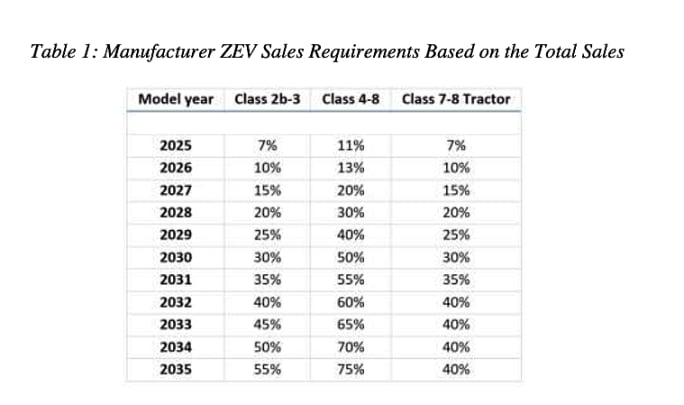
Photo: Oregon DEQ
The rule also includes a one-time reporting requirement for certain businesses that operate one or more facilities in Oregon that own, operate or dispatch five or more medium- and heavy-duty trucks, and it requires certain businesses with 2021 gross annual revenues of more than $50 million, to report information on fleet vehicle usage and location data no later than June 30, 2022.
Because not all vehicle applications or sectors will be able to make the transition to zero-emission technology in the near term, meaning there will still be demand for conventionally fueled vehicles, California developed the Heavy Duty Engine and Vehicle Omnibus Regulation to reduce tailpipe emissions associated with the continued sale of new non-ZEV medium- and heavy-duty trucks. Oregon is now adopting this rule as well.
The Omnibus rules apply to on-highway heavy-duty engines sold in Oregon beginning with engine model year 2024, and to on-highway medium- and heavy-duty trucks sold in Oregon beginning with model year 2025. The rules require lower NOx and PM2.5 standards for new truck engines (both diesel and non-diesel engines). NOx limits will be 75% below the current federal standards in 2024 and 90% below the federal standards in 2027. NOx reductions will also reduce secondary nitrate PM2.5 formation. The PM2.5 standard will be reduced by 50%, said the agency, "primarily to prevent backsliding with potentially less-efficient particulate controls to accommodate the lower NOx standard."
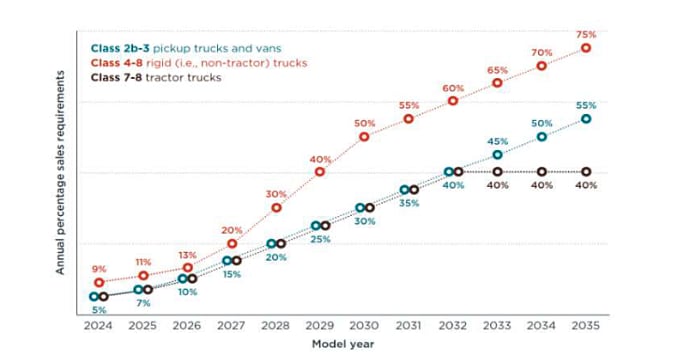
The ACT rule culminates at a ZEV sales mandate between 40-75% of all new sales depending on truck class.
Photo: Oregon DEQ
Beyond Oregon
The federal Clean Air Act grants the U.S. EPA jurisdiction for establishing emission standards for new motor vehicles, including heavy-duty trucks. It prohibits states from establishing standards — except for California. However, states may adopt vehicle emission standards that are more stringent than the federal standards if they are identical to California's. Oregon has previously adopted California’s emissions standards for passenger cars and trucks and, this rulemaking adds standards for medium- and heavy-duty vehicles.
While Oregon is the first state to adopt these rules following their creation and adoption in California, five other states — Washington, Maine, Massachusetts, New Jersey, and New York — are considering adopting at least the ACT this year, as well. These seven states contain more than 20% of the national fleet of medium- and heavy-duty trucks, according to Federal Highway Administration data.
Last year, Oregon joined 14 other states and the District of Columbia in setting a goal of 100% electric truck and bus sales by 2050. Adopting the ACT and HDO rules will accelerate this transition.
Oregon will see a projected $21.2 billion in net societal benefits and avoid 84,000 respiratory illnesses by 2050 with the adoption of these two rules, according to an independent study by MJ Bradley & Associates. Societal benefits include avoided premature deaths, missed work days, and other medical expenses due to lower diesel pollution, as well as financial savings from the low cost of electric fuel, and high-quality jobs from investments in Oregon charging infrastructure.
The study found Oregonians will see many health, climate, and economic benefits of the ACT and HDO rules by 2050, including:
Delivering net societal benefits of $21.2 billion, including public health benefits and savings for fleet owners and utility customers.
Avoiding nearly 84,000 respiratory illnesses, 160 premature deaths, and 120 hospital admissions and emergency room visits.
Reducing greenhouse gas pollution from trucks and buses by 50 million metric tons, particulate matter by over 1,290 metric tons, and smog-forming nitrogen by nearly 223,300 tons cumulatively by 2050.
Saving household utility customers $70 annually and commercial customers $410 per year on electricity bills.
Saving fleet owners more than $1 billion annually, in part through savings on fuel and maintenance.
Attracting nearly $87 million annually in investments in public electric vehicle charging infrastructure.
The report also found the ACT and HDO rules would contribute to reducing truck and bus emissions by 93% for nitrogen oxides (NOx), by 83% for particulate matter (PM), and by 55% for greenhouse gas emissions (GHGs), compared with today’s emission levels.
More Green Fleet

Fleet Forward Conference Introduces One-Day Passes for 2026
New one-day registration gives fleet professionals the flexibility to attend Tuesday, Wednesday, or Thursday, with passes available for $199 through Sept. 18.
Read More →
CALSTART Rebrands as Catalyst Mobility, Will Combine with Forth in 2027
CALSTART has rebranded as Catalyst Mobility and will combine with Forth at the start of 2027. The new organization said it is poised to become one of the world's largest, strongest, and most impactful clean transportation nonprofits.
Read More →
Electric Truck and Charging Programs to Boost Sustainability at NY & NJ Ports
Together, the Port Authority of New York and New Jersey and CALSTART will electrify drayage and terminal operations serving the East Coast’s busiest container port. A pair of incentive programs totaling $45 million has launched to accelerate adoption of zero-emission drayage trucks and terminal tractors.
Read More →
Xos Hub Surpasses One Gigawatt-Hour of Energy Delivered in the Field
A single Xos Hub has surpassed one gigawatt-hour of energy across more than 33,600 charging sessions in the field, demonstrating performance that supports Xos' expansion across new products and markets.
Read More →
Carrier Transicold Launches All-Electric Vector 8200 TRU for Diesel-Free On-Site Cold Storage
Carrier Transicold’s first engineless multi-temperature TRU helps fresh- and frozen-food fleets add supplemental cold storage capacity during seasonal peaks.
Read More →
Narro Trucks Introduces Electric Utility Vehicle
Narro Trucks officially launched its operations on Aug. 20 and hosted a ride and drive to showcase its electric truck, which will be produced in Virginia.
Read More →
Samsung SDI Takes Full Control of GM Battery JV as Indiana Plant Pivots to Energy Storage
Samsung SDI is taking full control of its Indiana battery plant with GM, marking a major shift from the EV-focused joint venture Charged Fleet first covered in 2023.
Read More →
NWSA Taps CALSTART to Administer Zero-Emission Drayage Assistance Program
CALSTART will provide free technical assistance services to drayage fleets serving the Ports of Seattle and Tacoma and looking to transition to cleaner technologies and help decarbonize freight hubs.
Read More →
EV Fleet Reality Check: What Operators Wish They Knew Before Electrifying Their Work Vans
Electric work truck upfits bring new compatibility questions. Learn how parts availability, OEM guidance, power demands, and route planning can affect fleet performance.
Read More →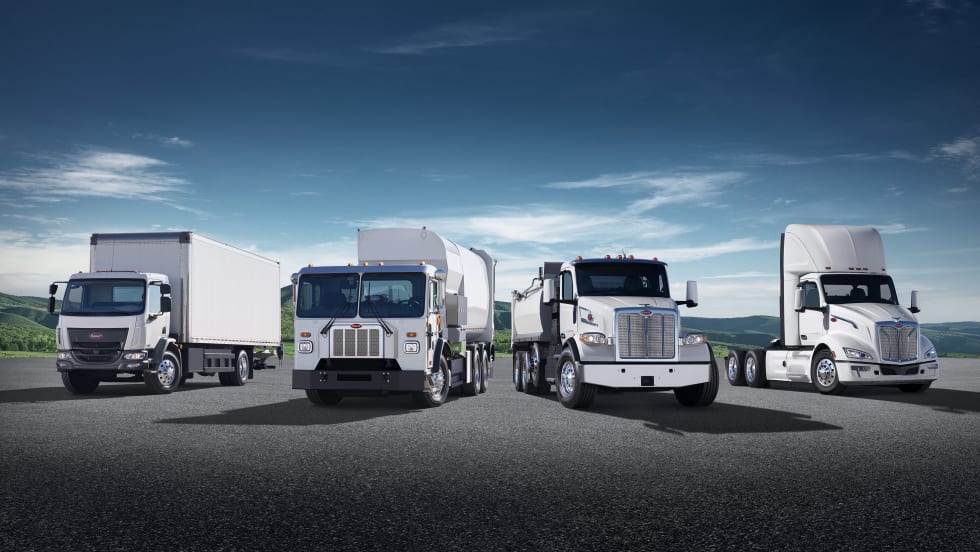
Peterbilt Expands Sourcewell Partnership with Electric Vehicle Lineup
Peterbilt Motors Company’s cooperative purchasing agreement with Sourcewell and its Canadian partner, Canoe Procurement Group, now includes including Peterbilt's battery-electric vehicle lineup.
Read More →