




N.C. Moving Company Standardizes Fleet with Kenworth T370
North Carolina-based 1-800-PACK-RAT has become a player in the moving and storage business, thanks, it said, in part, to standardizing its fleet to Kenworth T370 medium-duty models.
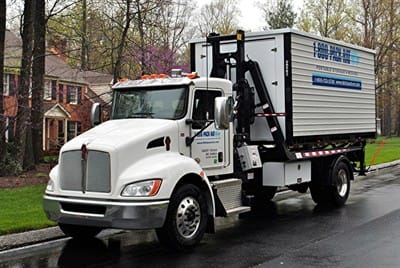
Photo: Kenworth
North Carolina-based 1-800-PACK-RAT has become a player in the moving and storage business, thanks, it said, in part, to standardizing its fleet to Kenworth T370 medium-duty models.
The 13-year-old company began standardizing with the Kenworth T370 medium duty truck several years ago after moving from another brand truck due to reliability issues, according to Kevin Barbour, senior vice president of operations for 1-800-PACK-RAT. "What we were running then was really limiting us in servicing our customers - we couldn't go 40,000 miles before a problem would crop up," recalled Barbour. "We needed a more reliable truck that could give us dependable service."
Barbour said he found a solution, thanks to a 1-800-PACK-RAT franchise in North Carolina that had begun buying Kenworths - having great success with uptime and fuel economy. "That caught our eye," said Barbour. "They tested out the Kenworths for us, and it gave us the confidence to move forward with an order. Today, we're running 115 of the Kenworth medium duty trucks, with 30 more on order, and we've standardized on the Kenworth T370." The trucks are purchased through MHC Kenworth - Wilmington in North Carolina.
The transition in trucks has been a game changer, said Barbour. "The trucks have been ultra-reliable and we've been getting up to 2 mpg better fuel economy with the Kenworth T370s versus our old trucks. When you consider we drive about 60,000 miles per unit annually, going from 6 mpg to 8 means an extra $10,000 a year in fuel savings per unit. That's huge."
The Kenworth T370s are equipped with PACCAR PX-7 engines rated at 280 hp, and driven through Allison automatic 5-speed transmissions. They feature a 230-inch wheelbase to handle the lifts and 16-foot by 8-foot container boxes. According to Barbour, many of the T370 straight trucks will also pull trailers with container boxes. "That gets us pretty loaded, but the Kenworths have plenty of power for the job. When we pick up the containers, we either bring them back for storage at our facility, or move them to a customer's new location - if they're relocating for example. We can handle short-haul moves, or if they're moving across the country, we can accommodate that as well."
Since most company drivers operate in residential areas, the company needs a truck with a tight turning radius. "The T370 is excellent in that area and the drivers all enjoy the performance and comfort the truck offers. We have a management program and the entrée into the company is first to become a driver to learn the business from the ground up," Barbour said. "Spring is our busy time of the year and we augment our regular driver pool with temporary and on-call drivers. We frequently pull from local fire departments where the fire fighters often have multiple days off. It works well for them, as well as for us."
Today, 1-800-PACK-RAT has 62 warehouse locations servicing more than 70 markets with a population approaching 200 million people throughout the United States. The company also crossed the border into Toronto in 2013 - opening a company store. It operates approximately 200 medium-duty trucks overall and 30,000 containers for its customers - handling both residential business and corporate accounts.
More Operations
Family Ties Inside the Fleet Families Building Careers Across Generations
Three fleet families share what it really takes to work together, learn across generations, and keep business from following them home.
Read More →
Shades of Fleet Call for Voices: Fleet's Hidden Heroes
Fleet’s hidden heroes are often the ones keeping everything moving behind the scenes. September’s Shades of Fleet is looking for dispatchers, coordinators, parts specialists, and other support pros to share their stories.
Read More →
Truck Centers, Inc. Celebrates National Truck Driver Appreciation Week with $1,000 Fuel Card Giveaways
During National Truck Driver Appreciation Week, Truck Centers, Inc. is offering customers a chance to fuel up for free. Customers at all Truck Centers locations can enter to win one of four $1,000 fuel cards from Sept. 14 - 18.
Read More →
Fleet Guides, AI Time-Savers, Truck Tariffs & Fuel Strategy Lead the News
This week’s Truck Chat Cheat Sheet covers new fleet vehicle guides, practical AI use cases, U.S.-Canada truck production, mixed-energy strategy, and more.
Read More →
What Fleet Employers Are Missing When Hiring Veterans
What if some of the strongest candidates for fleet are already out there, but their experience is written in a language our industry does not always recognize?
Read More →
Automotive Fleet Opens 2026 Personal Use Survey for Commercial Fleet Managers
Less than two weeks left! Commercial and corporate fleet managers are invited to share how their organizations handle company vehicle personal-use policies, charges, and driver eligibility.
Read More →
What Resilient Fleets Do Differently When Conditions Change
Fleet resilience is about more than reacting to disruption. Lauren Fletcher talks with AP Fleet’s Alex Coveney about flexibility, planning, scaling, and what helps fleets adapt when business conditions shift.
Read More →
If We Want the Next Generation in Automotive, We Have to Give Them a Reason to Care
The automotive industry talks constantly about its workforce shortage. But before we can recruit the next generation, we may need to do a better job giving kids a reason to care about automotive in the first place.
Read More →
Ram ProMaster City Under $40K, Truck Tariffs, and AI Maintenance Lead the News
A sub-$40K commercial van, tariff questions, AI-powered maintenance, and a new EV production strategy headline this week’s Truck Chat Cheat Sheet.
Read More →
Bob Adamsky Shares the Fleet Lessons You Usually Learn the Hard Way
After more than 30 years in fleet, Arrow International’s Bob Adamsky has learned that the job is about far more than vehicles. He shares the lessons he wishes every fleet manager could learn a little earlier.
Read More →