



Mercedes-Benz M-Class Achieves Top Safety Pick
The Mercedes-Benz M-Class has succeeded in passing what is now the stricter crash test carried out by the American Insurance Institute for Highway Safety (IIHS), picking up the "Top Safety Pick+" (TSP+) award in the process.
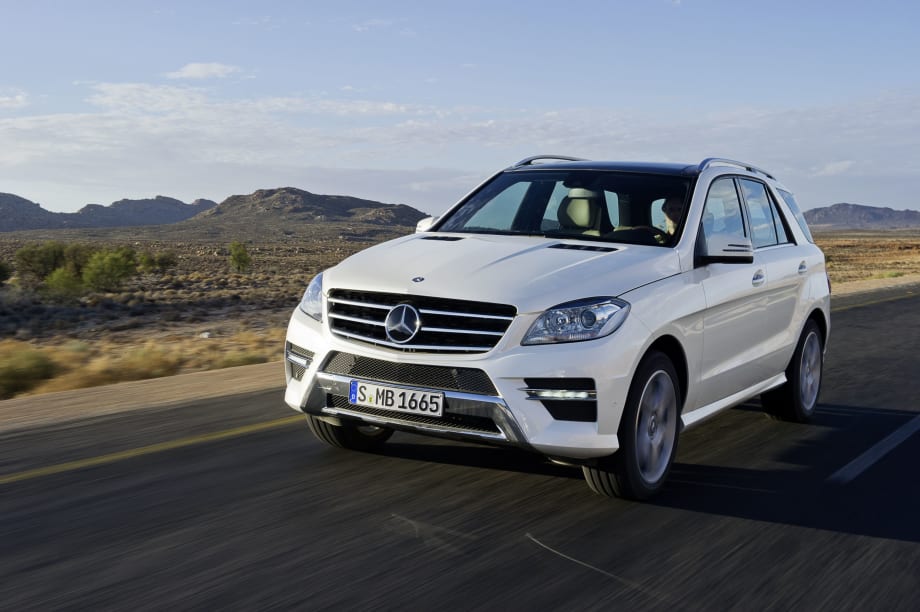
The Mercedes-Benz M-Class has been named an IIHS TSP+.
The Mercedes-Benz M-Class has been named an IIHS TSP+.
The Mercedes-Benz M-Class has succeeded in passing what is now the stricter crash test carried out by the American Insurance Institute for Highway Safety (IIHS), picking up the "Top Safety Pick+" (TSP+) award in the process.
The premium SUV already received five stars in the U.S. NCAP and Euro NCAP tests in 2012. As a result of this latest award, the M-Class has again achieved the best marks and defended its leading position in three of the world's most important and most demanding safety ratings.
Overall, as part of the M-Class development, Mercedes-Benz tested no less than 36 completely different load cases under real test conditions. This included comprehensive simulations as part of the digital prototype phase.
A new element of the rating applied by the IIHS – an organization supported by various vehicle insurance companies – is the so-called "small-overlap test."
As part of this, a front-impact test is carried out at 64 km/h with a face contact ratio of 25 percent. This is designed to simulate a front impact in which the driver tries to swerve to the side but does not quite manage to avoid the vehicle coming in the opposite direction.
Model-year 2014 vehicles must pass this test to receive the "Top Safety Pick" award. Out of the total of five crash tests carried out by the IIHS (frontal 40 percent, frontal 25 percent, side impact, whiplash and roof crush), only the small-overlap test may be assessed with a rating of ACCEPTABLE, while all other tests must be performed with a best mark of GOOD in order to achieve the new TSP+ award – something which the M-Class has now succeeded in doing.
The NCAP (New Car Assessment Programme) ratings, on the other hand, are based on another face contact ratio in the case of the front impact: for the U.S. NCAP for example, in the front impact the vehicle is driven into a fixed barrier at a speed of 56 km/h with a full face contact ratio.
In contrast, the front impact of the Euro NCAP is carried out against a deformable barrier at a speed of 64 km/h and with a face contact ratio of 40 percent (offset crash test).
In addition, different side impact tests and tests on child and pedestrian safety are included as part of the ratings, and the standard of equipment with assistance systems is also increasingly being incorporated into the assessment.
For more information, visit www.Fleet.mbusa.com.
Related Content:
IIHS Takes Top Safety Picks to a Higher Level
The Insurance Institute of Highway Safety (IIHS) has raised the bar on frontal crash protection with a fifth safety test. Vehicles that perform well in all five categories can now earn a higher level of recognition: Top Safety Pick+.
Originally posted on Automotive Fleet
More Small Fleet


Developing Budget-Friendly Driver Safety Programs
From driver training and safety meetings to one-on-one coaching and incentive programs, several small fleets share how they have developed a safety culture with their drivers using low- to no-cost resources.
Read More →
Boosting Last-Mile Fleet Uptime, Safety, and Value with AI Vehicle Inspections
AI-powered inspections are transforming last-mile fleets by replacing manual checks with highly accurate automated scans that detect defects in seconds. By giving fleet operations visibility into the daily condition of their vehicles, you can identify trends over the vehicle’s lifecycle that enable improved procurement decisions, route management, driver training and accountability.
Read More →
Five Ways Seat Belts Help Prevent Injuries
There are five ways seat belts protect occupants from injuries, according to the Tennessee Department of Safety and Homeland Security.
Read More →
It’s here: The 2026 Fleet Technology Trends Report
What does AI mean for fleets? Get the answer — and learn other top tech trends.
Read More →
Small Fleets, Big Impact: How Independent Drivers Power Wreaths Across America
Check out how small fleets and independent drivers power Wreaths Across America each December and why their impact matters more than ever.
Read More →
VMS Survey Finds 65% of Small Fleet Managers Run Operations Alone
A new VMS survey shows small fleet managers are stretched thin, with most handling operations solo and eager to adopt digital tools for relief.
Read More →
Tips for Driving Safely on Halloween Night
This video features a reminder from the Connecticut Department of Transportation (DOT) and the Connecticut Police Chiefs Association, urging drivers to prioritize safety this Halloween.
Read More →
AI, Access, and Uptime: VMS’s Next Chapter with David Prusinski
VMS’s new Co-CEO, David Prusinski, shares how an AI-first approach will give small fleets and repair shops the tools to compete like big players.
Read More →
Fleet Managers Share Winter Prep Tips: It's Never Too Early!
Three fleets share best practices to prep vehicles for winter and prevent downtime when the cold sets in.
Read More →