




Ice Distribution Company Weighs Leasing, Rental Costs Over Ownership
Ice manufacturing and distribution company, Summit Ice President Brian Washnock looks at how the company manages its mix of owned, leased and rented fleet, and more importantly, how he gets the ‘peace of mind’ that his drivers and trucks are safe.
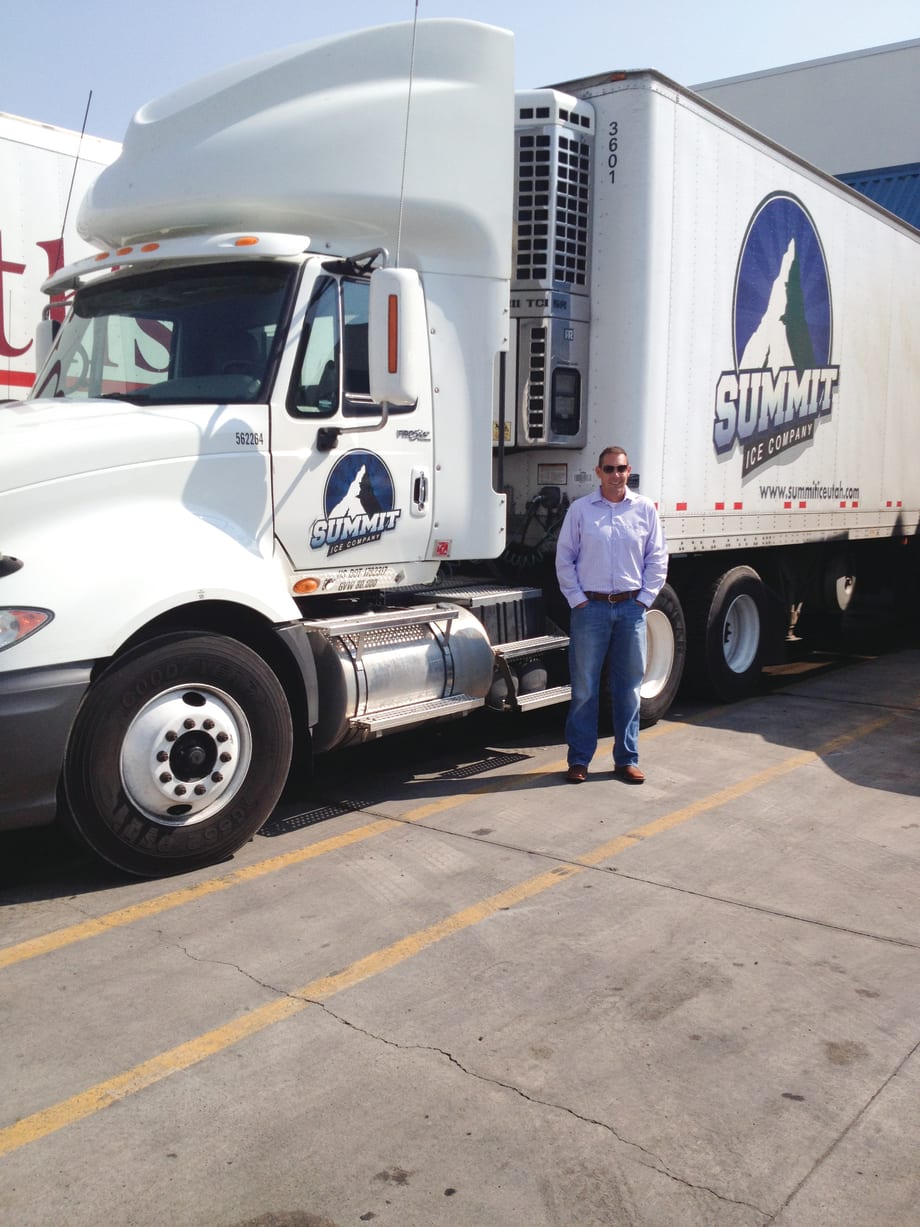
Brian Washnock, Summit Ice President
Brian Washnock, Summit Ice President
Ice manufacturing and distribution company, Summit Ice President Brian Washnock looks at how the company manages its mix of owned, leased and rented fleet, and more importantly, how he gets the ‘peace of mind’ that his drivers and trucks are safe.
— By Joanne M. Tucker
Managing a company that has its peak business during one season of the year has resulted in a mix of lease and long-term rental plans for Summit Ice, a Salt Lake City-based ice manufacturing and distribution company.
According to Summit Ice President Brian Washnock, at its highest peak in the summer months the company has a fleet of 15 trucks, which are leased and rented through Ryder and Penske.
“Whether you own the vehicles or do year-round leases, you’re stuck with a lot of the equipment all-year round, and it may or may not be getting used — so that is the challenge we face,” Washnock says, adding that the rented trucks are typically used for four to five months out of the year. The company also now has a commercial cold storage business to help with the off season.
At any given time, the fleet includes at least eight International and Freightliner 36- to 48-foot tractors, and then the rest of the fleet includes all International 18- to 20-foot straight trucks with reefers. While the company owns all its reefers and trailers, and two tractors recently acquired from another ice company, the remaining trucks are rentals or are on full-service, closed-end leases.
Vehicle Ownership: ‘It’s Just another Animal’
The two trucks that Summit Ice owns needed extensive maintenance work when the vehicles were first acquired, Washnock says, adding that he is tracking all the maintenance work done on these two vehicles, which are serviced by Ryder, to see what kind of maintenance plan would be necessary if Summit Ice owned its fleet and if it would be worth the maintenance costs.
“Who is to say that we would fix something or maintain something that we really don’t know anything about or have expertise in? Well, the truth is, we probably wouldn’t,” Washnock admits. “Like what a lot of small fleets probably do, we would wait until it breaks.”
Washnock says that he trusts the preventive maintenance intervals done by Penske and Ryder and that he likes getting new equipment on a regular basis. “By doing a full-service lease, I get the peace of mind that the maintenance is all done for me,” he says. Summit Ice is even considering replacing the two owned trucks with leased tractors once they’re sold off.
A main concern for Washnock in owning and maintaining his fleet, which sees an average of 50,000-60,000 miles per year-per vehicle, are the initial costs it takes to get a preventive maintenance program off the ground. Though, he notes that once the company has matured there’s a possibility it would own a majority of its fleet and rent summer fill-in equipment as necessary. “But with it being our fourth or fifth year, I’m just not prepared,” he says, adding that managing the company vehicles is akin to managing an additional business. “It’s just another animal.”
The breakdowns Summit Ice does have to worry about are on the refrigeration units, not its fleet.
The Leasing Extras
In addition to maintenance, Washnock notes that Penske and Ryder also help with his Department of Transportation (DOT) regulations, “which can be nerve wracking,” he says.
In fact, Summit Ice just had its first DOT audit earlier this year. Washnock says that the company did well and that he first attributes that to his general manager, but also to Penske and Ryder. “They’re doing a lot of the reporting to where the entire burden is not on us,” he says. “And that helps tremendously. I can’t imagine having to do everything ourselves.”
Both Penske and Ryder worked with Summit Ice to spec the tractors to accommodate the heavy ice loads. He says that the weight maxes out quickly on a 53-foot tractor/trailer at about 2,000 lbs. per ice pallet. And in the mountainous terrain of northern Utah, going up a canyon at 10 mph becomes a safety issue. He says that tractors traveling through that area now all have “beefed up” engines and transmissions over the standard equipment. As well, more substantial suspension systems were installed on the straight trucks to mitigate the heavy loads.
Driver and Route Management Reducing Fuel Costs
Starting in 2008 with two trucks rented from Penske, Summit Ice isn’t looking to own its full fleet anytime soon. “We’re an ice company that happens to do trucking. We’re not a trucking company that happens to do ice,” Washnock says, adding that the company didn’t start with a single customer or commitment. “It was totally built on speculation.”
Route management, for example, started off as a “big circle,” Washnock says, where two employees could hit the full route in about four hours. Since then, through its ice supplier Modern Ice, Summit Ice has purchased GPS routing and driver behavior management equipment from GreenRoad. Each truck is equipped with a system from GreenRoad, which must be uninstalled every time a rented or leased truck is returned.
Washnock says that the company knew it needed GPS for “a lot of reasons,” including mitigating risks by knowing driver location, and improving route management and overall fuel savings. This summer will mark the first full season Summit Ice has used the product since it was installed in the fall of 2011.
Regardless, Summit Ice has already seen a reduction in driver idling and improved route management. “I think idling was a bigger problem than we realized,” Washnock says. “All the drivers are going to say they don’t idle the trucks, but truth be told, the trucks get idled a heck of a lot more, but we didn’t realize it.”
Washnock says he expects GreenRoad to lessen Summit Ice’s annual fuel costs year-over-year. He says that he can already see savings because even though fuel prices are up and his fleet has grown over last year, average fuel costs per truck are down. “I’m really curious to see where we end up at the end of summer,” he says.
In avoiding negative driver reactions to the technology, Washnock says he reminds drivers that not only are they driving a company-owned asset, but that they too are an important asset to the company. He says drivers get feedback through the system’s display inside the truck, but that he doesn’t discuss it with drivers unless there is a major concern or a regular driving pattern that could be improved.
Data gathered by GreenRoad is also used for positive driver feedback, according to Washnock, who also says that it’s important for managers to keep an open mind when implementing driver behavior technology. “The drivers I assumed were going to be the worst haven’t been, and drivers I thought would be the best aren’t necessarily the best,” he says.
Summit Ice also uses Advantage Route Systems, a field data collection software company. Advantage Route Systems even has a package tailored just for the ice delivery industry, among others such as coffee delivery.
Washnock says the company added the software because it knew it needed more “professionalism” at the point of sale, and to streamline invoicing and reduce administrative costs by not having to input invoices once a delivery crew returned to the office. “This way we were doing things the same way as the Coca Cola’s, the Pepsi’s, the Frito Lay’s — and all those other grocery delivery guys,” he says.
To read more small fleet profiles, click here to see a full list.
More Small Fleet


Developing Budget-Friendly Driver Safety Programs
From driver training and safety meetings to one-on-one coaching and incentive programs, several small fleets share how they have developed a safety culture with their drivers using low- to no-cost resources.
Read More →
Boosting Last-Mile Fleet Uptime, Safety, and Value with AI Vehicle Inspections
AI-powered inspections are transforming last-mile fleets by replacing manual checks with highly accurate automated scans that detect defects in seconds. By giving fleet operations visibility into the daily condition of their vehicles, you can identify trends over the vehicle’s lifecycle that enable improved procurement decisions, route management, driver training and accountability.
Read More →
Five Ways Seat Belts Help Prevent Injuries
There are five ways seat belts protect occupants from injuries, according to the Tennessee Department of Safety and Homeland Security.
Read More →
It’s here: The 2026 Fleet Technology Trends Report
What does AI mean for fleets? Get the answer — and learn other top tech trends.
Read More →
Small Fleets, Big Impact: How Independent Drivers Power Wreaths Across America
Check out how small fleets and independent drivers power Wreaths Across America each December and why their impact matters more than ever.
Read More →
VMS Survey Finds 65% of Small Fleet Managers Run Operations Alone
A new VMS survey shows small fleet managers are stretched thin, with most handling operations solo and eager to adopt digital tools for relief.
Read More →
Tips for Driving Safely on Halloween Night
This video features a reminder from the Connecticut Department of Transportation (DOT) and the Connecticut Police Chiefs Association, urging drivers to prioritize safety this Halloween.
Read More →
AI, Access, and Uptime: VMS’s Next Chapter with David Prusinski
VMS’s new Co-CEO, David Prusinski, shares how an AI-first approach will give small fleets and repair shops the tools to compete like big players.
Read More →
Fleet Managers Share Winter Prep Tips: It's Never Too Early!
Three fleets share best practices to prep vehicles for winter and prevent downtime when the cold sets in.
Read More →