




Dive Deeper: Ram Revolution Program Provides Inside Look at EV Trucks
Geotab Study Reveals Electric Pickup Trucks Will Revolutionize EV Adoption
By analyzing de-identified data from 404,652 light-duty trucks, this EV Suitability Assessment showed potential for fleets.
by Charlotte Argue/Geotab
June 28, 2022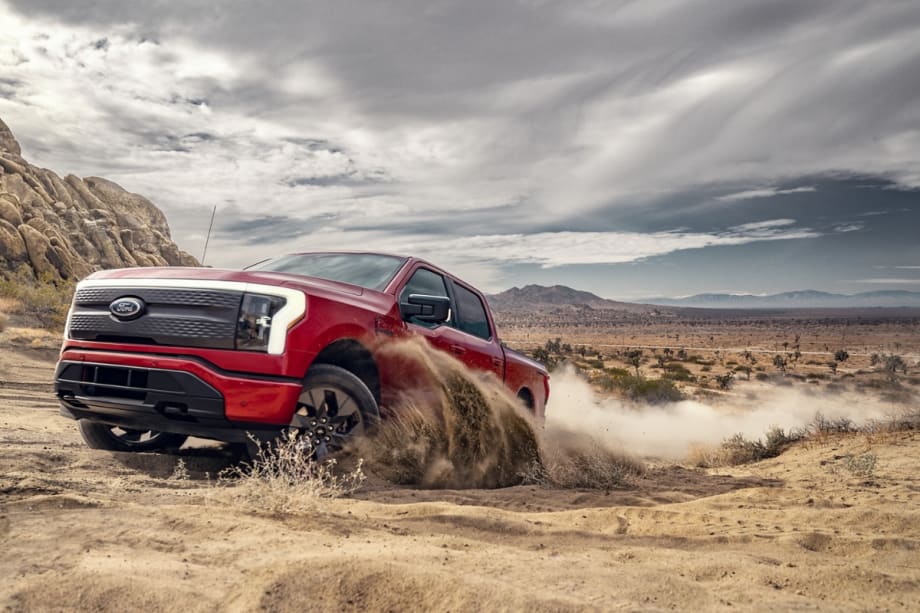
Geotab set out to evaluate whether the current electric pickup models on offer have the required range capabilities needed for real-world fleet applications and if they would be economically viable.
Photo: Ford
4 min to read
In October 2021, Geotab conducted a fleet electrification study with Enterprise Fleet Management that analyzed over 91,000 of their vehicles. Using Geotab’s EV Suitability Assessment (EVSA), the study showed that they could replace up to 45% of the analyzed vehicles with EVs once electric pickup trucks entered the market.
In a new aggregated EVSA study, Geotab set out to evaluate whether the current electric pickup models on offer have the required range capabilities needed for real-world fleet applications and if they would be economically viable.
By analyzing de-identified data from 404,652 light-duty trucks (LTD-class 2, 2a, 2b) across the U.S. and Canada, this EV Suitability Assessment showed potential for fleets.
Fleet vehicles are often thought of as being pushed to the limits, for both utilization and workload. However, when examining actual vehicle usage solely based on daily range requirements, 76% of the trucks could be replaced with an EV and not run out of charge during the day. Half of the light-duty trucks analyzed never exceeded 280 miles (450 km) in a single day over the entire year and tended to stay well within the range capabilities of most electric pickup models entering the market.
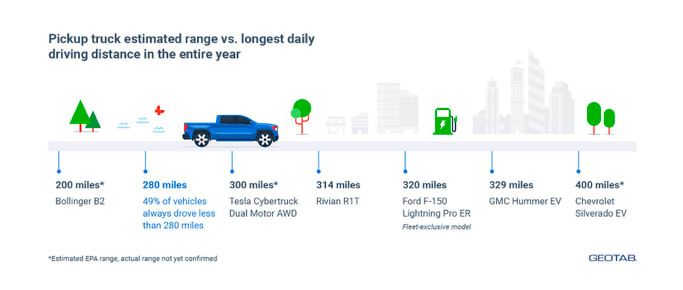
In a new aggregated EVSA study, Geotab set out to evaluate whether the current electric pickup models on offer have the required range capabilities needed for real-world fleet applications and if they would be economically viable.
Photo: Geotab
With fleet electrification it’s not just about the range, the economics must make sense. For now, the electric pickups coming to market have a higher price tag compared to their gas equivalents. Fortunately for a fleet operator, it’s the total cost of ownership (TCO) that counts.
Pickup trucks are known for their high fuel consumption and subsequent fuel costs. Electricity is not only cheaper than fossil fuel alternatives, its price is more stable and predictable. This fact, along with the overall reduced maintenance costs resulting from fewer moving parts, means that EVs have a lower operating cost.
The question is – do the savings on fuel and maintenance offset the premium cost of the vehicle?
The answer depends on how the vehicle is used.
Geotab found that 45% of light-duty trucks used by fleets hit this ideal scenario over a seven-year service life. In fact, the study found that by electrifying those trucks deemed economically viable fleets could save an average lifetime savings of $4,000 per vehicle.
If fleets could access a $4,000 purchase incentive, 56% of trucks could go electric and save money over seven years. A rebate of $6,500 bumps this up to 62%.
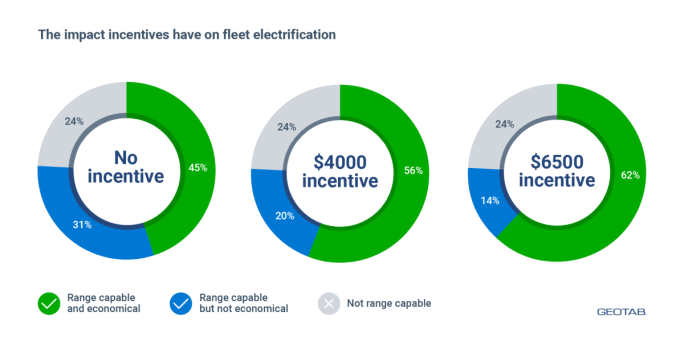
If fleets could access a $4,000 purchase incentive, 56% of trucks could go electric and save money over seven years. A rebate of $6,500 bumps this up to 62%.
Photo: Geotab
EVs are generally more powerful than their internal combustion engine (ICE) equivalents. Ford announced that their electric F-150 Lightning delivers 563 horsepower and 775 lb.-ft. of torque. Rivian and GM have made similar statements, for their R1T and Hummer respectively, showcasing that electric pickups will have the power for more demanding use cases.
Electric motors and their battery packs take less space than a traditional engine. This means these EVs have more storage with a trunk at the front – sometimes referred to as a frunk.
Another benefit that sometimes gets overlooked is that EVs are significantly quieter than ICE vehicles. Studies have found that noise from vehicle traffic has various health implications, including stress and hearing loss. Truck drivers who have switched to electric have reported a better and safer work environment from reduced vibrations and noise.
Next, the weight distribution of the battery along the bottom of the vehicle, gives the truck a lower center of gravity. This provides EVs with better handling and more stability, even when the bed is empty.
Finally, most models have auxiliary power connections so you can charge power tools or equipment – without idling. Some models are equipped with up to 11 outlets, which combined can provide up to 9.6 kW worth of power. This allows the truck to become a mobile worksite and would be especially useful for construction or field service fleets.
Electric pickup trucks represent a huge opportunity for fleets. The models entering the market already meet over three-quarters of the nearly half a million analyzed vehicles’ daily driving requirements and represent cost saving opportunities. As their purchase price comes down, whether through a rebate or as a result of the falling cost of battery technology, they will become even more economically desirable.
Editor’s Note: This article was edited from a release written by Charlotte Argue, senior manager, fleet electrification at Geotab.
More Green Fleet

Fleet Forward Conference Introduces One-Day Passes for 2026
New one-day registration gives fleet professionals the flexibility to attend Tuesday, Wednesday, or Thursday, with passes available for $199 through Sept. 18.
Read More →
CALSTART Rebrands as Catalyst Mobility, Will Combine with Forth in 2027
CALSTART has rebranded as Catalyst Mobility and will combine with Forth at the start of 2027. The new organization said it is poised to become one of the world's largest, strongest, and most impactful clean transportation nonprofits.
Read More →
Electric Truck and Charging Programs to Boost Sustainability at NY & NJ Ports
Together, the Port Authority of New York and New Jersey and CALSTART will electrify drayage and terminal operations serving the East Coast’s busiest container port. A pair of incentive programs totaling $45 million has launched to accelerate adoption of zero-emission drayage trucks and terminal tractors.
Read More →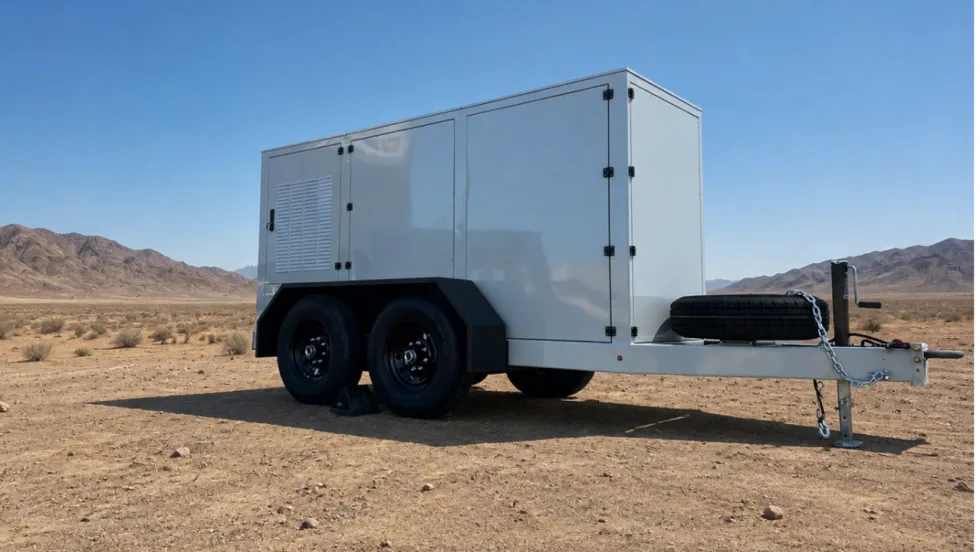
Xos Hub Surpasses One Gigawatt-Hour of Energy Delivered in the Field
A single Xos Hub has surpassed one gigawatt-hour of energy across more than 33,600 charging sessions in the field, demonstrating performance that supports Xos' expansion across new products and markets.
Read More →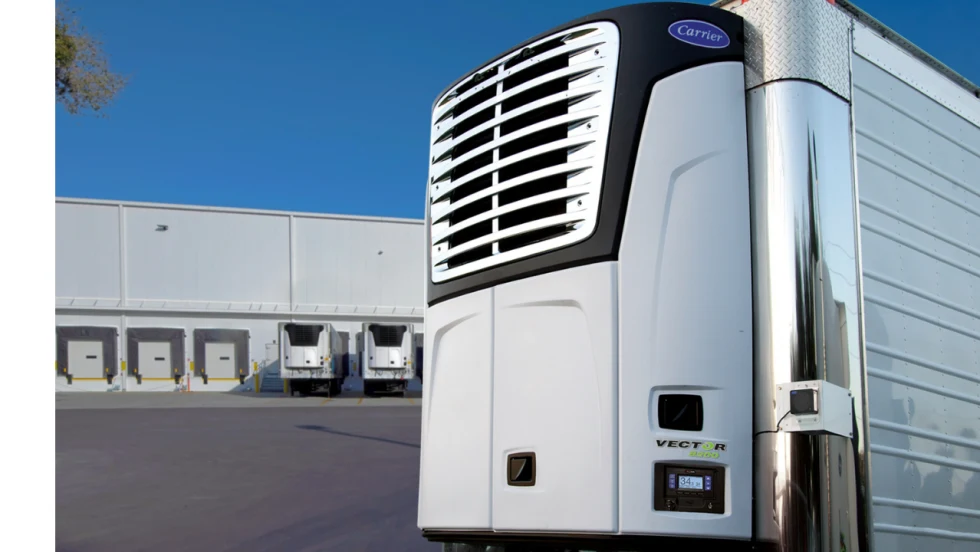
Carrier Transicold Launches All-Electric Vector 8200 TRU for Diesel-Free On-Site Cold Storage
Carrier Transicold’s first engineless multi-temperature TRU helps fresh- and frozen-food fleets add supplemental cold storage capacity during seasonal peaks.
Read More →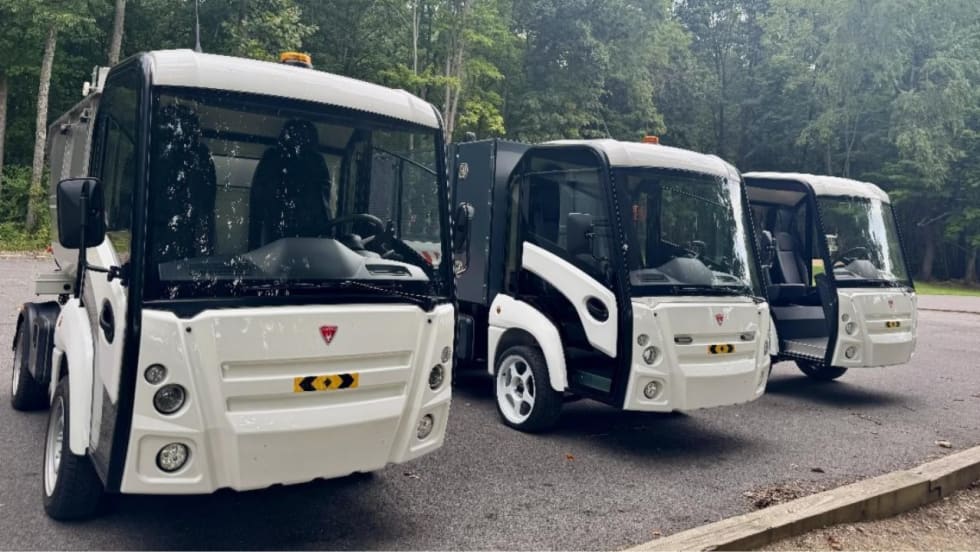
Narro Trucks Introduces Electric Utility Vehicle
Narro Trucks officially launched its operations on Aug. 20 and hosted a ride and drive to showcase its electric truck, which will be produced in Virginia.
Read More →
Samsung SDI Takes Full Control of GM Battery JV as Indiana Plant Pivots to Energy Storage
Samsung SDI is taking full control of its Indiana battery plant with GM, marking a major shift from the EV-focused joint venture Charged Fleet first covered in 2023.
Read More →
NWSA Taps CALSTART to Administer Zero-Emission Drayage Assistance Program
CALSTART will provide free technical assistance services to drayage fleets serving the Ports of Seattle and Tacoma and looking to transition to cleaner technologies and help decarbonize freight hubs.
Read More →
EV Fleet Reality Check: What Operators Wish They Knew Before Electrifying Their Work Vans
Electric work truck upfits bring new compatibility questions. Learn how parts availability, OEM guidance, power demands, and route planning can affect fleet performance.
Read More →
Peterbilt Expands Sourcewell Partnership with Electric Vehicle Lineup
Peterbilt Motors Company’s cooperative purchasing agreement with Sourcewell and its Canadian partner, Canoe Procurement Group, now includes including Peterbilt's battery-electric vehicle lineup.
Read More →